
Mojo's blog banner

Category: Bridge

  • Teaching bridge with a hand dealing machine

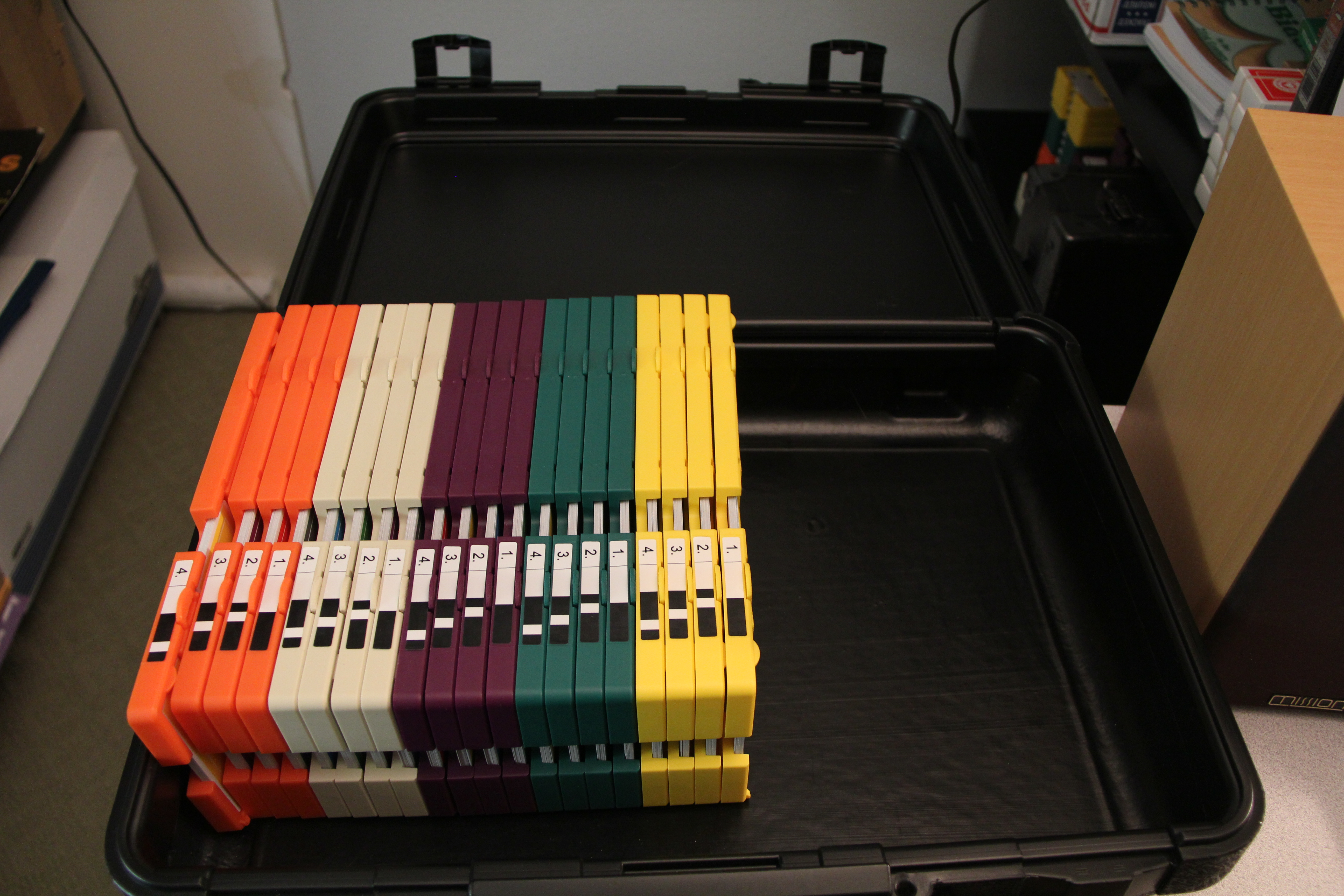
    Prepared hands for class.
    Here are five tables worth of hands ready for my next class. Each table gets boards one through four, in a distinctive board color.

    Last month I took a leap and purchased a bridge hand dealing machine. The PlayBridgeDealer4 is very popular with bridge clubs and tournament managers for preparing pre-dealt hands and duplicating them across many sections of a tournament.

    Some day down the road I may find myself directing bridge games for a local club. When I do, I’ll use the machine to prepare randomly shuffled hands before the game, and provide hand records with analysis afterward.

    Meanwhile, I can put the machine to excellent use for preparing hands for my bridge classes.

    The Dealer4 comes with some excellent Windows-based software for generating random deals, doing hand analysis, and printing hand records. It also works very effectively for constructing bridge hands manually. I’ve prepared hands for the first three class series from the ACBL curriculum, the club, diamond, and heart series classes. In fact, you can download each series as a zip archive of .PBN files from whiteoaks.com here.

    ACBL offers these card decks that allow students to manually sort class hands during class. It’s confusing for some, frustrating for others, but foolproof for the teacher. (Photo from BaronBarclay.com)

    Before I had the Dealer4, I was a great fan of the special cards prepared by the ACBL specifically for these classes. The backs of the cards are marked in a way that lets the students sort out the hands manually during class. It’s (mostly) foolproof, and requires no more preparation on my part than dropping a deck of these cards on each table of students.

    I can’t really say that having the dealing machine has made class prep “easier” in that regard. I’m not saving time in class preparation.

    But I am saving time during class itself. Sorting the cards is a common source of frustration for the students, and it eats up a lot of class time. When the sorts don’t always come out exactly right, it takes more time to correct the problem.

    Plus this classroom card sorting exercise is not something that has the slightest bit of value later on in their bridge playing, either at home or the duplicate club.

    So the benefit of pre-dealing the hands is for the classes. It means that I spend more time fretting and worrying. I’ve had nightmares where I show up for class with the wrong hands sorted into the boards, or a mix of hands in the wrong boards. I find that I just have to be more careful with class preparation. So far everything has come out perfectly, but I still have to spot-check my work.

    So now that I could deal hands magically and reliably, I had to get a little playful with the process as well. What if I could provide pre-sorted hands for the students?

    Having sorted hands is meaningless at the bridge club. When a hand is played once, it will no longer be sorted. In class though, it again saves time the students might have spent sorting their hand and laying them out double-dummy for study. It’s true that hand-sorting is a useful skill, but they have plenty of time to pick that up with their own shuffled decks.

    If I start with a completely sorted deck of cards in the Dealer4, the hands that arrive in the pockets will be sorted as well. So the puzzle for me was how to use the Dealer4 to sort the decks before dealing them into four hands.

    Sorting by suits is trivial, simply send all the spades to one hand, the hearts to another, and so on. But I wanted to sort the cards by rank as well.

    I came up with a two-pass deal that gives me an approximate rank sort as well as a suit sort. For the first pass, I send all the lowest ranked cards to North, the next highest to East, next to West, and the highest-ranked to South. Here’s the deal I use:
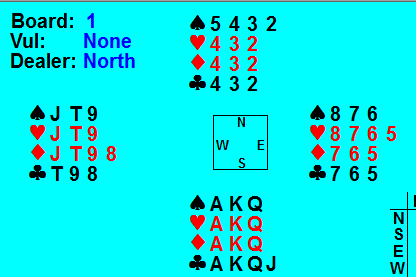
    bridge-sort-1

    That gives me a deck with all the low cards on the bottom, and the high cards on the top. Then I pass the deck through again for a sort by suit:
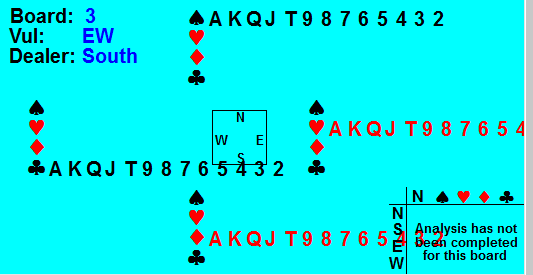
    bridge-sort-2

    The result is a full deck that is sorted by suits, and approximately sorted by rank as well.

    Since the Dealer4 needs to have two decks in the hopper, I work on two decks at a time to get this sort. So after four passes through the machine, I have two mostly-sorted decks of cards.

    Then I use these sorted decks to populate my boards for class, and know that I’m the coolest bridge teacher in my zip code. 🙂

    Postscript: I now have a three-pass deal that returns fully sorted hands. I’ll write it up in a followup blog post. 🙂

    The card dealing machine is a fascinating bit of mechanical engineering, and I know you can’t resist seeing it in operation. So I made a little video (3:00 minutes) that shows how I feed decks into the machine for the pre-sort, then load boards into the machine to set up hands.

  • “Why didn’t you just …”

    Here’s one post that’s equally valid for bridge and computer programming.

    Have you ever accomplished some task and had someone say “Why didn’t you just” do it some other way? Usually their suggestion is assumed to be the obvious or simpler way to do something.

    In bridge, maybe you misplayed the hand, or chose a different lead on defense. In software, there’s always some tool or technique that would make the job easier.

    The problem with this question is that it’s essentially rhetorical. My answer almost always falls into two camps: either “I didn’t think of that,” or “I didn’t know about that.”

    On rare occasions, I actually did know about some alternative method to use, and I rejected it after investigation. That’s quite the exception.

    At the bridge table, this takes the form of choosing a line of play that didn’t work on this hand; everyone who chooses the other way is going to get a better result. Most of the time my choice is based on which way has the best odds of being right, but often enough I either don’t know the odds, or have misinterpreted the information I have at the table. Sometimes it’s a toss up, and sometimes I’m acting on a hunch. On rare occasions the opponents have done something clever enough to mislead me!

    In software and systems, there’s even a famous acronym that covers this: T.I.M.T.O.W.T.D.I. (from Perl) which means “There is more than one way to do it.” Often enough, it doesn’t matter which way you choose. Sometimes a different approach is simpler, more understandable, more efficient, more something. Often there are so many different ways to do something that you just have to pick one and go with it.

    My point is this: Most of the time when you ask this question, you should already know the answer. The question accomplishes little aside from the embarrassment of the recipient.

    It’s for this reason that I always dread presenting my work in software, and why code reviews are so painful. It’s nearly impossible to present your own code to a group of programmers without hearing someone say “why didn’t you just …?” Once in a while you will have a reason for rejecting an alternative, but most of the time you just didn’t think of it, or didn’t know about the better alternative.

    Here’s what I have to say about that.

    When you’re at the bridge table, and you see your partner horribly misplay a hand, give them the benefit of the doubt. Most of the time it’s best to say nothing, but perhaps, “Wow that was really bad luck,” or “Oops, I guess that didn’t work!” Laugh it off and go on to the next one.

    In software, things are a little more serious. If you find yourself shaking your head at some technique, design, or code, resist the urge to say “Couldn’t you just refactor the Gizmo object with the Framistat library?”

    Instead, try something like, “Hey, I bet if you included the Framistat library we could make the Gizmo object a lot cleaner.” That shows that you already understand that I either didn’t know about the Framistat library or didn’t think of using it. It helps to put a positive spin on the conversation.

    In the software business there are so many tools and techniques that it’s often impossible to understand and research all of the alternatives. Having one that works is more valuable than anything else. Discovering true bugs and faults should be the goal. (That, and not having hard tabs in your source code. 🙂 )

    Once at the bridge table after making a beatable contract, one of my opponents turned to her partner and said, “Why didn’t you lead a club?”

    He responded loudly, “Because your partner is not God!”

  • How SAYC Happened

    It’s sort of my fault.

    I was at the bridge club a few months ago when a young asian fellow stopped in to see how the games worked. The director invited him to kibitz my table, and I chatted with him a little between hands. He admitted that he enjoyed playing bridge and sometimes played online. And he mentioned that he played SAYC. That’s the Standard American Yellow Card published by the American Contract Bridge League (ACBL)

    I had to smile. That’s kind of my fault. I told him the story, but I’m not sure he believed me.

    It started with OKBridge

    It was 1993 or so when we first started playing bridge online using a system built by Matt Clegg called OKBridge. Matt had learned to play in college, and wanted to find a way to keep playing as his friends scattered around the map after school. OKBridge proved very popular, and started attracting players from every corner of the internet. I loved playing there and became friends with Matt.

    Those were the days when you would connect to the net from your Unix system, or dial-up to a Unix host such as Netcom with a terminal emulator. The OKBridge client was a “curses” terminal app, later growing into a Windows app and all the other doodahs you find today. I know Matt turned it into quite a business, but we haven’t kept in touch.

    While it was great joy picking up partners and opponents from the four-corners of the world, it was always difficult to agree on a system of bidding conventions quickly for a pick-up game.

    I had just the idea.

    Mojo “yellow card” Appleseed

    Long prior to this, the ACBL had developed a reasonably simple “standard” convention card with a few popular modern conventions for use specifically in individual tournaments, where you would have a different partner for every round. They called these “Yellow Card Individual” events at the tournaments. The convention card itself was printed on yellow paper and they offered a detailed document of exactly the specifications of the system.

    I recognized an opportunity. I called ACBL and ordered a stack of 500 Yellow Card convention cards and 100 of the accompanying booklet.

    On OKBridge and in discussions on Usenet rec.games.bridge, I offered to send a copy of the card and booklet to anyone who would send me a return envelope. I probably mailed thirty or forty cards and booklets.

    I was working for Caere Corporation in Los Gatos at the time; we specialized in optical character recognition. I had access to scanners and OCR software, and soon had an electronic rendition of the convention card itself as a GIF (in color, and yellow of course), and scanned the booklet after work to have the full text description of the system available.

    Everyone hates it

    I remember the reaction being mixed. The card itself didn’t match anyone’s existing card. Everyone had complaints about this or that agreement in the card. The experts wanted a 2/1 Game Force card, and the beginners couldn’t really take in everything on the card. If I sit down with a partner before a game, our card would be a lot different from SAYC.

    Even so, people saw the value of having something concrete that could be agreed to in seconds that should be well-understood, especially given the detailed text description. SAYC hadn’t been known by that abbreviation before then, it was just “the Yellow Card.” In the online bridge shorthand that quickly developed, SAYC as an abbreviation was inevitable.

    Fast-forward to November 2009 where I’m attending the ACBL’s Teacher Accreditation Program as a refresher at the San Diego Nationals. I’ve just returned to the game after a nine-year hiatus, and thinking of teaching bridge again. There I learned that they’ve tweaked the “Bidding” course to match with the specifications of the Yellow Card.

    In the past month or two I started playing online on BridgeBase, a beautifully constructed online bridge playing network. SAYC is the “default” convention card there.

    No one uses it right

    Now let me step on my soapbox for a moment.

    Here’s a typical profile note on BBO:

    “SAYC. Xfers, weak 2’s, jumps, NF Stayman, weak jump response”

    What’s wrong with this picture?

    First of all transfers, weak two-bids, and weak jump overcalls are already part of the SAYC convention card. Mentioning them again is redundant.

    Secondly, weak jump responses and non-forcing Stayman are not part of SAYC. You shouldn’t say you’re playing SAYC when you’re not playing SAYC! Sure, it’s Standard American at its roots, but it’s not the Yellow Card. [Edit: Actually NF Stayman is not excluded from the Yellow Card, (or any other system that uses Stayman).]

    To truly play SAYC you should use its set of conventions without changes, love ’em or hate ’em. And it’s not really that bad.

    The most complex convention on the card, arguably, is Jacoby 2NT major suit raises. People know the 2NT bid, but many people are unfamiliar with the opener’s rebids, which are spelled out quite precisely in the Yellow Card booklet.

    Come play with me

    So yes, I have a favorite convention card. I will also play SAYC. All I ask is that if we sit down at a table and you offer to play SAYC, say it like you mean it! There are great advantages to having a precisely spelled-out system that both parties understand.

    Find me on BBO as MojoLA.

    Postscript: It’s been many years since I’ve seen the original ACBL Yellow Card or its description booklet. I’ll try to find links to the originals and add them to the blog here, just for fun.

  • Joy of Bridge

    Mojo playing bridge on the Sea Princess
    Mojo playing bridge on the Sea Princess

    Throughout my life I’ve been something of a serial hobbyist, with a tendency to pursue a hobby obsessively until I burn out on it, or at least until the flame starts to cool. Over the years I’ve tackled ham radio, flying airplanes, gliders, motorcycling, tournament bridge, and astronomy.

    (My one lifetime avocation is computer programming and internet servers, which long ago became my profession.)

    I was deeply involved in organized bridge for several years. I directed games at the San Jose Bridge Center, traveled to tournaments, and taught a couple hundred students to play the game. I was even president of our local bridge unit for two years.

    In 2000 I finally achieved “Life Master” rank in the American Contract Bridge League, and hung up my cards. I didn’t make Life Master quickly. For one thing, I was never a bridge prodigy, just a reasonably smart guy who enjoyed playing the game. I was also so busy teaching and directing I didn’t get to actually play cards as often as I might have.

    But why walk away from it? Why abandon the game I was so deeply involved with for so long?

    For one thing, of course, there were plenty of life changes, job changes, my lovely new wife Jane, moving from Campbell to Marin and then Los Angeles. Astronomy had become the newest passion to get most of my attention, and I’m still enjoying that.

    I can also honestly say that I didn’t miss bridge. Competitive bridge can have an unpleasant dark side.

    I’ll never forget stepping into a hallway at the North American Bridge Championships to see a red-faced player berating his partner loudly and mercilessly.

    As a director I was often asked to rule on a judgment call against players whose bridge experience certainly far exceeded mine, and often enough there were arguments and confrontation. I’m not an argumentative person, and confrontations like that could leave me sleepless for a day.

    (Tournament bridge is much like the world of tournament Scrabble. The movie Word Wars is a great rental. One major difference — bridge doesn’t offer cash prizes.)

    All along I knew that bridge would still be there when I was ready for it.

    In June I took my first cruise with Jane and her family on the Sea Princess to Alaska. Bridge is a classic cruise activity, and Englishman John Beard was an entertaining and congenial teacher and director. I played five sessions of duplicate with a delightful lady from Texas who was really kind of hopeless at bridge.

    This past weekend, Jane was in Toronto speaking at Starfest. Rather than stay home in my pajamas playing Free Cell, I opted to go out and play bridge.

    I kibitzed a few hands on a Thursday evening at the Beverly Hills bridge club tucked into what looked like a former storeroom in a community center.

    I dropped in on the Arcadia Bridge Center on Friday, and played in a North American Pairs qualifying match. Patrick Cardullo and I qualified for the Flights A and B unit final with a second-place finish.

    I played a fun club game on Saturday with Tom Miyake, and made plans to meet him on Sunday for a unit swiss team game in San Marino. On Sunday we played with pick-up teammates and took second overall out of 18 teams.

    I won my first masterpoints in nine years, and had a blast. In all those dozens of bridge hands, there wasn’t a single unpleasant moment.

    In my return, I was reminded of what I love about organized bridge.

    First there’s the game itself: the thrill of watching your partner execute a perfect end-play to make a doubled contract, recognizing a squeeze play as it develops and executing it, and the unforgiving and humbling nature of the game when you make a small mistake.

    Then there are the people who play the game. During my weekend binge every player I met was interesting, delightful, and gracious. Bridge players come from all walks of life. They are smart and tend to be eccentric. The best players enjoy the inevitable humor in the endless patterns and chaos of the card deals, along with the foibles and misunderstandings. Yes, there is ego and intimidation in bridge, as in any competitive sport, but fortunately it’s rare.

    The best players in competitive bridge will have you smiling and enjoying every minute while they’re beating your pants off. That for me is the joy of bridge.