I set up the AP180 last night and was able to capture comet NEOWISE as it passed through Ursa Major.
This video is fifty frames covering about 27 minutes, from 9:11 p.m. to 9:38 p.m. on July 19, 2020.
Each frame is a 10-second exposure.
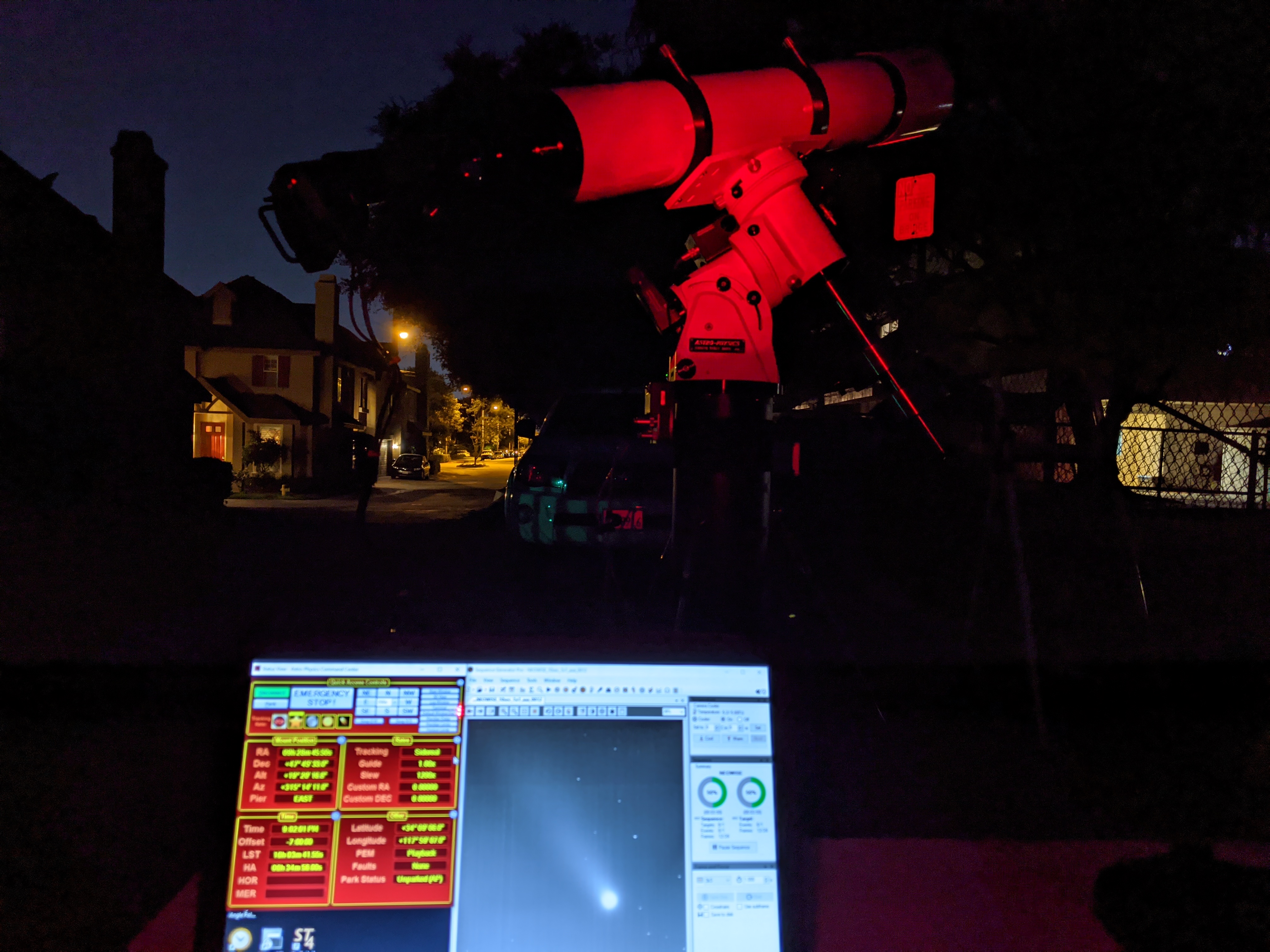

I set up the AP180 last night and was able to capture comet NEOWISE as it passed through Ursa Major.
This video is fifty frames covering about 27 minutes, from 9:11 p.m. to 9:38 p.m. on July 19, 2020.
Each frame is a 10-second exposure.
We had several great clear nights in Monrovia. I had a night where everything clicked. If I hadn’t napped a bit, I might have gotten two or three more Messier objects.
I think now I know the most difficult part of urban astrophotography — at least with the camera I use: Finding suitable guide stars!
I can position quickly and easily to center my target object in the frame, and have no guide stars in the guide camera suitable for guiding. When the available guide stars are all fainter than the sky glow, PHD2 will lock onto any random signal it thinks is a star, then spend the entire exposure hunting for it.
I’ve learned to do the hunting myself before a shot. I can pan in a spiral around the object and watch for a suitably bright guide star to show up. As a result, many of my objects in these two nights of imaging are not quite framed the way I’d hoped.
Now my planning is going to be tougher. I may not be able to fill in many of the missing targets I didn’t catch this month until almost next year.
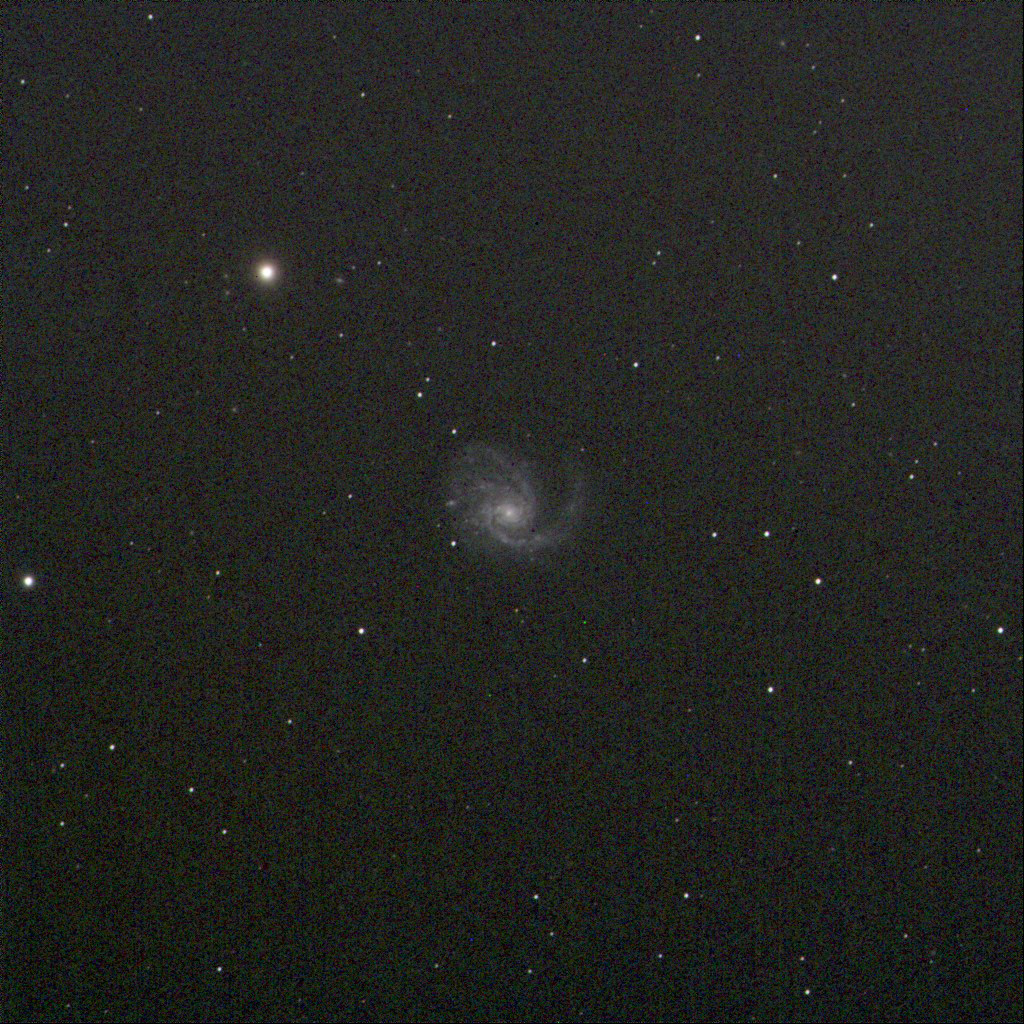
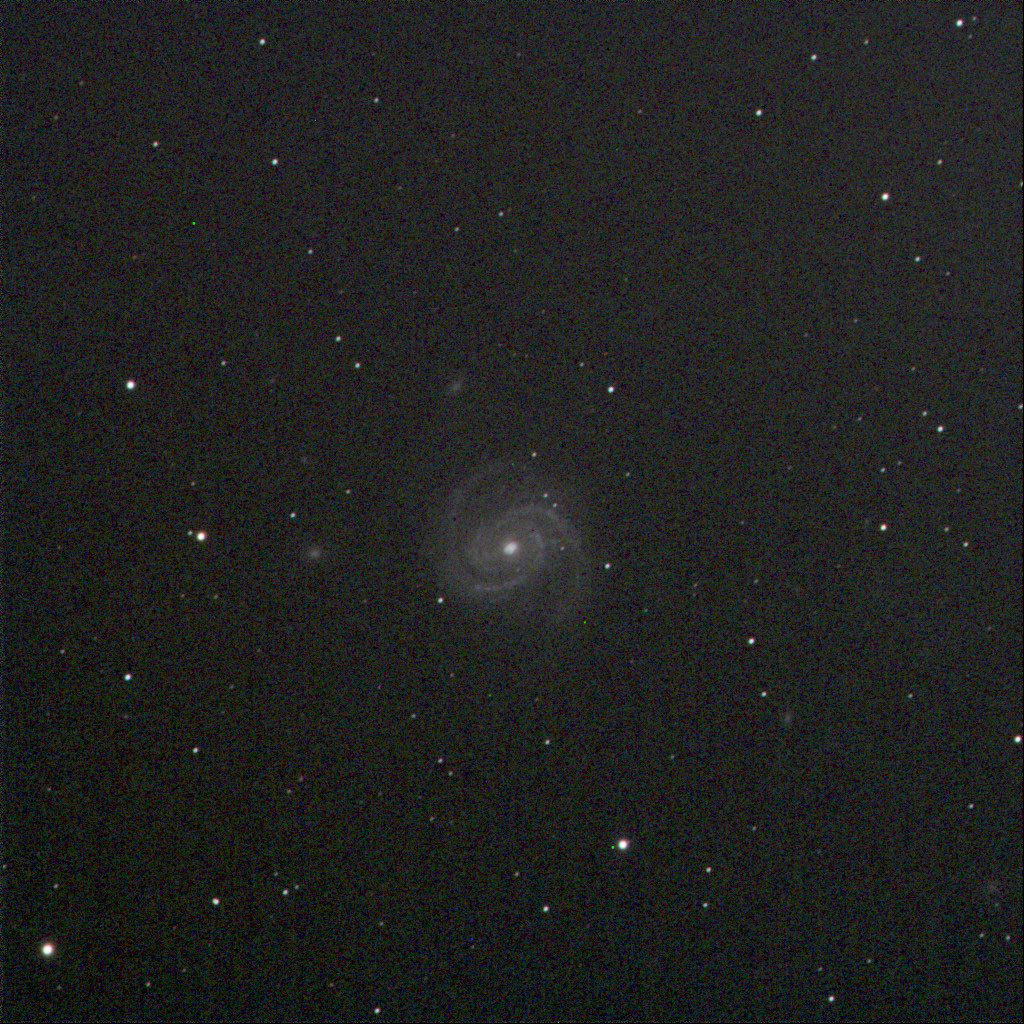
All of these images are 30 minutes of data, using six 5-minute subexposures. The telescope is an f/9 180mm Astro-Physics Starfire AP180EDT, mounted on an AP1100GTO mount. The camera is an SBIG ST-4000XCM one-shot color CCD.
Click on any of the pictures to link to the full resolution version, mostly twice the size (and half the sharpness).
From the evening of May 24:
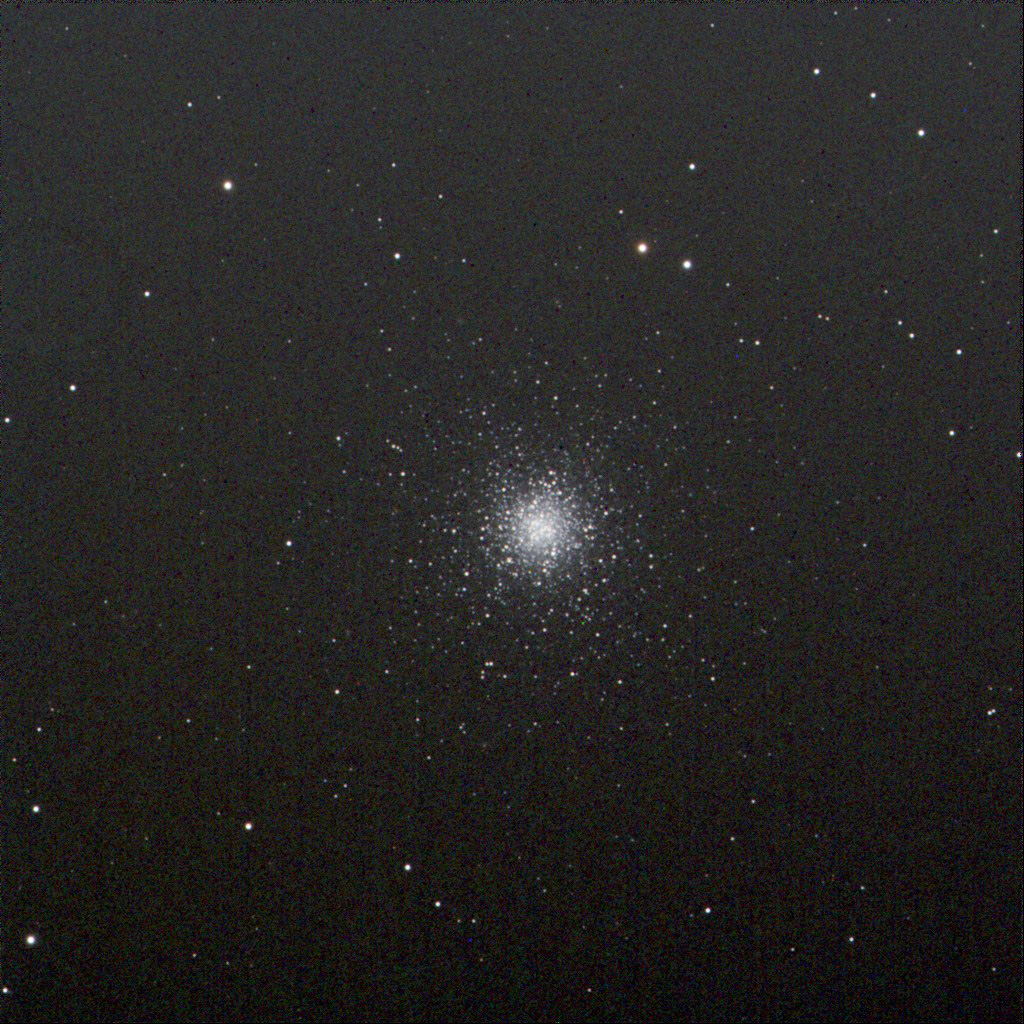
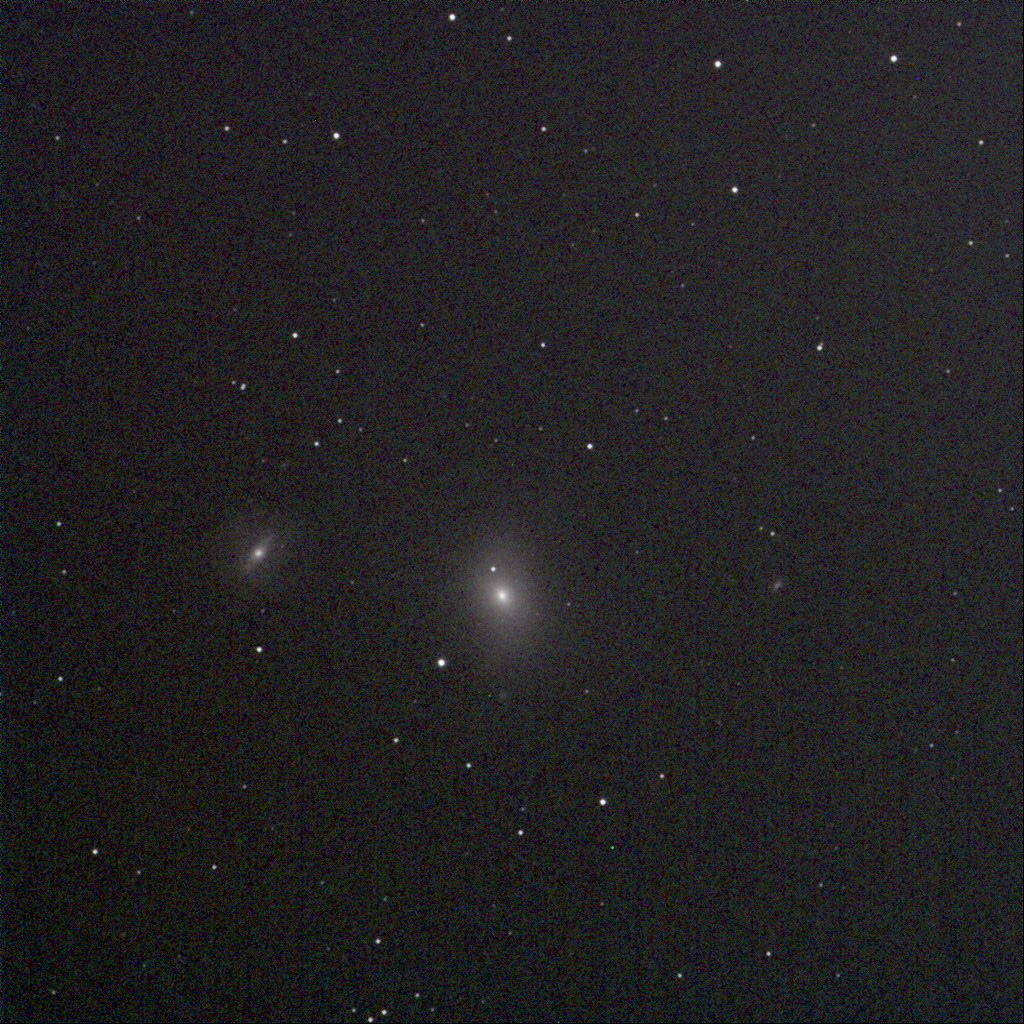
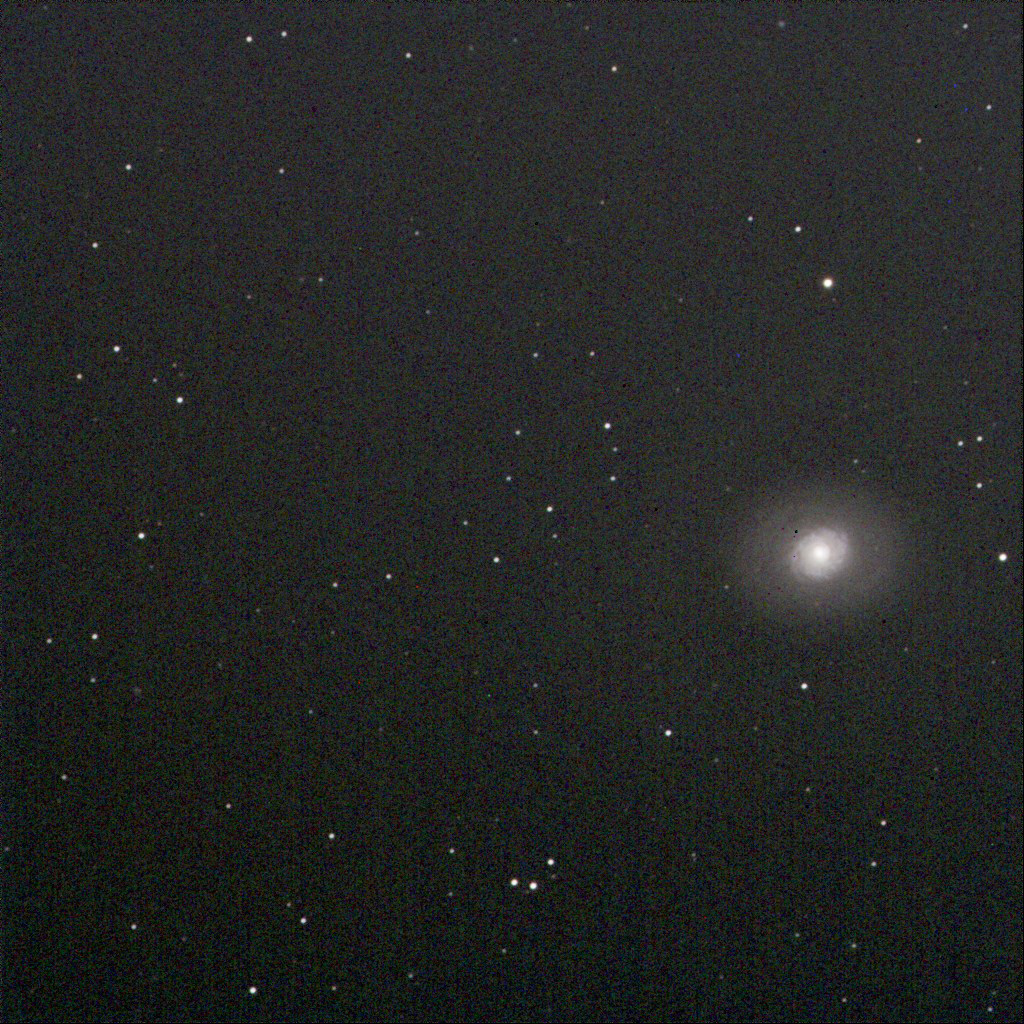
My best image of that night was this one of M5. It could just be the excellent signal-to-noise ratio, but it’s possible that a fog layer was reducing the sky glow from Los Angeles.
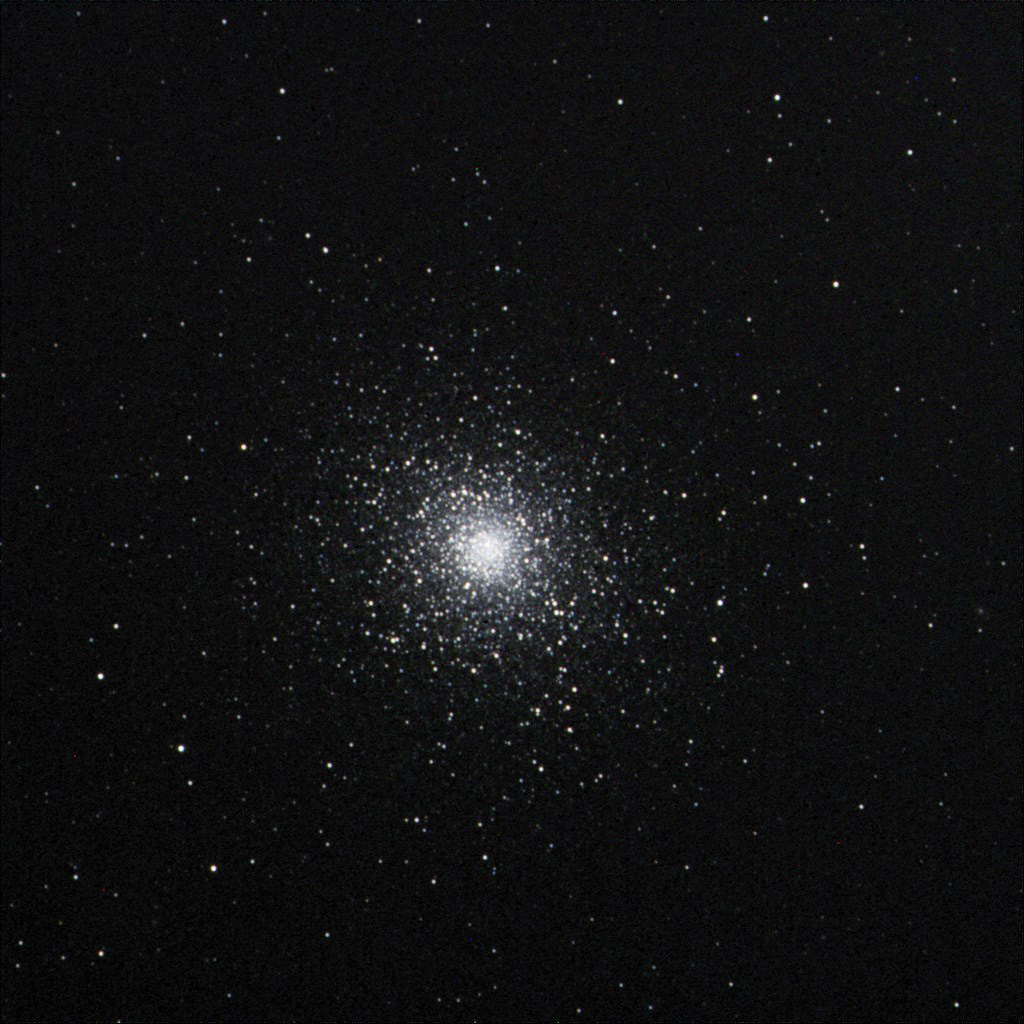
The next night, May 25, I had more trouble finding guide stars.
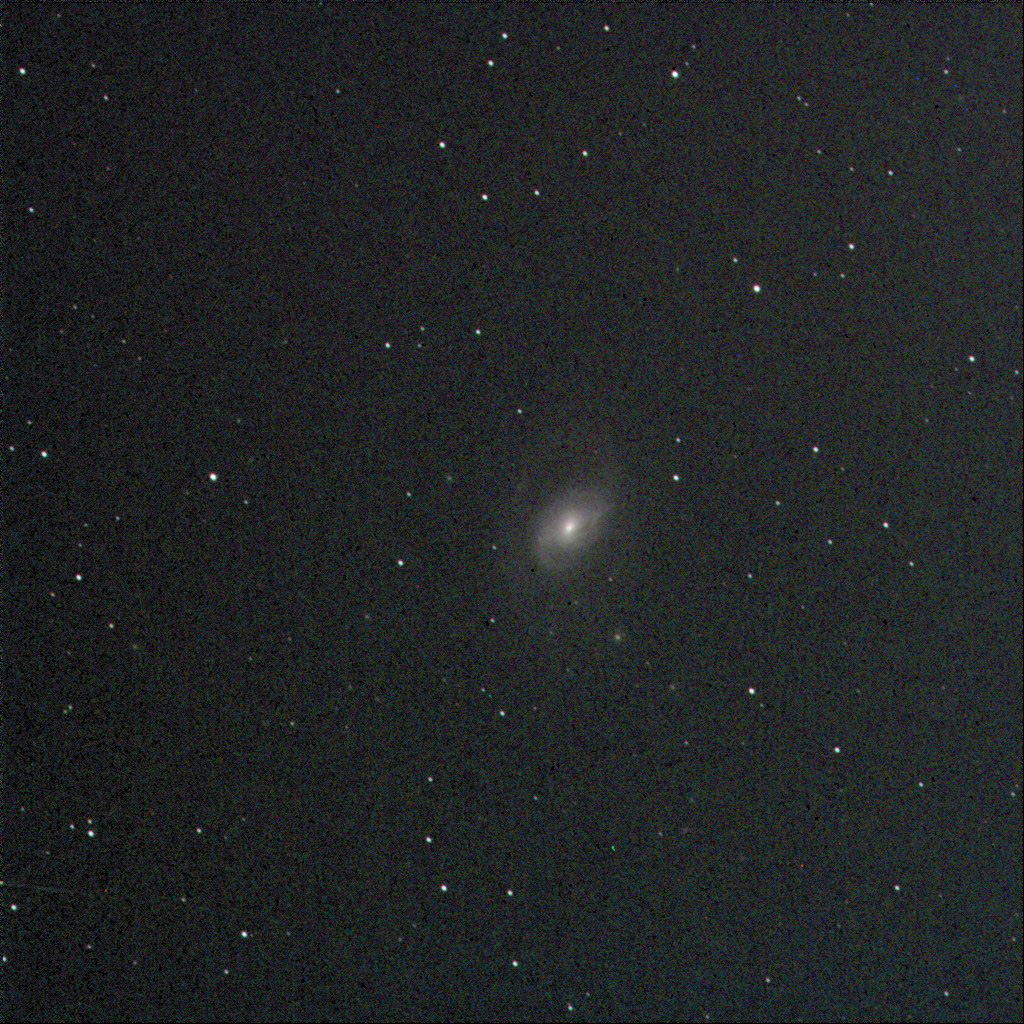
I shot M61 because it was next in my list, but Jane recalled seeing that it had an active supernova. It’s there in the image. I’ll let you discover which star is the supernova.
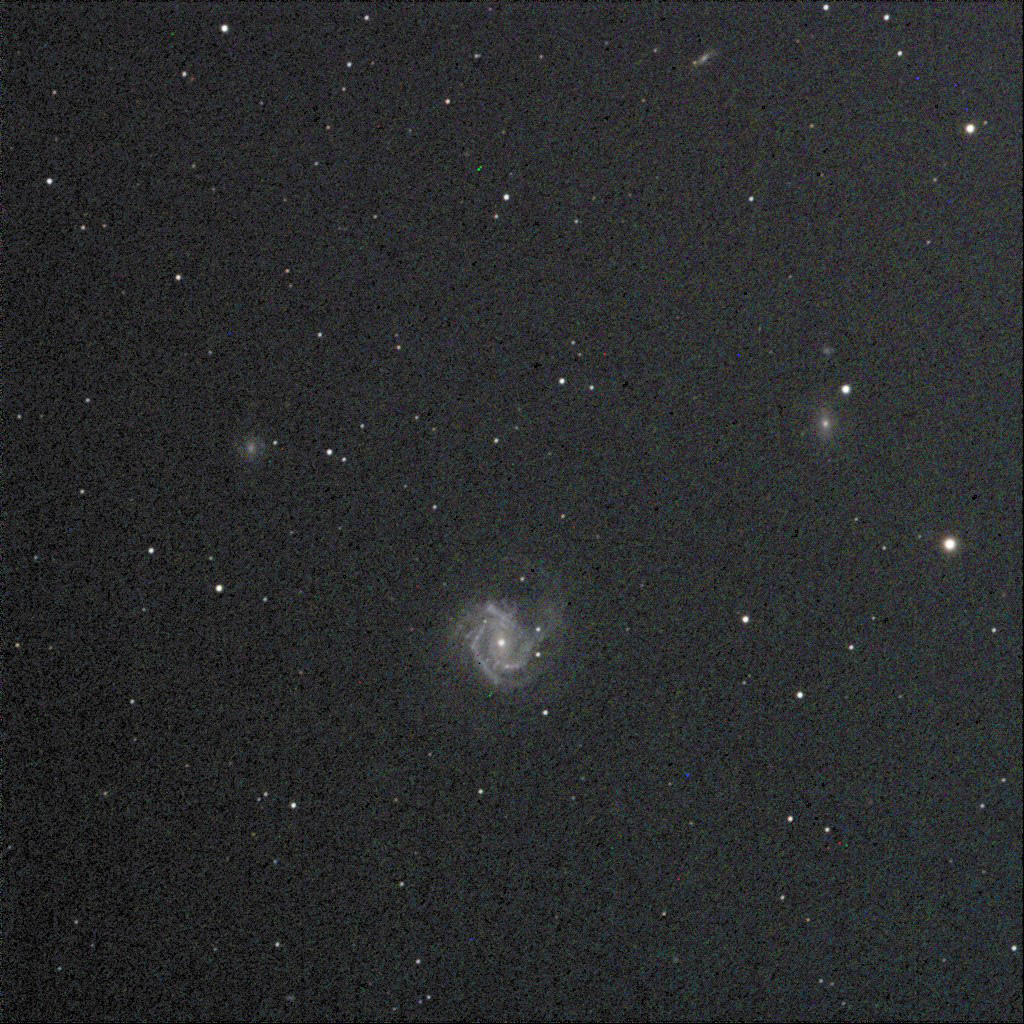
Last night (Saturday, May 23, 2020) was a beautiful dark clear night in Monrovia. Tonight is forecast to be even better and warmer. I can’t resist! When will I sleep?
By the end of evening twilight, I was aligned, focused, calibrated, synced, and ready to image.
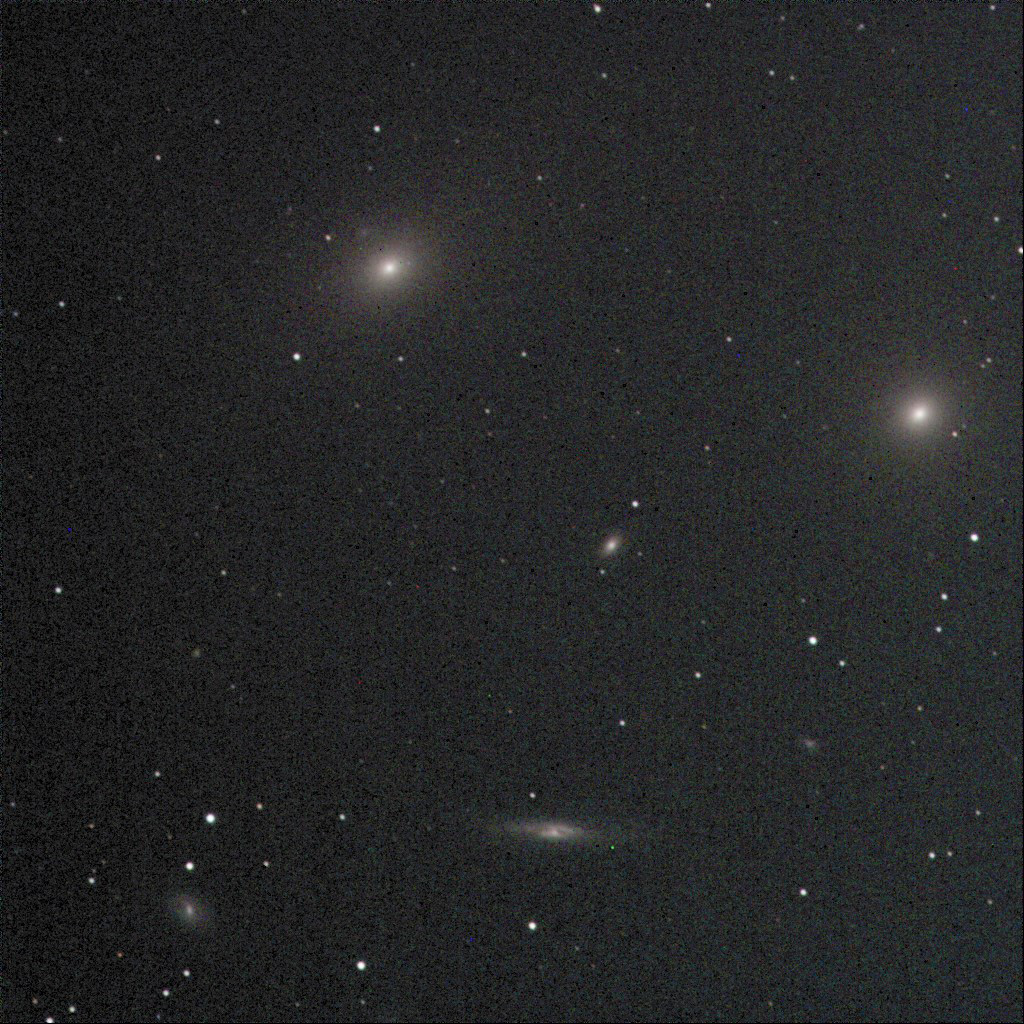
I’ve been cherry picking Messier objects that were near their highest altitude for the evening. There’s a trio of galaxies near each other in Leo, M95, M96, and M105. I thought I’d start with these.
This is where I discovered the real weakness of urban astrophotography. For M95 and M96, I could not find a guide star anywhere nearby. I took a couple of images only to have the guiding software (PHD2) hunting around and guiding on what it thought were stars. The results were all squiggly lines. So I mostly gave up on those two for tonight.
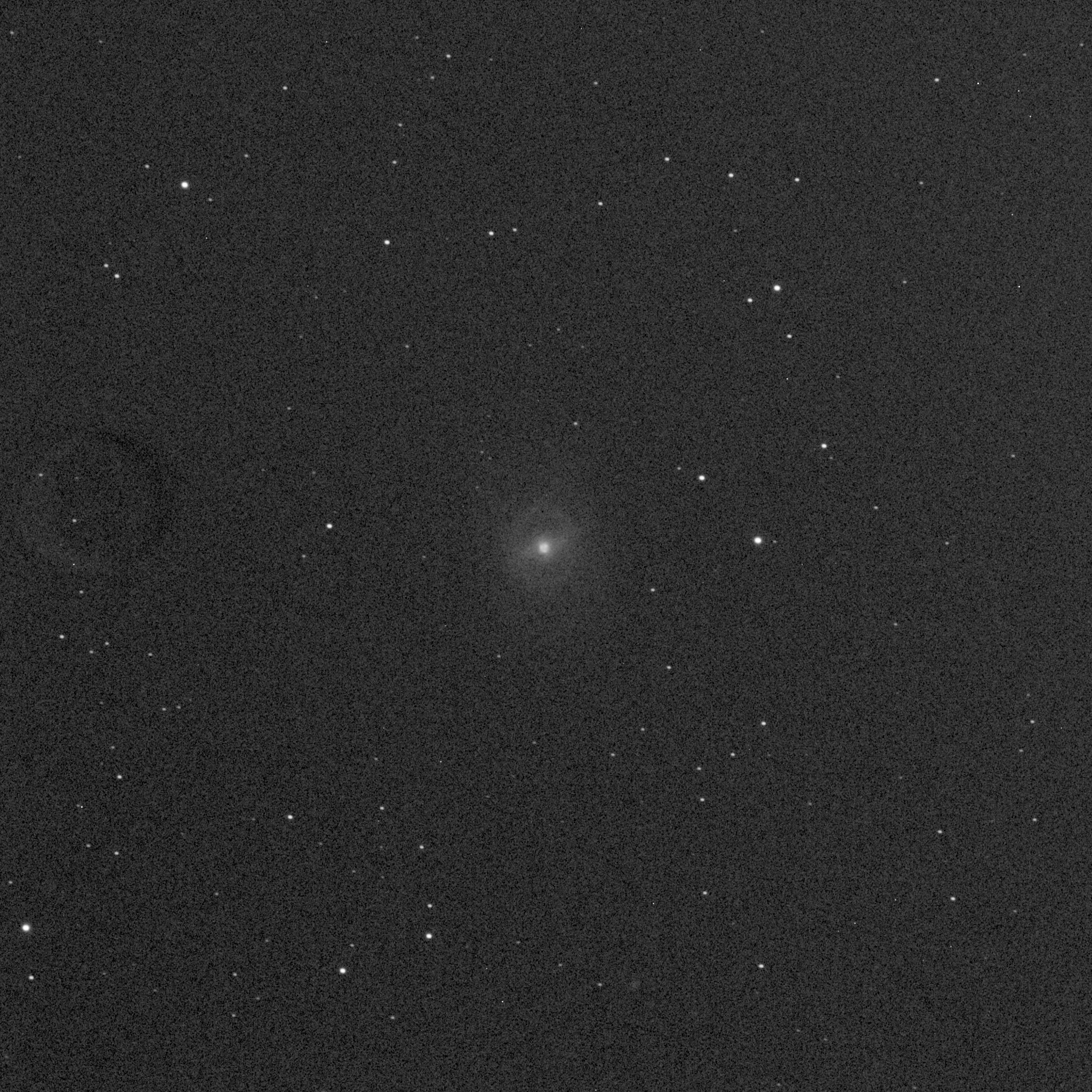
I had better luck with M105, and got a nice image of it with two nearby NGC objects.
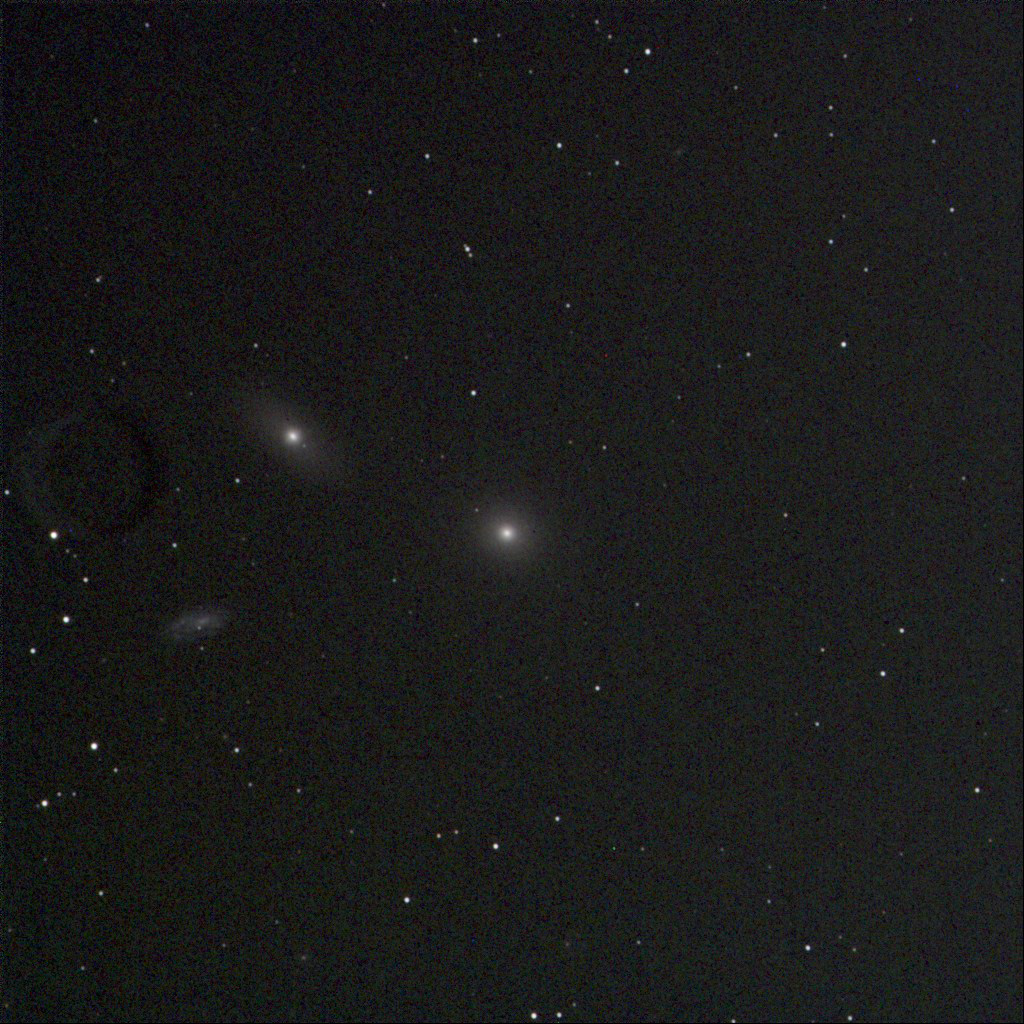
But wait, there’s an interesting detail. You might not see it if you’re in a bright room, or with a bright background. You might click on the image for the full resolution version.
Do you see that odd circle in the background, left center?
That’s nothing mystical, it’s just caused by a mote of dust on the imaging glass of my camera. The mote is “out of focus” so it appears as a shaded circle. I correct for those by taking a series of flat images at the end of the night. I point the telescope at the zenith and put a light panel on top of the scope. I calibrate the timing so it generates a flat grey image around 50% of the camera’s dynamic range. (I’ll take a picture of that process tonight to show you.)
Here’s the flat from last night’s imaging run, stretched in contrast so the differences show a little more:
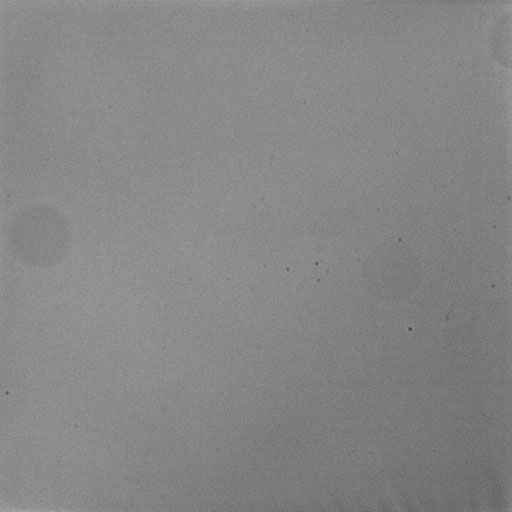
I didn’t shoot flats for years because I couldn’t figure out how to get a neutral grey image target in the field, and calibrate it for a 50% image. Now that’s handled by my light panel and software that calculates the right image duration.
You can see the dark circle on the flat that matches up with the circle in the background of the M105 image. That leaves a mystery — why didn’t the flat correct for the dust mote, like it usually does?
As a test, I recalibrated the image without the flat, and the circle was still there, but it didn’t have the “3D” look to it from the calibrated image.
You can see the same problem in two other images from last night:
Look, there it is again — that dust mote circle in the left center of the image.
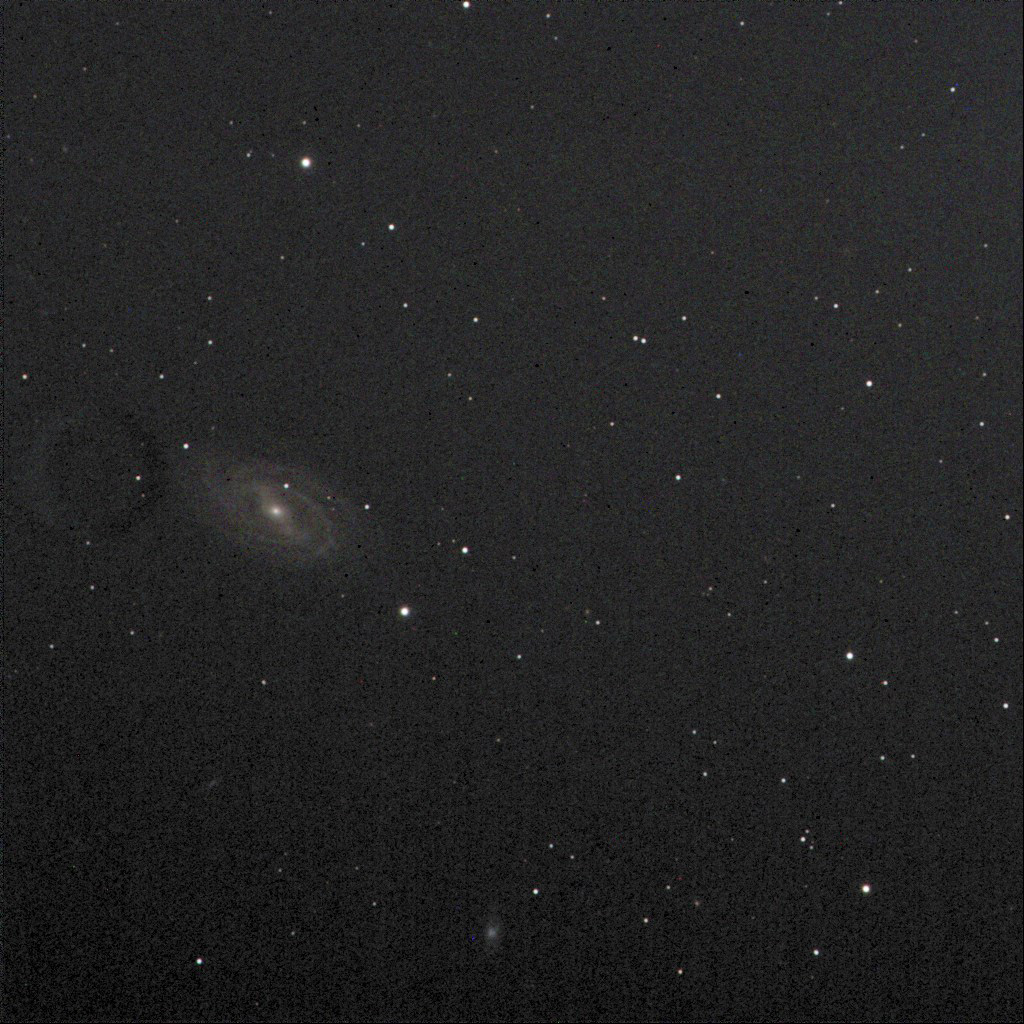
And yet again, there’s the circle just to the left of M109.
Now here’s the last image from last night. Under the circumstances, I thought this was a beautiful shot of M63 the “Sunflower” galaxy.
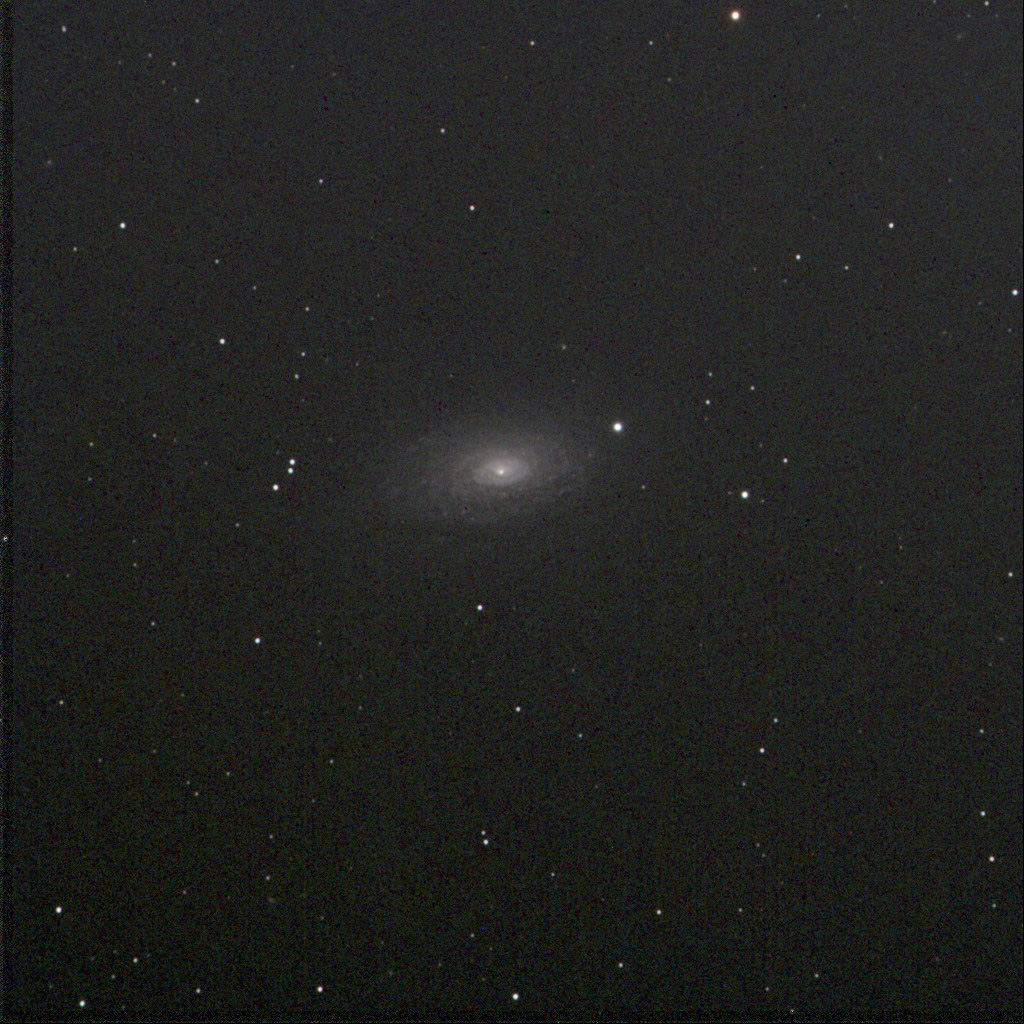
Wait, where did the dust circle go? It’s not there! The flat worked perfectly for my M63 image.
That mystery dust circle was a puzzle as I was processing the images in the wee hours of Sunday. When I saw this last one, I understood what happened. Can you guess?
I always shoot my flats at the end of the evening. It’s that one dreaded task I have to do before packing up the gear in the wee hours. It has to be done while it’s still dark.
The flat worked perfectly for my last image. It could only mean one thing:
The dust mote that made the circle shifted position during all the telescope movements during the evening.
During the early evening exposures, it was in a slightly different spot on the glass cover than it was during the last image. You can see the effect — the flat compensation shows extra bright on one side, and extra dark on the other. That’s what gives it the “3D” raised, or depressed, effect.
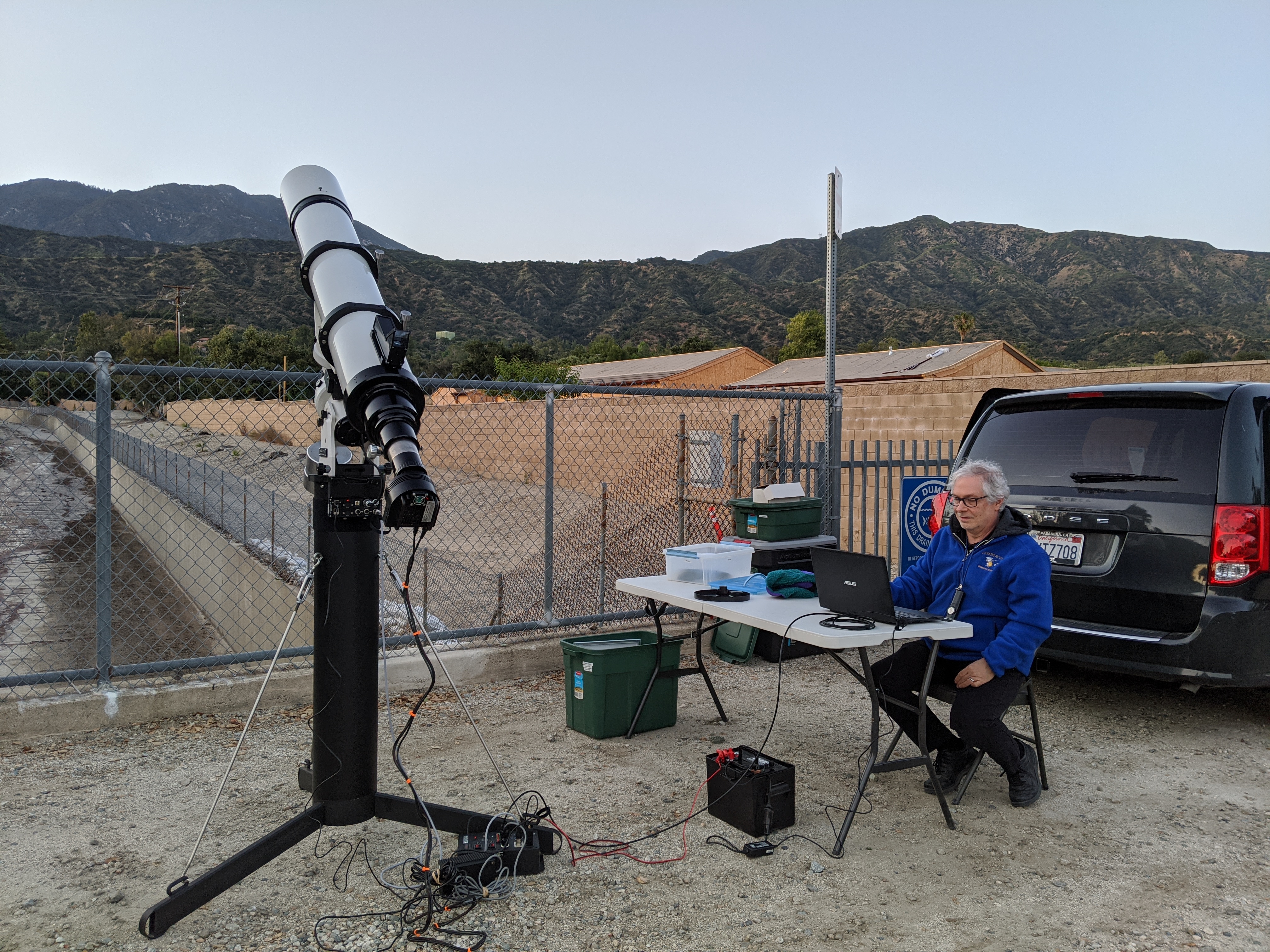
The previous post mentions how I started trying out photographing Messier objects from my home in Monrovia, using my Astro-Physics Traveler 105mm f/6 refractor. The results were encouraging enough that I had to bring out the giant AP180EDT and see how that would go.
This is not a one-person telescope. It really takes two to lift it into the mount rings, and dismount it after the session. I’m heavily dependent on Jane for the setup and (most importantly) the takedown. It turns out she’s a full supporter of the project, and offered to help me take down even when it would mean waking her at 2:30 or 3:00 a.m. That’s true love!
While we’ve had the telescope for about twenty years, the original mount has been replaced with an AP1100GTO. That should make it an astrophotography demon. Without the ability to “goto” an object, this project would be all but impossible in the city sky glow.
My experience with the equipment consists of about two evenings testing, and one evening of actual observing, so there was a lot of tinkering, calibrating, and adjusting. I was fixing and tuning the hardware, and learning the software. I spent hours doing fine polar alignments, recording “bad pixel” maps for the guider, diagnosing guiding errors, and such.
That said, I still managed to capture what I consider stunning images for such a bright location. I’ve been logging two more Messier objects each evening, and with several good clear moonless nights in a row, I haven’t been able to resist.
I’ll just put all the comments in the captions. If you click on any of the images it will link to the highest resolution version, with every wart visible. 🙂
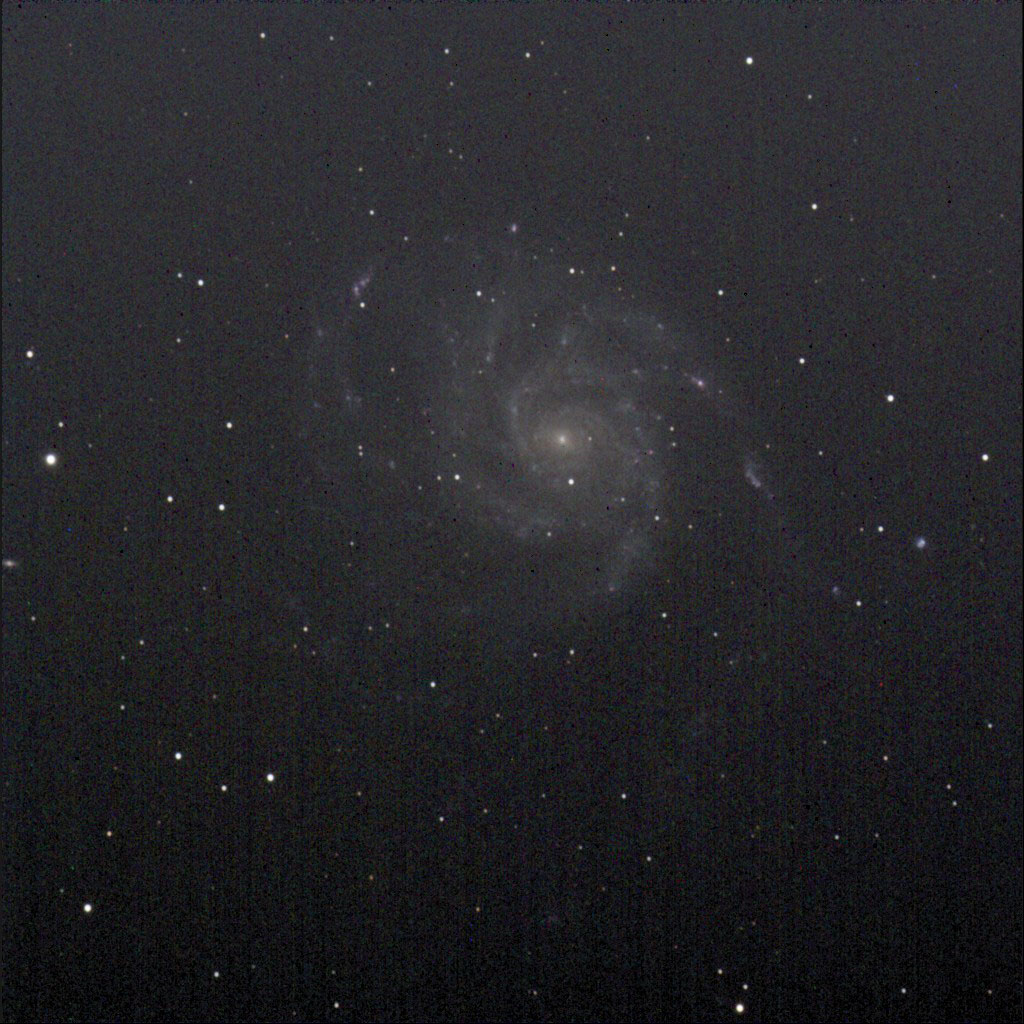
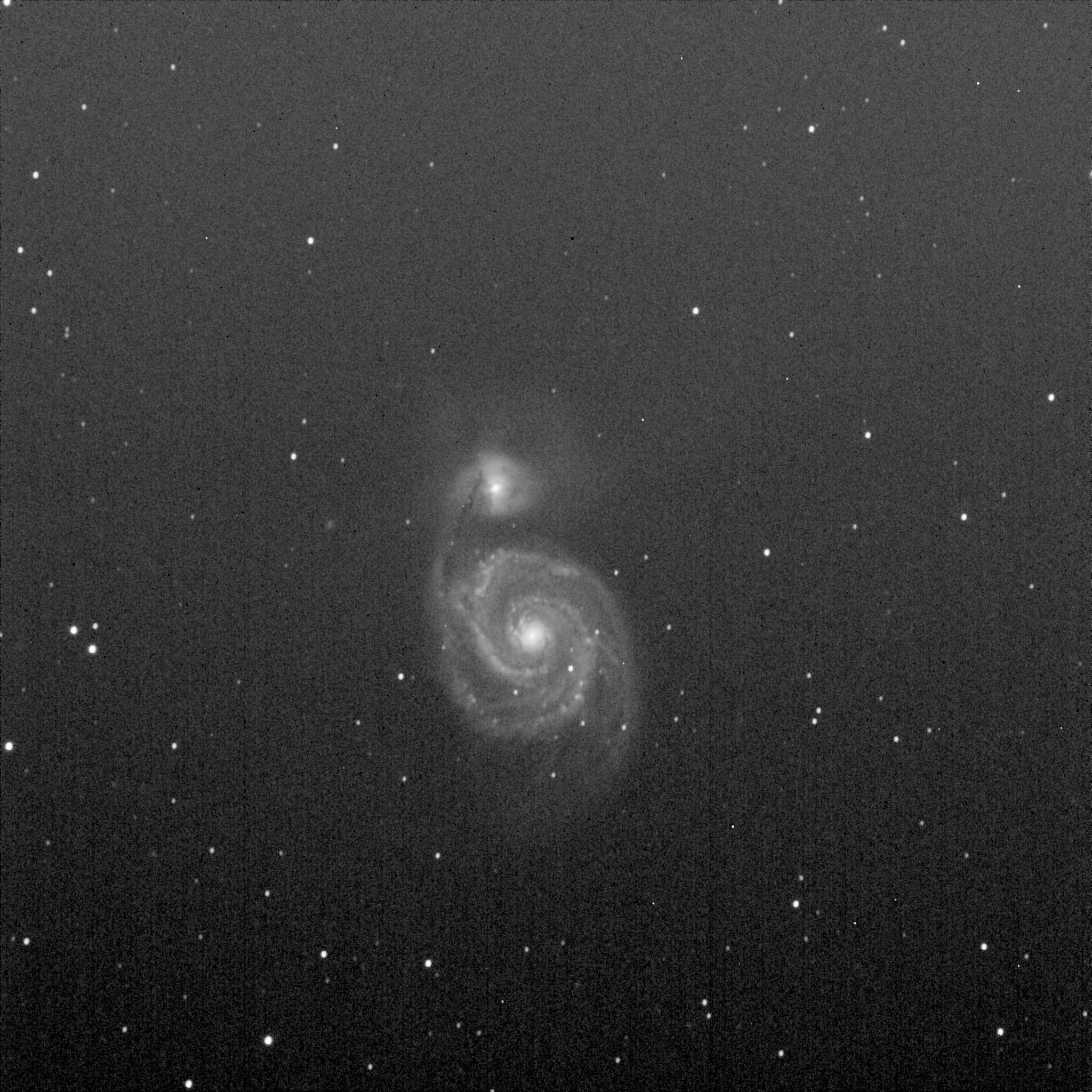
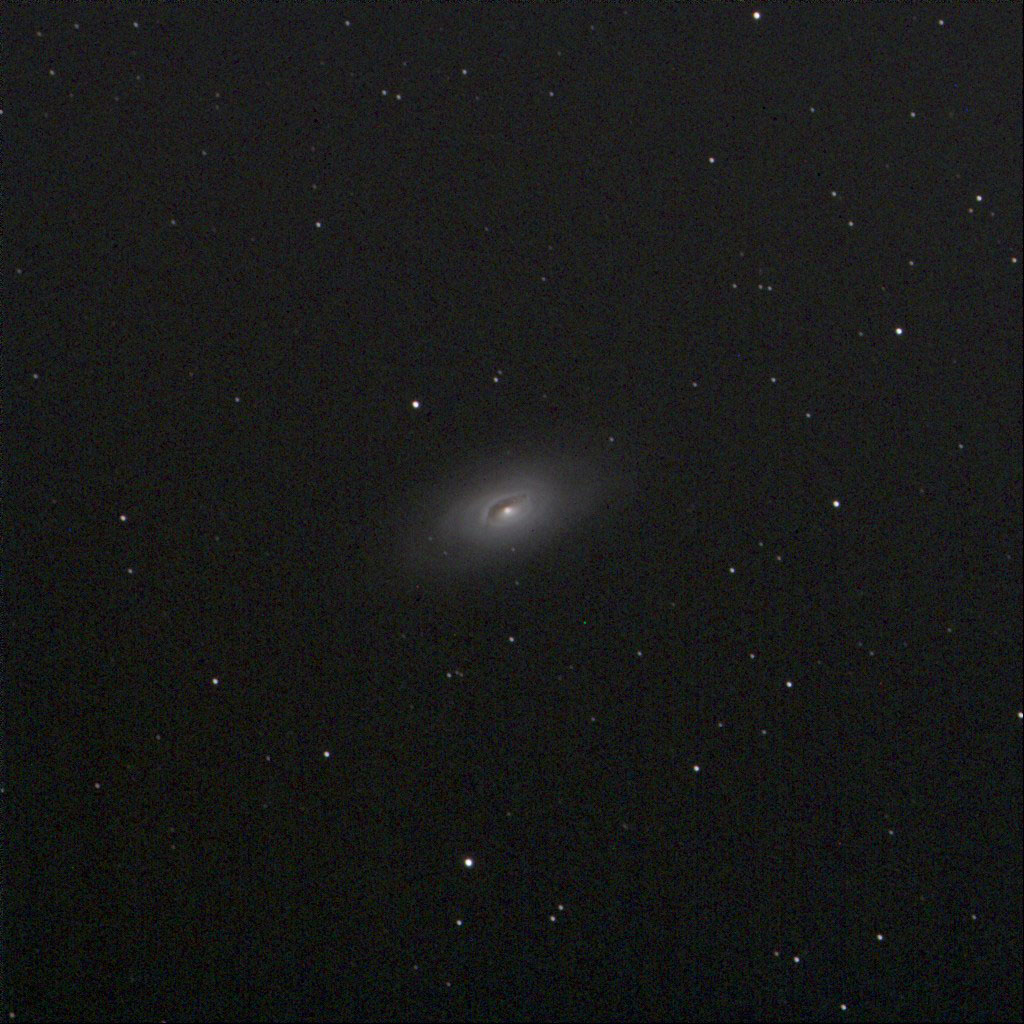
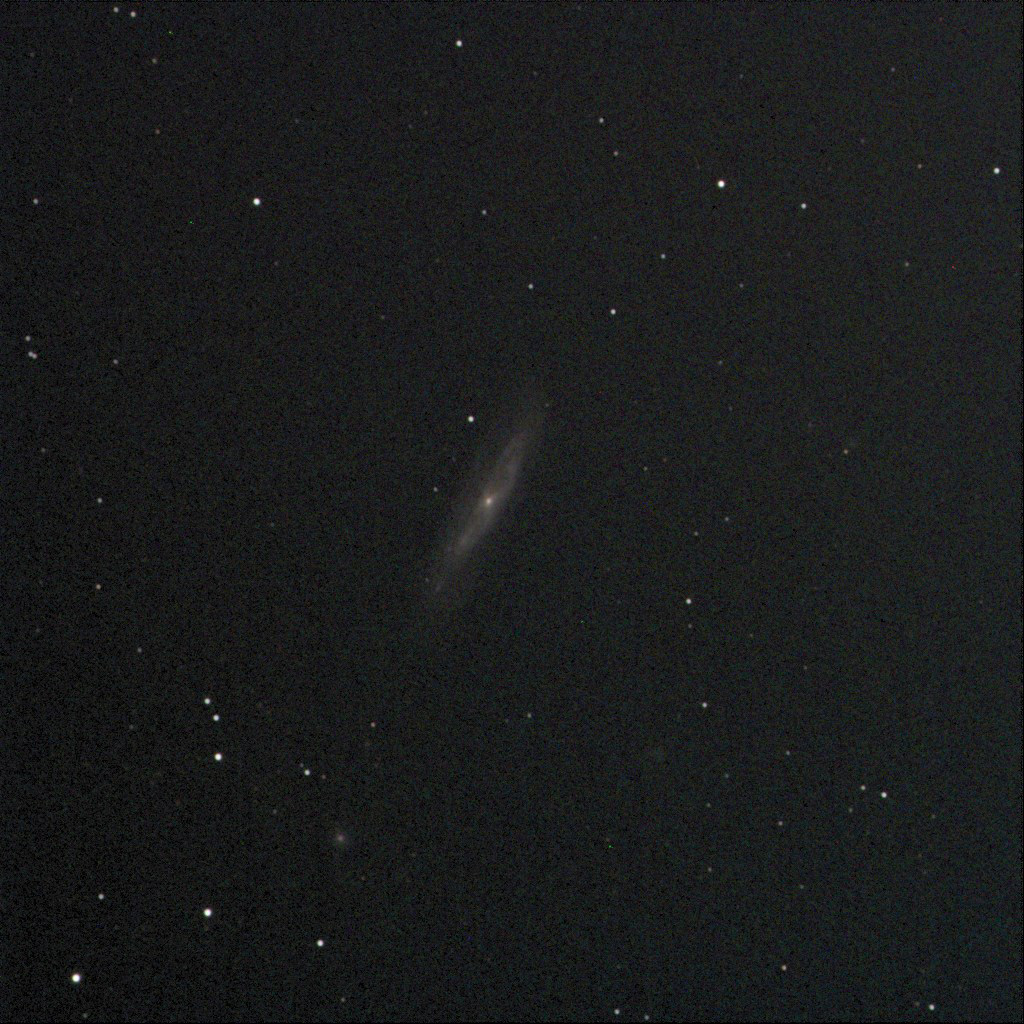
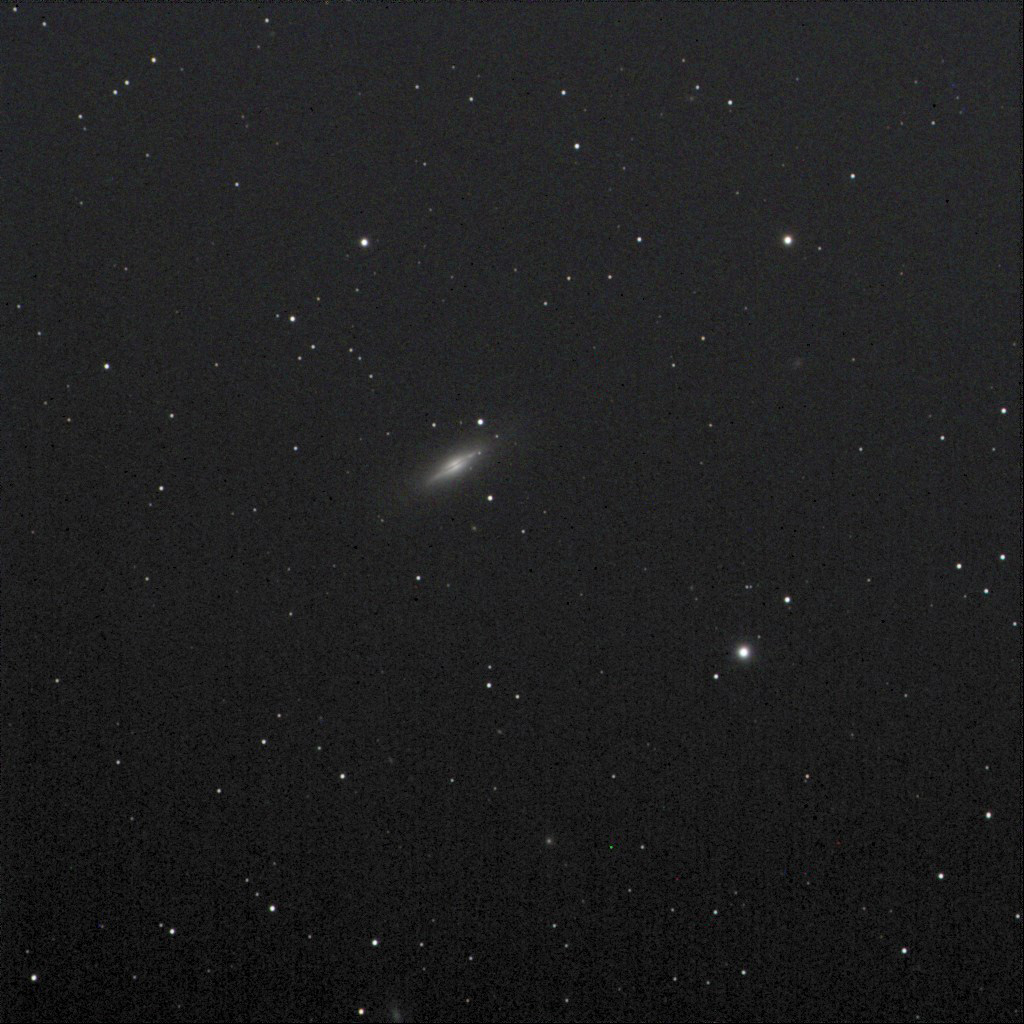
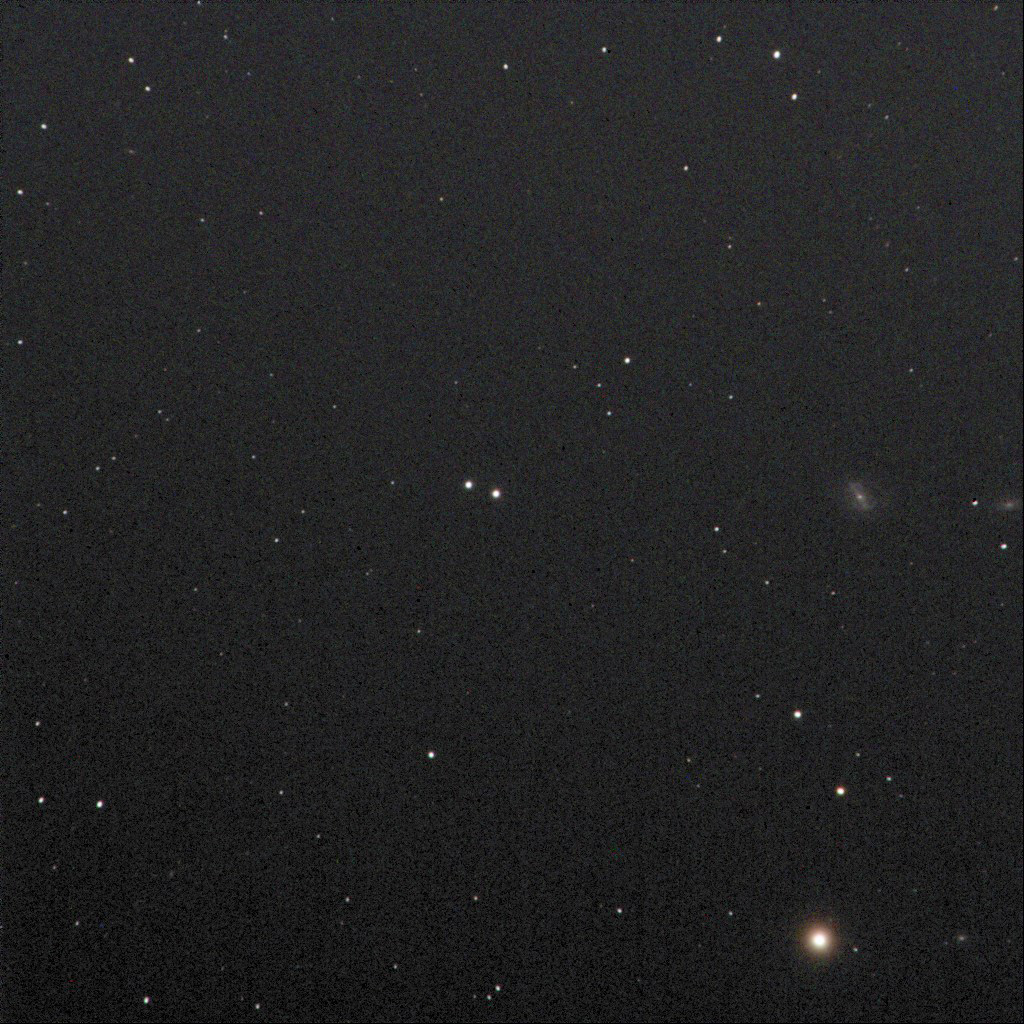
Tech details:
All of the images here were made by collecting 30 minutes of light, as six 5-minute exposures. The images were processed with CCDStack2.
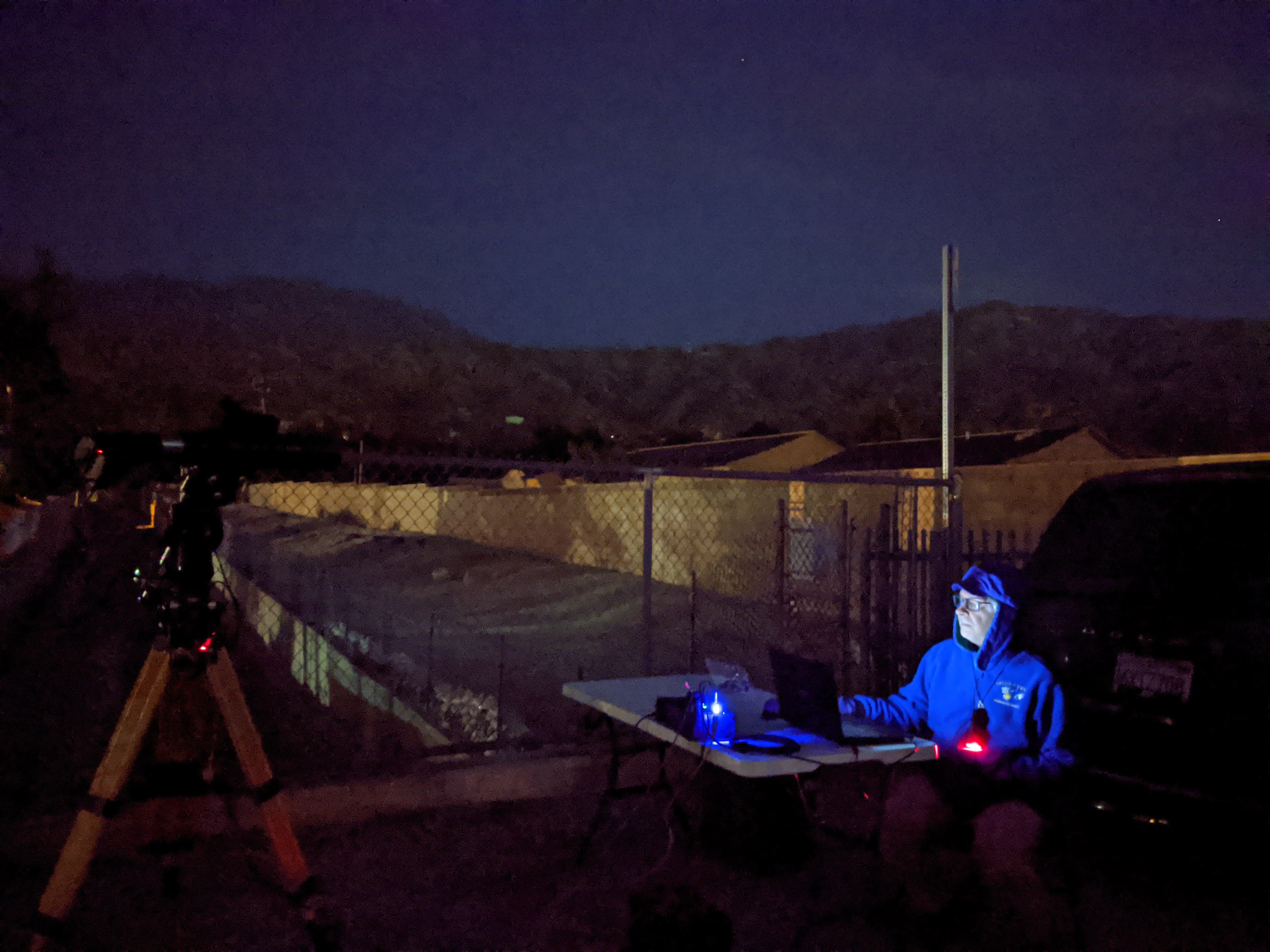
Normally I wouldn’t even have considered trying this project. I’m known for hauling my telescopes to a dark sky site in the desert to do deep sky astronomy — visual or photographic.
But here we all are, staying home for the duration.
I have a spot about 50 yards from my front door. It’s a bridge over Sawpit Wash, partially paved, partially gravel. It has really good horizons, and no serious outdoor lighting nearby. When Jane and I first moved in we thought it might be our home astronomy site. We’ve done a little planet observing there. She famously counted meteors from there.
I thought maybe I could at least image a few bright open clusters, maybe a bright galaxy here and there.
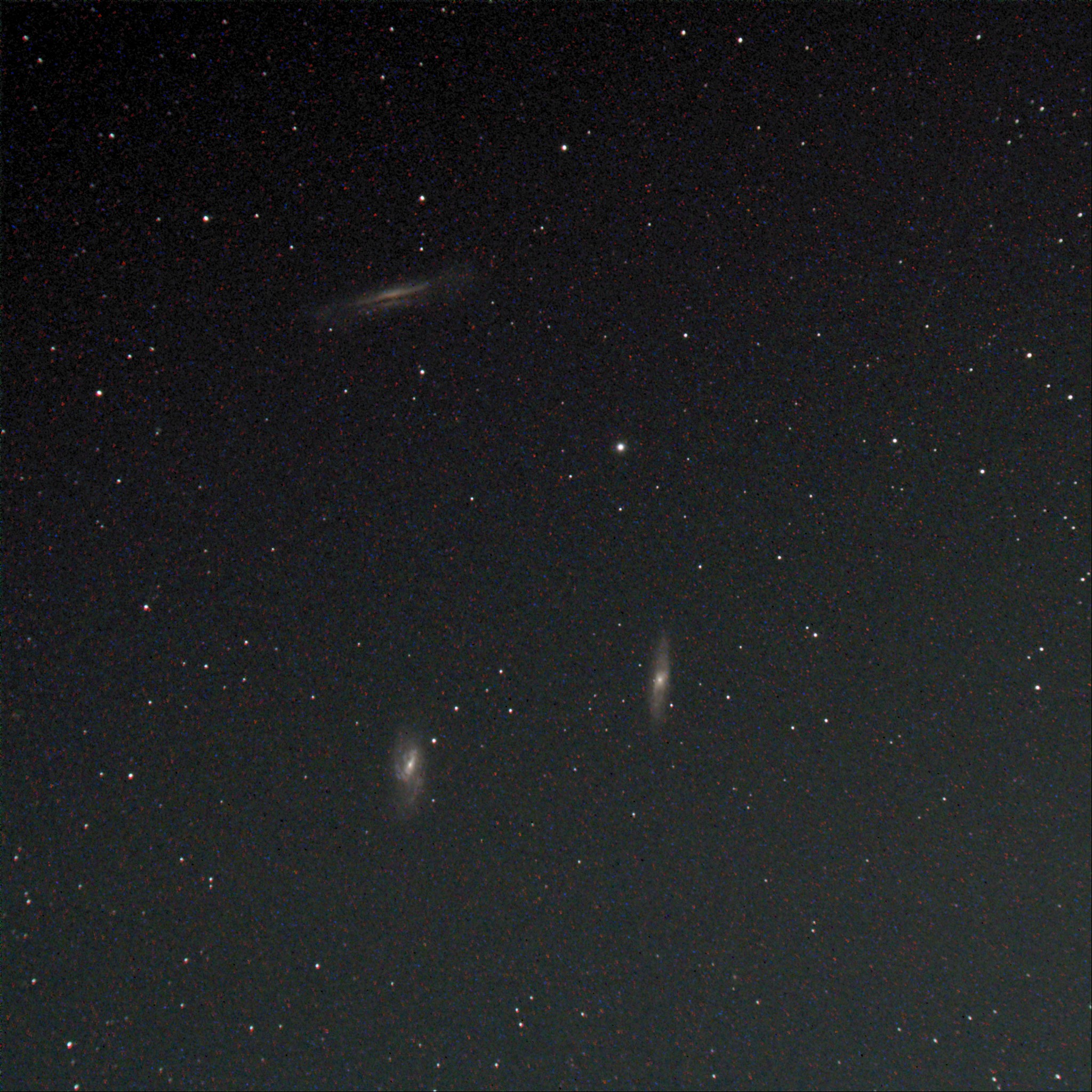
I started with the Traveler, a 105mm f/6 refractor, and looked for targets that would be high overhead, into the darkest part of the sky. Leo was high, and the trio of galaxies including M65 and M66 looked promising. The results were encouraging.
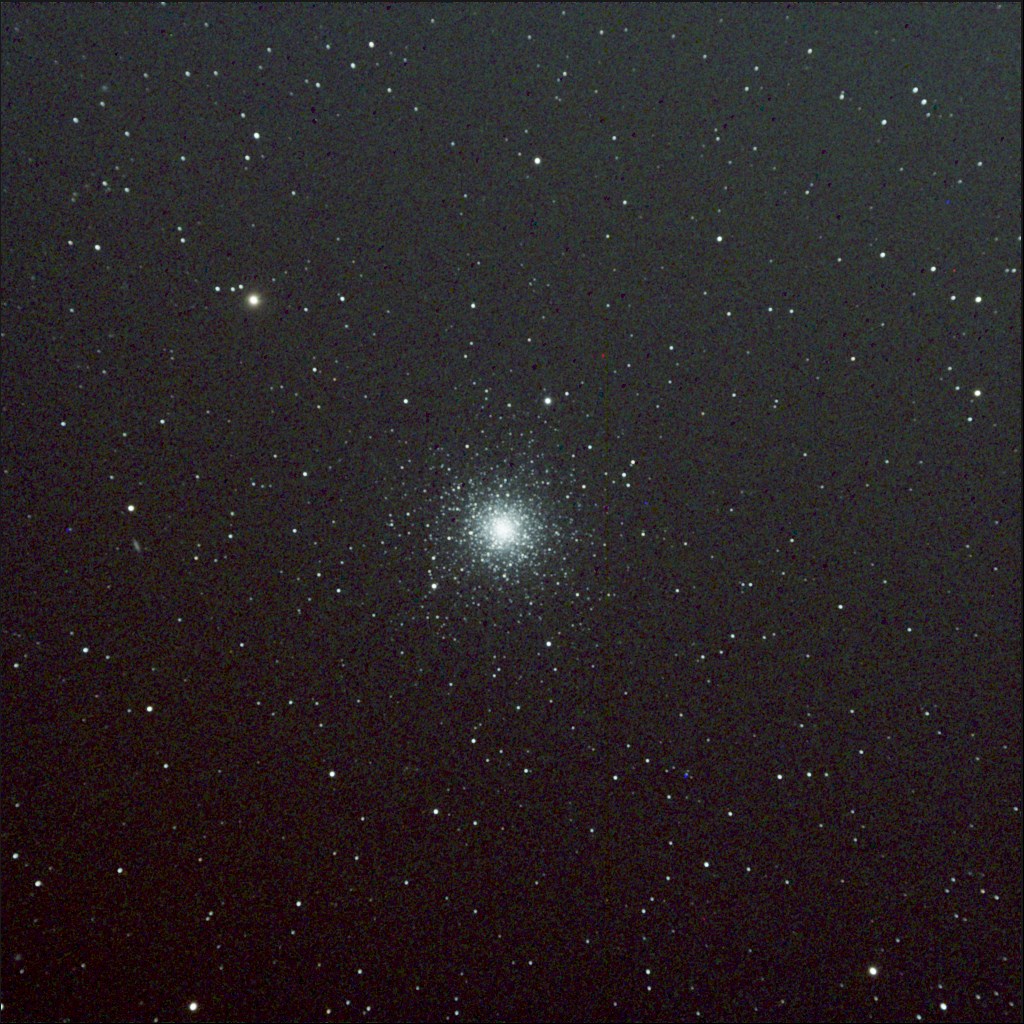
The results were so promising, I thought I’d try my favorite globular cluster, M3.
M3 and I have history. It was one of the first deep sky objects I attempted to observe visually from home in Campbell, CA, deep in the San Jose light dome. I was observing from my street corner almost directly under a street light, with a Celestron 8-inch SCT. I spent about two hours hunting, and finally found a barely visible fuzzball in the eyepiece. I was ecstatic!
Now here it is from the Los Angeles light dome with a good astrophotography camera.
I had great fun with the Traveler over the next few clear nights. I think it’ll be a fun challenge to see if I can photograph all of the Messier objects from Sawpit Wash. I’ve started picking them off two or three in an evening.
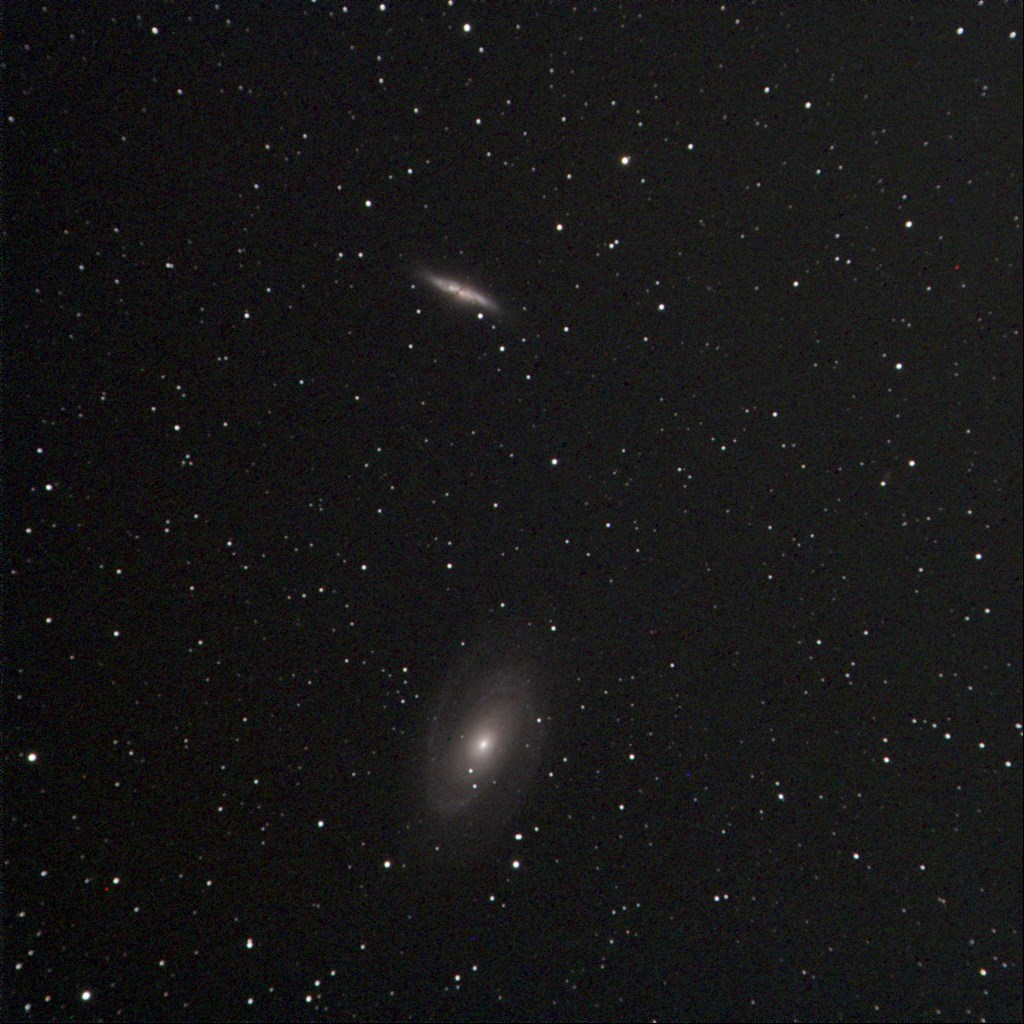
Here’s my capture of a favorite pair of galaxies in Ursa major, lovely spiral M81 and turbulent M82.
If I could grab all the Messiers two at a time, this would be easier. Here’s M108 and M97 the owl. In this one you can see the effects of the sky glow gradient from city lights:
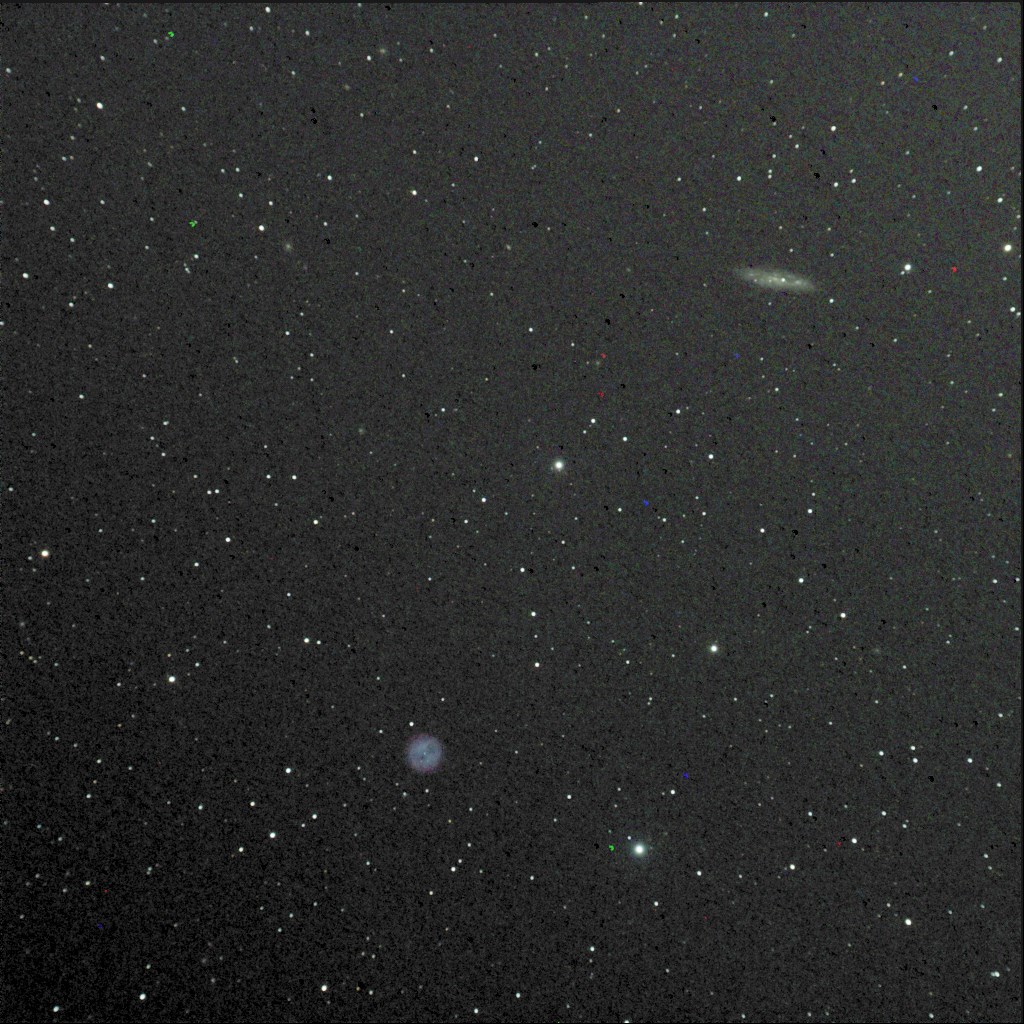
The city lights affect everything about this astrophotography. What’s really surprising is how effective the photos can be, even so.
After several evenings with the 4-inch telescope, I was really itching to spend some quality time with our AP180EDT refractor. That’ll be the next blog post.
This is the first new blog post from me in four years, and long overdue.
Why blog now?
I enjoy writing and reporting about stuff in my life: astronomy, travel, bridge, wine, photography, network systems.
And Facebook is Dead To Me.
Since my last post, Jane and I have both retired, I opened and closed a weekly bridge club, we cruised half the globe on Seabourn and Crystal (teaching and directing bridge games along the way), purchased a Tesla Model S and drove it to the bridge nationals in Memphis and Las Vegas, and acquired a new telescope mount.
Now I’m in the preparatory stages of opening a new full-time bridge club in Pasadena.
I’ll be working again soon, and working hard. I think I’m going to love it, but with that sense that I need to take advantage of this slow time to do things I won’t get to do as often.
I’ll be building a new website (Drupal 8) for the Pasadena Bridge Club soon. I have bridgemojo.com for posting bridge feature articles, and I’ll plan to continue that.
Our poor WordPress sites have gotten very little love. I’m sure Jane would appreciate a facelift as much as I would. At the very least, I should move them to a new server with a current version of PHP. (I see I really need to add SSL certificates, too.)
I need to build a new mail server and develop the habits of keeping it patched and current. The old one is like a pair of comfy shoes that feels so comfortable even while I know the soles are starting to get holes and they need to be thrown out.
The Pasadena Bridge Club is going to test all of my skills to build and maintain a comfortable, attractive, high-tech (without looking it), full-time bridge club. I should be documenting the process. (How do I support multiple computer screens in different rooms? Working on that.)
During our travels, we did “research” visiting bridge clubs large and small scattered around the world: Spain, Oxford, London, New York, and all around Southern California. I should write trip reports.
I’m going to start with an astronomy observing report. It was my first all-night excursion in about a year, taken while Jane is enjoying traveling in Europe with her sister. Optimistic that we’d be able to do some mid-week observing this year, we signed up for two observing pads at GMARS, the observing site of the Riverside Astronomical Society.
I had a great shakedown night, dusting off the cobwebs of a year’s disuse (and all of the associated software upgrades). I’ll post photos, an observing report, and an update on the new tools I adopted for doing astrophotography in upcoming posts.
Saving that for later … right now I have a bridge game to play in.
Thanks for lending an ear …
— Mojo
If you’re like me, you have exactly two places from which to buy high-speed internet service: your phone company (mine is Verizon) or your cable TV provider (mine is Time Warner Cable).
That sounds like competition, doesn’t it? If you don’t like one, you can go to the other.
After nine years (and about $10,000) with Verizon high-speed internet (for a commercial account), I closed up my internet servers and asked to switch to a retail consumer account.
There was no hardware change required, purely accounting and configuration.
At first my Verizon commercial account rep was very helpful and understood my desire for limited downtime. She looked at the back log for a consumer account creation, and postponed my account closure date three days to allow for that.
Once my account was in the hands of the consumer internet division, the company once again became the bureaucratic behemoth that it is. My commercial account rep handed off my call to a consumer/residential rep, and assumed that all would be well. At that point I was told that they could not initiate any action for a residential account until the commercial one was closed. In other words, there was no reason to delay closing the commercial account.
Still, my residential rep promised a call on October 14, my close date, and stated he would “do his best” to expedite service for me. He provided the phone number of his “secretary” to reach him on connect day.
October 14 arrived, and early that morning my internet service was turned off — right on schedule. The day came and went with no call from the consumer rep.
On Tuesday morning, I started calling the “secretary” number. After three messages, I finally got a return call at about 10:30.
Everything seemed to be going well until my rep said that the account would be established “no later than” October 18, three days hence. At that point I said “cancel the order” and ended the call.
I visited Time Warner’s site and ordered cable installation. True, there’s no way TWC could respond any faster, and I have an installer appointment for Friday morning, October 18.
Still, Verizon has lost me as a customer, and besides internet service I’ll move my landline telephone service off of Verizon as well.
Do they care? Should they? The answer to both is “probably not.”
I only recently learned of the importance of a “maverick” when it comes to competition and markets. I learned about this from a splendid NPR Planet Money podcast, Episode 438: Mavericks, Monopolies And Beer. It tells the story of why the Federal Trade Commission halted a planned merger between Anheuser-Busch InBev and Grupo Modelo. It would convert the beer market into a duopoly of two companies: InBev and Miller Brewing.
In this case Grupo Modelo acts as a “maverick” company, forcing the two giant corporations to genuinely compete and innovate, despite being a tiny player in the beer market.
The podcast is twenty minutes very well spent.
The thing about internet service is that there’s a huge barrier to entry for any would-be competitor. Who could be the maverick?
Two words: Google Fiber.
The effect of Google Fiber entering the internet service market in Kansas City and Austin has been exactly the beneficial effect of a maverick in a marketplace dominated by two giants. The big companies find themselves forced to actually make the investments they’ve promised.
Remember Verizon FiOS? Were you waiting for it to arrive at your house? Keep waiting — they’ve long since halted the roll-out. They only built out enough FiOS to get regulators off their backs for a while.
The phone company and the cable company have this in common: They hold a monopoly on service to your home granted by your local government. The opportunities for corruption here are enormous.
We are dealing with a duopoly with no maverick, the two companies have no incentive to compete at all. No one is there to disrupt the market.
Where do I turn when Time Warner Cable can’t perform? Do I go back to Verizon? Sadly Google is taking its own sweet time to add markets, and the hope of having a viable competitor here in Los Angeles county is negligible in my lifetime.
Here are some of the symptoms of the internet/TV service monopoly:
TV distribution has a market disruptor in the form of Netflix (and maybe Vudu and Hulu). But even those disruptive forces have to travel the same broadband pipes that are controlled by the massive duopoly. I don’t have good feelings about recently announced efforts by Netflix to cooperate with cable companies.
(And a topic for another day: sports franchises locking out non-cable customers from televised games.)
First I’ll mention that the AV preamp I started out with, a Marantz 7005 purchased as B-stock from Outlaw Audio, turned out to be hopeless. It would never successfully handshake video output to either of my displays, even with no sources connected. Sometimes on a hard reboot, it would send some video, then fail within a minute or two. After discussing the problem with Marantz and Outlaw technicians, they honored my return request and took the receiver back. Kudos to both.
I replaced the 7005 with a new 7701 purchased from Amazon. It arrived right on time in two days using Amazon Prime shipping. One advantage for the 7701 is a second monitor output for the main zone.
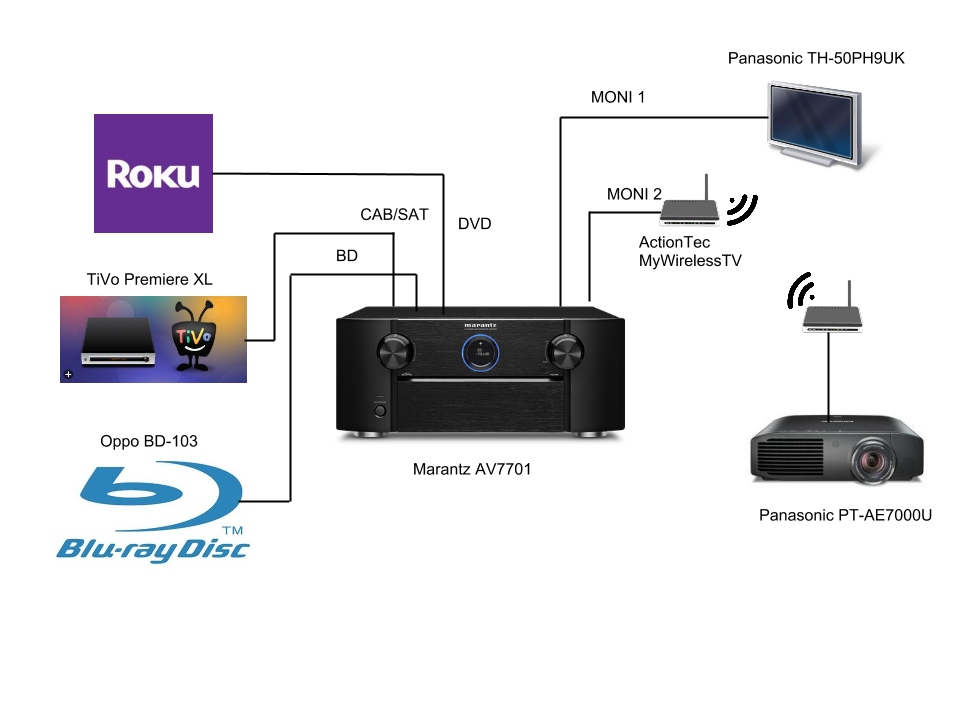
This diagram shows my original plan for hooking up my home theater:
My first effort was with an IOGEAR Wireless HD Kit (GW3DHDKIT). My kit turned out to be dead on arrival: the receiver and transmitter would never sync, at any distance from each other. That kit went back to Amazon for a refund.
I replaced it with an ActionTec MyWirelessTV. This kit gave the appearance of being much more reliable. We actually watched a movie using this system, by connecting the Blu-ray player directly to the MyWirelessTV transmitter.
But it never worked reliably when routed through the AVR: If I changed sources or cycled through different configurations, it would all fall apart. Indeed there were periods when the transmitter would completely crash and do a reboot. It frequently caused my Roku box to crash completely as well, requiring a power cycle to reset it.
My first attempt to calm the system was to insert an HDMI splitter. I fed MONI 1 from the receiver to the splitter, and fed its two outputs to the plasma and the MyWirelessTV transmitter. This was no better.
I acquired a Gefen HDMI Detective on a recommendation from my friend William Phelps. This seemed to be promising: I could use the “detective” to present a stable EDID to the receiver. My study of HDMI technology seemed to support my theory that the constantly changing state of the wireless kit was making the whole system unstable.
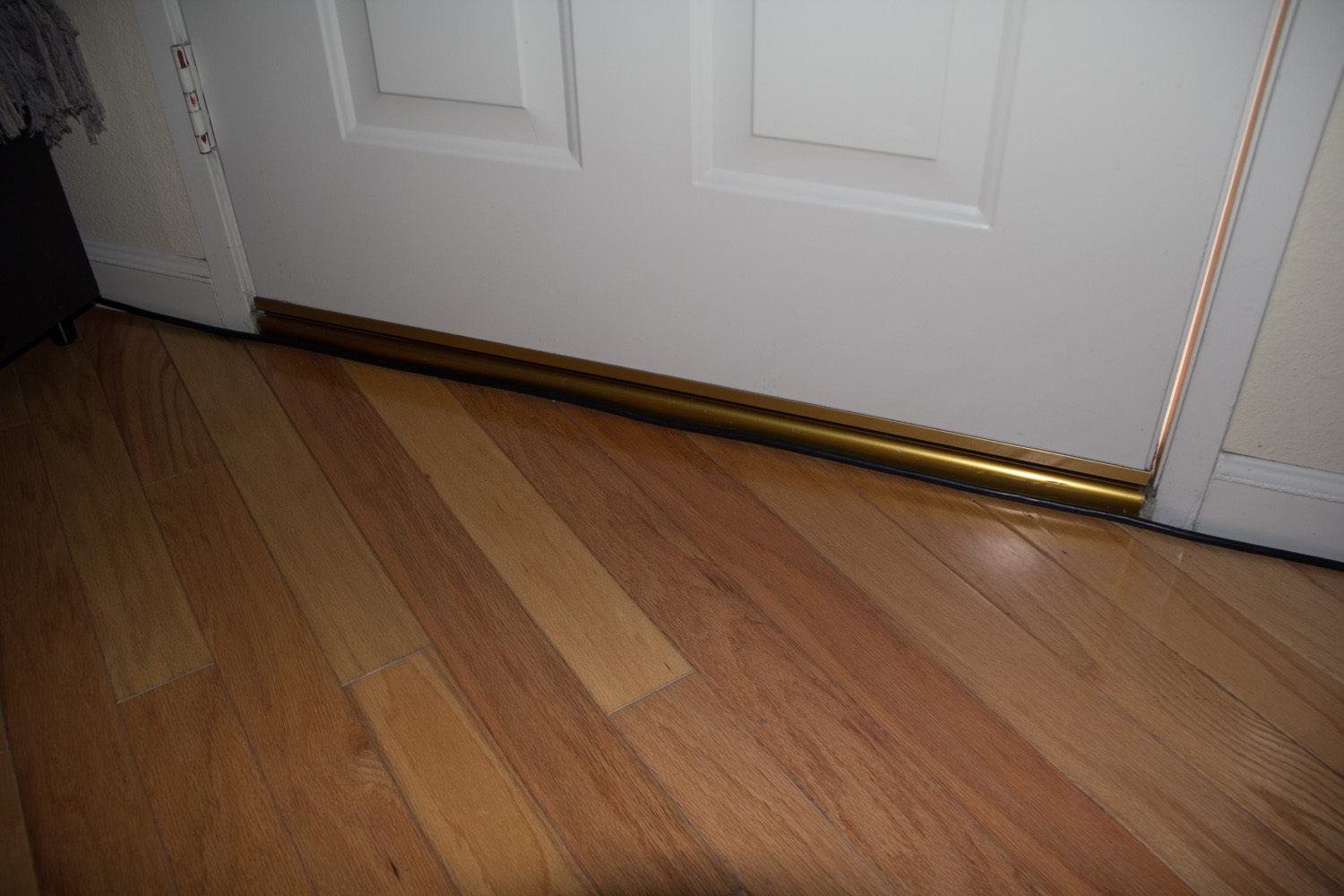
Then I had a revelation. I noticed that my front door was not flush with the floor of the living room.
There appeared to be room to run an HDMI cable from the front of my room to the back unobtrusively, without ripping the walls. I guessed at the distance and ordered a 35-foot HDMI cable from Amazon (thanks again Amazon Prime free two-day shipping). Even if it didn’t work out, it would be enough to replace the wireless link for testing.
I have a perfectly good cable conduit from my AV cabinet to my projector. Why not just use that? When I first built the system, my electrician put 1-1/2-inch conduit in the wall from my A/V nook, up two stories to the attic then down from the attic two stories through the center of the house to my projector mount. In that conduit my installer ran three coax lines for component video, power cable, one cat-5 wire for S-video (remember that?) and one cat-5 for a screen trigger relay. (The conduit is packed tight!) The whole path is about a 75-foot run! For HDMI, that means using some kind of extender, either with two cat-5 cables or a fiber link. I had hoped to cheat with a wireless link. I’m continuing to use the power wire and screen trigger, but may not ever go to the effort of pulling out the unused video cabling.
I unwrapped my new 35-foot cable and ran it from the projector to the AV cabinet. It turned out to be the perfect length. It rests neatly below the front door. I haven’t yet secured it there, but for the moment it’s staying nestled.
I ripped out the wireless HD kit, and plugged my new cable into the projector and the splitter. My scientific impulse is to change only one factor at a time and test that, but I defied that impulse this time and decided to rip the splitter out of the system as well. I routed the cable to MONI 2 on the Marantz, and went for broke.
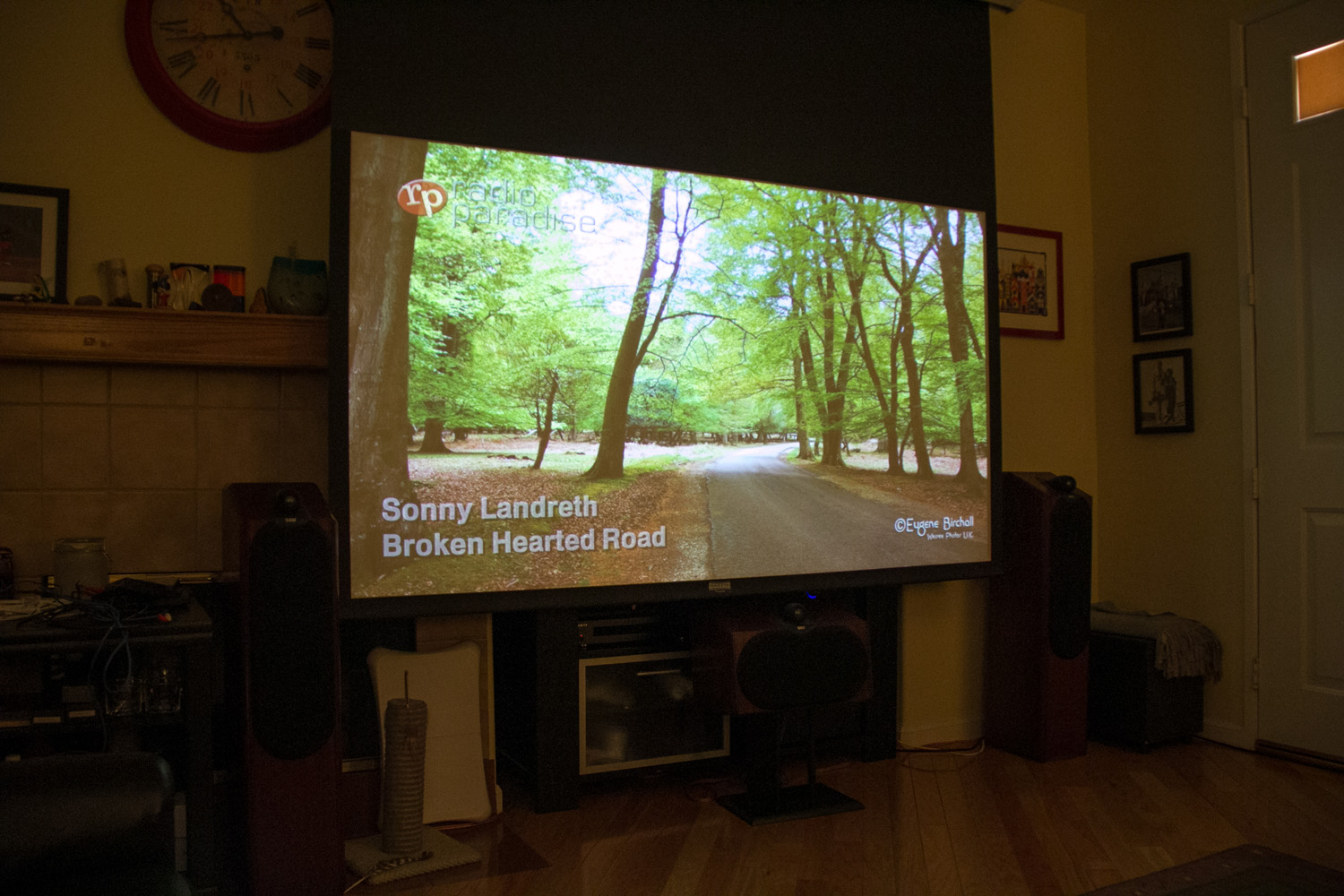
To my surprise and delight, every video source worked perfectly with both screens. The Roku didn’t crash. Configuration changes were completely smooth.
I configured the Blu-ray player to send 1080p video to the projector and the picture was beautiful. I even fed it some 3D video from a Lion King disc. I don’t yet have 3D glasses, but I could see that the picture was going to be perfect.
I set up the Marantz Audyssey calibration microphone and calibrated the receiver to my room. I put on the Muppets movie from 2011 and enjoyed it in gorgeous 1080p with great audio.
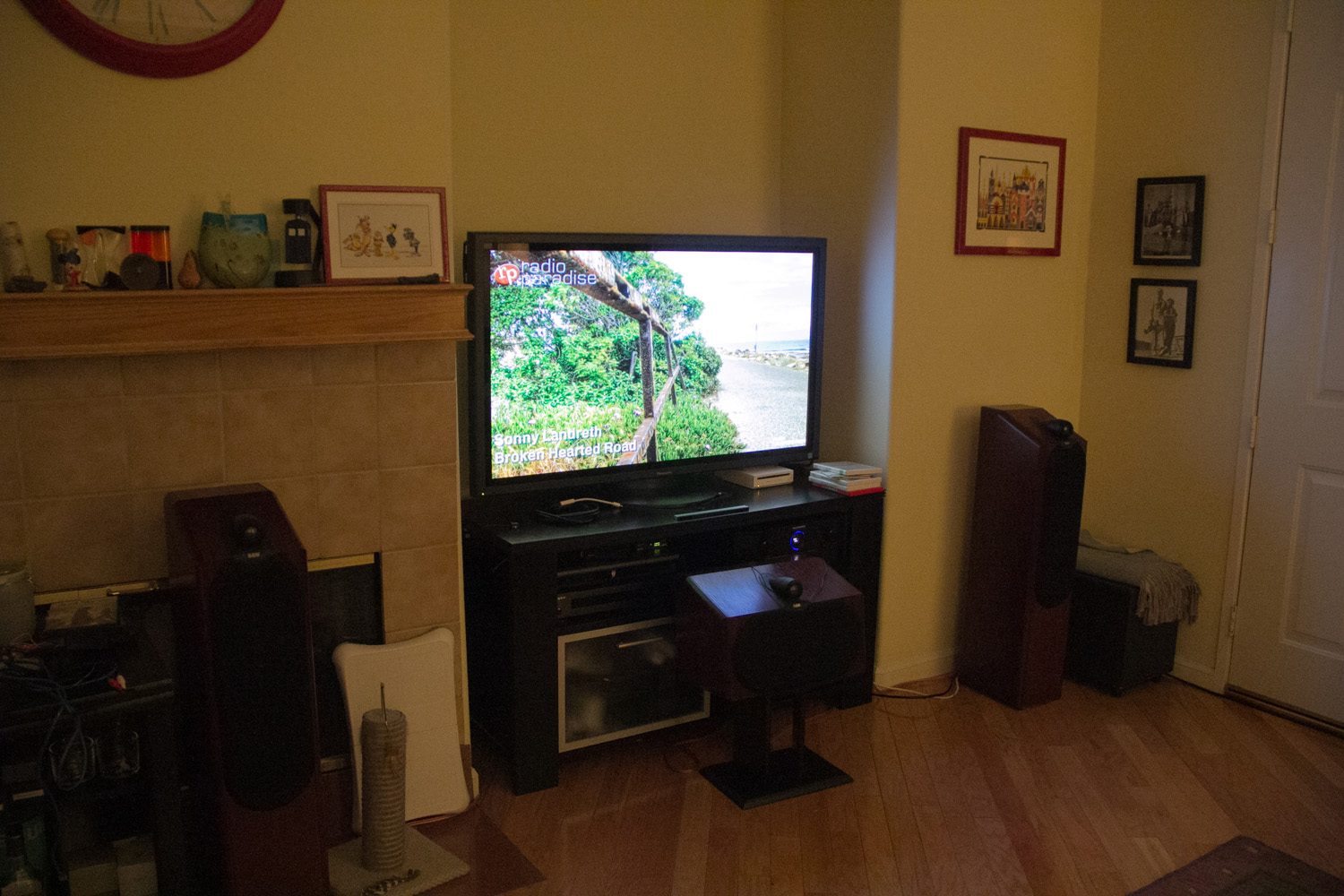
To complete the upgrade, I installed a set of Philips Hue wireless LED bulbs in our living room lamps. My new Logitech Harmony Ultimate remote control is able to control the bulbs. So now I have programmed lighting for each A/V activity: bright for radio, partial bright for the plasma screen (with one bulb that has a reflection in the screen for me turned off), and fade to dark for the projector.
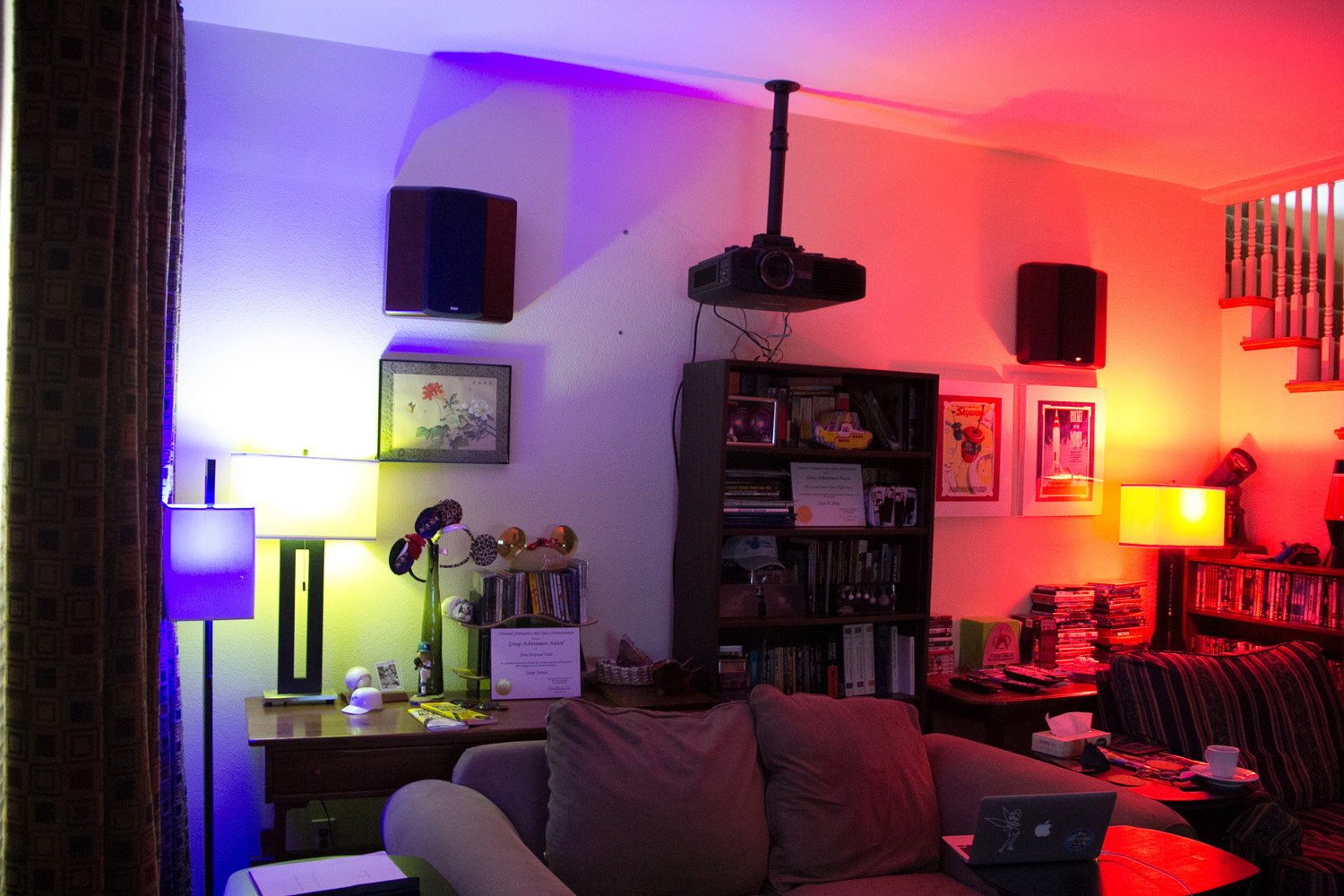
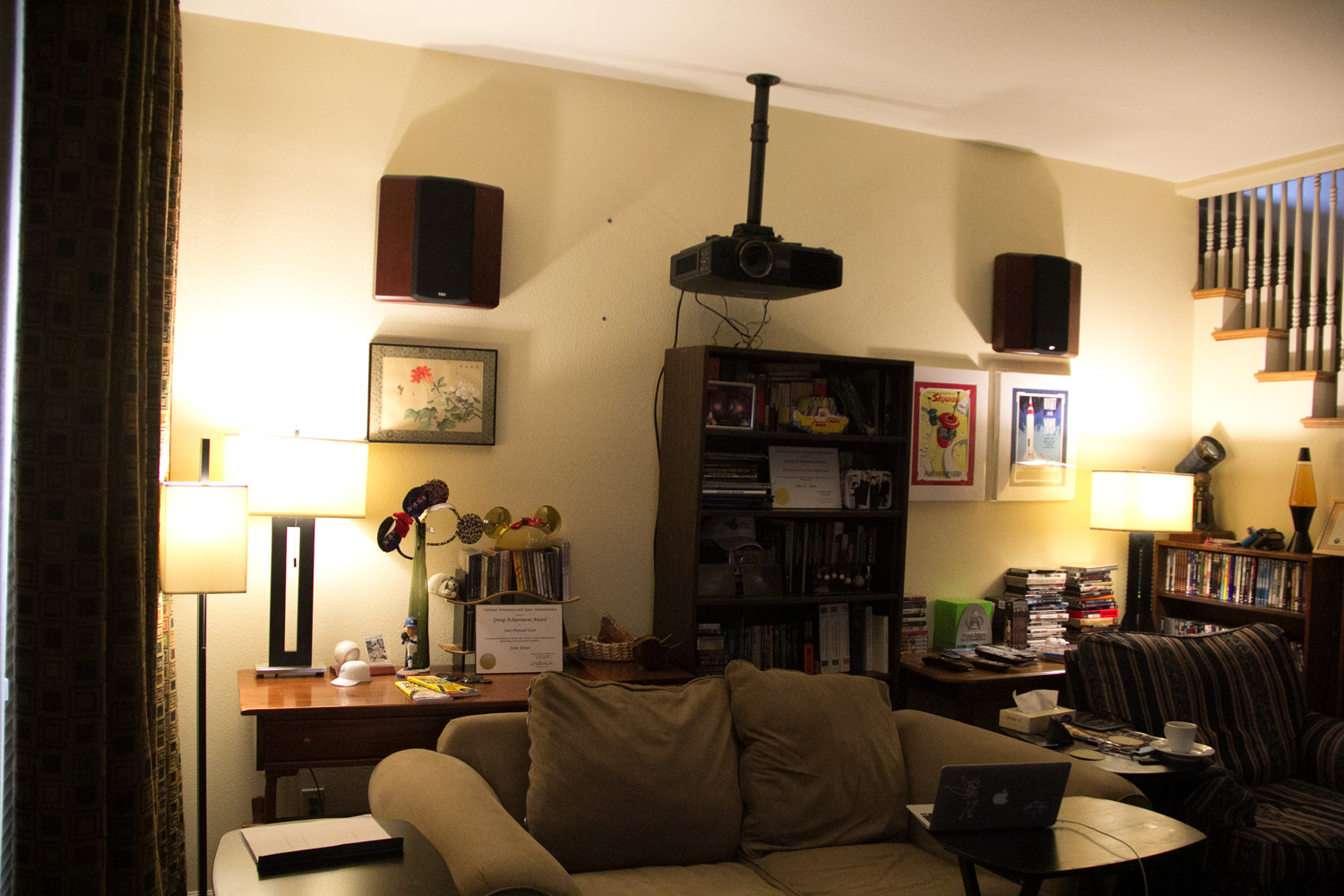
The final irony is that the Philips Hue bulbs are the single most impressive part of the whole upgrade. Still, the whole package looks and sounds great, and is dead simple to operate. Mission accomplished.
Old system:
Why upgrade?
The Rotel receiver has annoyed me for years with its few seconds of silence after mode switches (like Dolby Digital to PCM during a TV broadcast). It’s volume behavior was bothersome, with no way to compensate for different levels between sources. It’s old and has had one small power supply component fail (at the time I decided to have it repaired rather than replaced). A new one would offer HDMI switching and scaling.
The InFocus projector was old and growing dim, and did not support any HD formats. It looks good for DVDs. The long component video (YPrPb) run to the projector makes for a difficult color balance.
The Panasonic plasma display still looks great, and supports 720p HD, but it didn’t have an HDMI input port, necessary for things like Blu-ray Disc.
The Logitech remote was working fine, but its display screen has deteriorated.
I thought HDMI would reduce my nest of cables by eliminating a lot of component video and digital audio cables, plus a projector upgrade would give us true HD (even 3D) for movies.
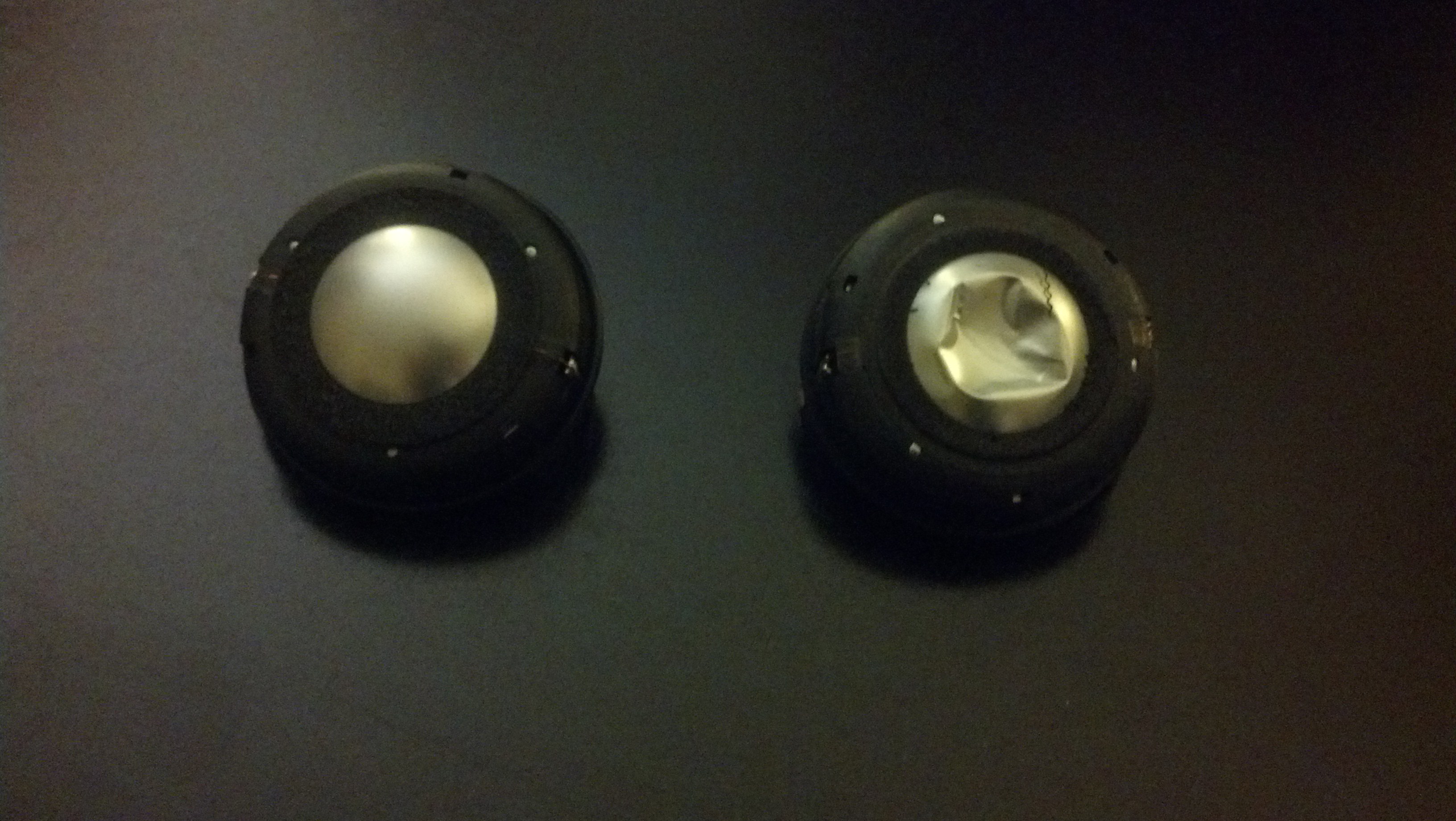
B&W does a pretty good job with a USA parts and service company. The tweeters on these speakers live in a little nodule at the top of the tower. New ones were moderately easy to plug in, though after several years getting the tweeter housing open and back together took quite a bit of force.
My Panasonic plasma screen was made in January 2007, and long since discontinued. When I purchased it, I never bought the optional HDMI terminal card, since I couldn’t route HDMI. I was concerned that the add-on board would be “unobtainium” as well. It turned out to be available and in stock at amazon.com.
Installing the card was definitely a two-man job. I roped my friend Preston into spending a couple of hours with me moving stuff around. We got the plasma display off its base, and the terminal card installed with no great effort. Yay!
I decided to go with separates: Outlaw Audio’s Model 7500 power amp looked solid and had great reviews, plus it’s priced quite a bit below its peers. I’m thinking that this power amp may be the last one I ever buy. It should live forever even when I replace preamp/preprocessor units.
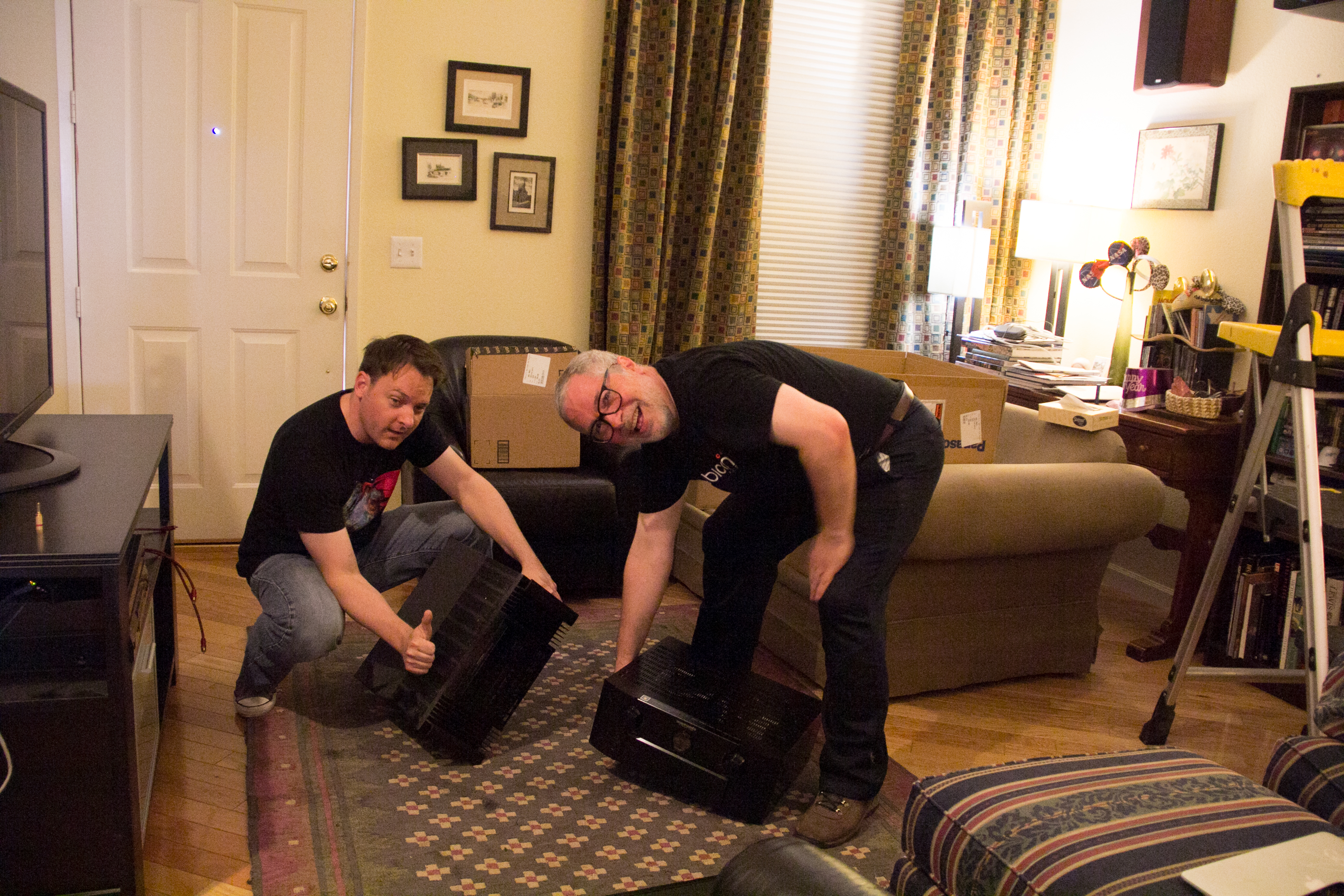
For a pre/pro, Outlaw also had a good deal on the Marantz AV7005. It had great reviews and all of the inputs and setup I needed.
With Preston’s help, we wrangled the power amp into a nice spot on the bottom of the A/V cabinet.
I had ordered a set of five balanced audio cables with XLR connectors from Outlaw along with the power amp and receiver, 0.5 meter each. Oops! No chance they would reach through the holes in my A/V cabinet. They’re really only useful if you can physically stack the pre/pro on top of the power amp.
So my fallback was to use some of my now-unneeded RCA interconnects and use the unbalanced audio connectors on each unit.
Sometimes that worked. If I held the interconnects just the right way, I wouldn’t get a ground-loop buzz. Well that’s stupid! That’s exactly the problem that balanced interconnects solves so elegantly.
So where to find five interconnect cables long enough to connect the pre/pro to the amp? This is not a mass-market item.
It finally occurred to me that Fry’s Electronics might have the connectors and wire and I could make my own interconnects. (I’d already struck out at Radio Shack on XLR connectors.) Indeed Fry’s had male and female XLR connectors, and enough stock for me to buy five of each. But finding two-conductor shielded cable at Fry’s was hopeless.
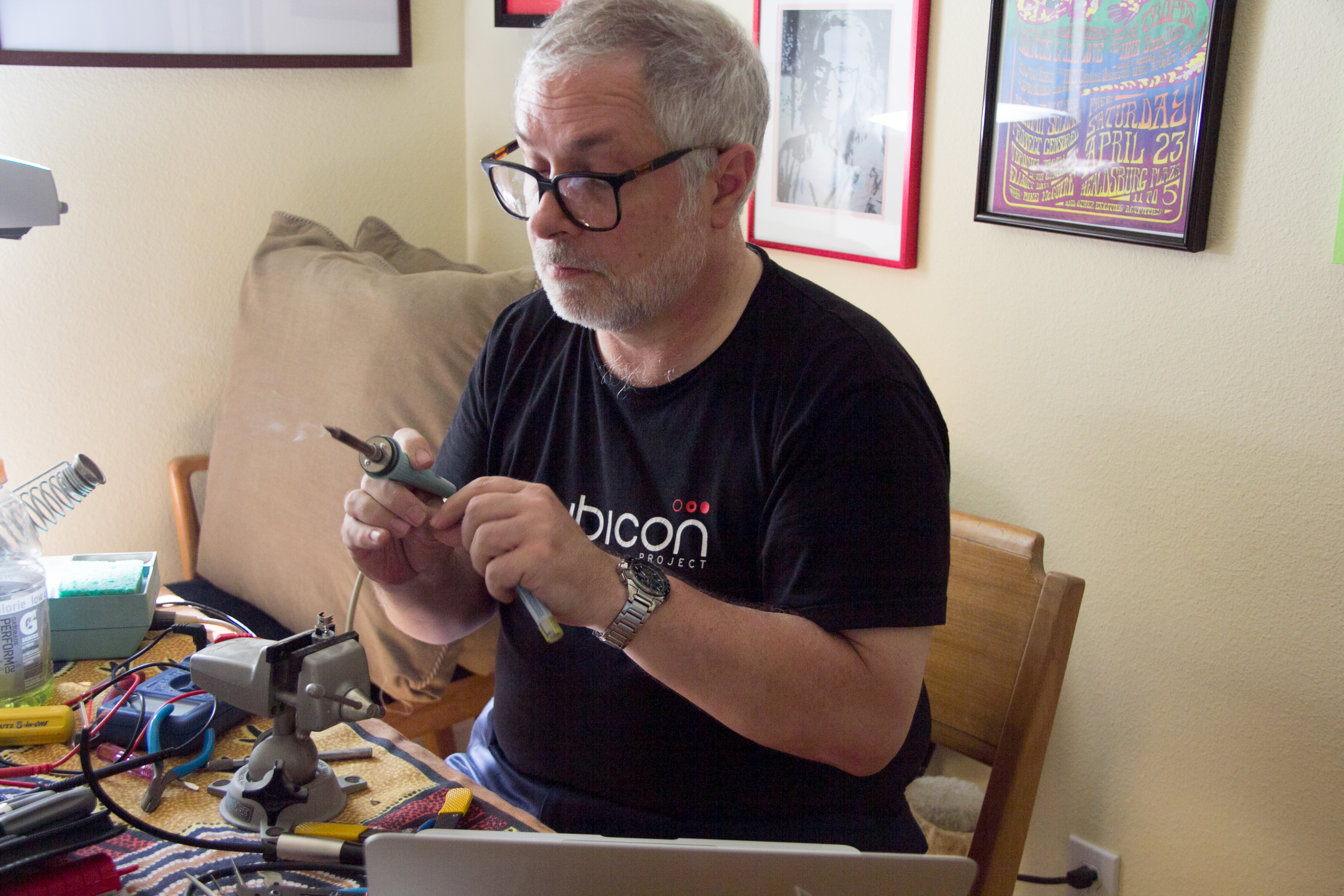
Indeed, back to Radio Shack, where they didn’t have two-conductor shielded cable either. But they did have a 25-foot microphone cable, with a male XLR on one end, and female XLR on the other! In my devious mind, I would cut that cable into five 5-foot sections, and build five balanced interconnects. I could even reuse the existing connectors on each end of the microphone cable.
The interconnects work beautifully. No buzz, easy routing, positive connections.
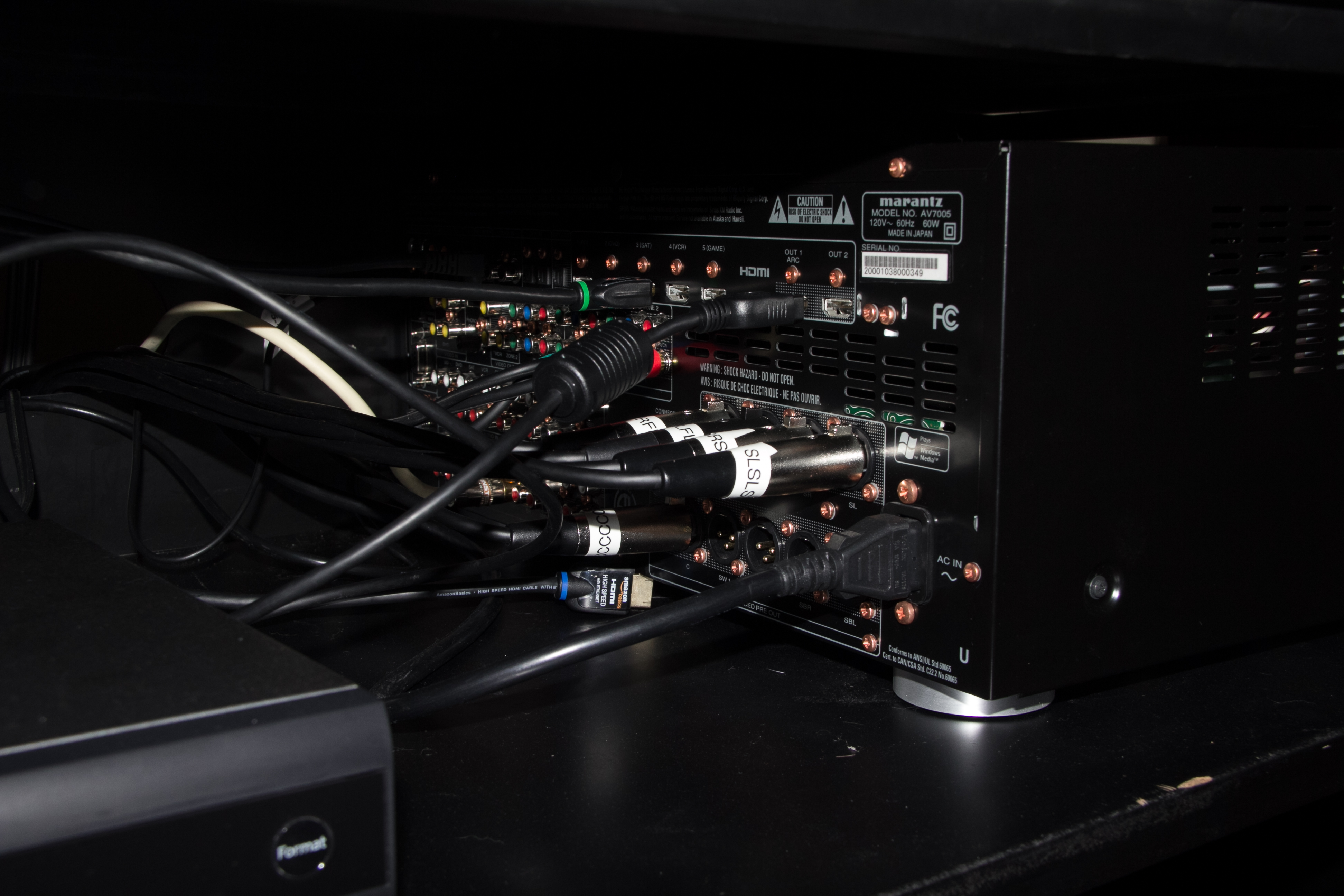
A word of warning: Outlaw Audio agreed to take a return of the five balanced audio interconnects, but stated that their policy doesn’t allow cable returns. Be careful when ordering cable from Outlaw!
Now with audio connected, time to plug in the plasma and check out the receiver’s setup menu.
I hooked up the new plasma HDMI terminal to HDMI “monitor 1” output on the AVR, and was rewarded with … nothing. The screen remained black, though it would flash with changes, and indicate signal present. Connecting the HDMI cable directly to the TiVo gave me a fine picture.
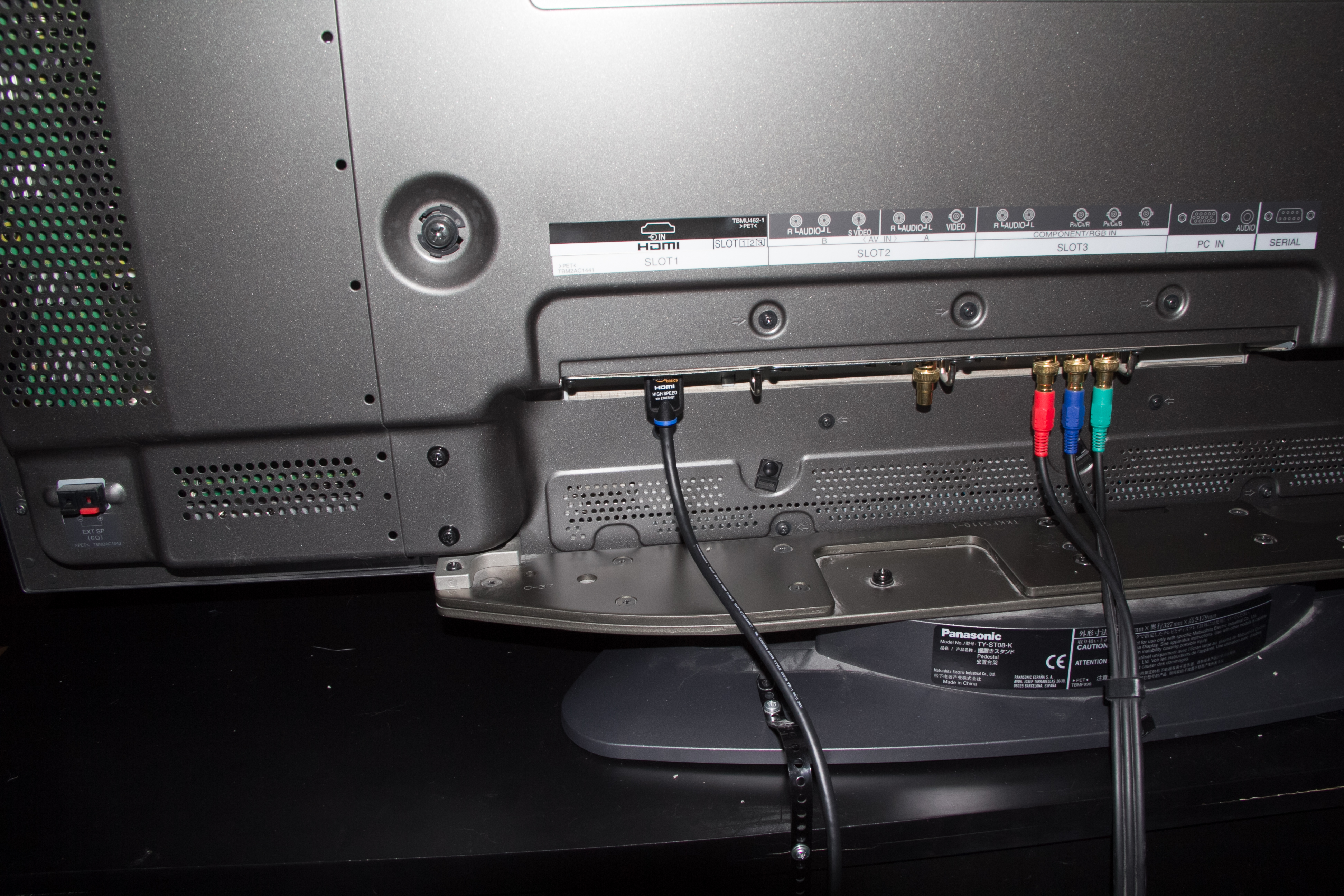
AVS Forum has been a great source of advice during the process. After attempting an “HDCP Reset,” I found that I could get video from the TiVo, through the AVR, to the plasma, at startup, for about one minute — even with the AV7005 menu superimposed nicely. After that, the display goes back to black and stays there.
I’m quickly learning that HDMI is not the promised land I had hoped! Compatibility is a serious problem between sources, switches, repeaters, and sinks. Some experts have found ways of working around some of these problems by using switches and tricking the sources into seeing a different EDID (I’m guessing that’s Effective Device ID).
I’m still working this problem, and this post is already way too long. I’ll continue my trials and tribulations in new posts.
Update: Saturday evening, everything points to the Marantz receiver as having trouble outputting HDMI signals.
I started out with an IOGEAR Wireless HD kit (GW3DHDKIT) to get video to the projector. The transmitter and receiver would never sync with each other. I ran out to Best Buy for a replacement, and ended up with a different brand instead: an ActionTec MyWirelessTV. It’s working beautifully.
With my three sources, I can send HDMI video with no problem to either the plasma display or the projector via the wireless link. If the receiver is in the middle, all I get are black screens.
I’ll post here how my dealings with Outlaw and Marantz go. If I have to return the receiver for service, that’s kind of a big deal!
Like so many of us, I need to lose weight. My doctor at Kaiser referred me to a new in-house weight loss program, a low-calorie “meal replacement” program. The program appears to be a franchisee of Robard Corporation’s “New Direction” program.
The program itself is very good. The class materials are current and instructive, and the high-protein shakes and bars are good quality.
But Kaiser’s management of the program has been incompetent at best, fraudulent at worst.
Unfortunately, I have no leverage with them. I pre-paid for 16 weeks of product and weekly classes. My first meeting was on October 22.
Things were fine on the program. By my eighth weigh-in on Dec. 10 I had lost 18 lbs. On that day our contact warned me that they were out of the most popular meal replacements, but promised they would be available soon. Okay, I could suck it up and get by on some of the more boring shakes and bars for one week.
The Dec. 17 meeting was going to be a big one, because our group’s next two meetings would be on Christmas Eve and New Year’s Eve. They would not hold meetings on those days, and we would have to pick up a three-week supply of product. Now the “shortage” of the popular flavors was a problem, because I would have to suffer through three more weeks of the Robard product I didn’t especially care for.
The Kaiser rep apologized sincerely, and offered to do what he could to trade in my undesired product for what I wanted. He gave me a phone number and an email address to reach him and arrange a replacement. Meanwhile everyone in my Monday evening class was told to enjoy the holiday and we would meet again in three weeks, on Jan. 7.
Over the next week, approaching Christmas, my emails went unanswered. I called the phone number he gave me to learn that he was on vacation and couldn’t be reached.
But wait, it gets worse.
Monday, Jan. 7, myself and four other weight-loss students waited patiently in a Kaiser Pasadena waiting room, only to learn that no one would be there for our class or to provide product. The five of us left our phone numbers, talked a nurse into letting us in to weigh ourselves unofficially on our favorite scale, and congratulated each other on making it through the holidays successfully.
One of the keys to successful dieting is developing good habits — getting on a roll and sticking with it long enough to be successful. We were now having our 16-week program interrupted, and all of that momentum erased for a week.
Finally three days later, someone from the program called to tell me that my class had been changed from Monday to Wednesday evenings, and our next meeting would be on Jan. 16. That’s nine days off program.
Finally we met on Jan. 16 and again were told that they were low on inventory and did not have my choice of the New Direction product. Somehow the manager managed to “find” one week’s worth of my favorite choice, and I crawled back on program.
Now we come to the final insult, at the Jan. 23 meeting, with four brand new weight-loss students, and a very apologetic staff. The regular program runner had called in sick, and they were out of several flavors of the available shakes and bars. They had someone there to fill in and take our orders. When she couldn’t give me first choice, she offered a replacement which I accepted, but then disappeared without ever delivering it.
So this past week I have again been off program.
At the Jan. 23 meeting, our meeting leader promised many times that we would be called the next day to make arrangements to get us product. As you can guess, I have had no phone call.
Sadly I have no leverage with Kaiser other than this blog post, and some effort to embarrass them publicly. Having pre-paid for the 16 week program, I know they will find some way to at least provide the physical product I paid for. Because of their change in class schedule, the Wednesday evening classes conflict with a class I am teaching for Pasadena City College, and I will not be able to attend the classes, only drop in, weigh in, and pick up product.
Like I said, the program is a good one. I can’t imagine how the management of it could have been worse.
My only recourse is to advise my doctor to reconsider before making any new referrals to the program. I will also copy the Robard Corporation with my complaint and recommend that they consider revoking their product license with Kaiser for the horrible service.