
Mojo's blog banner

Tag: AP180

  • Many firsts at GMARS

    Many firsts at GMARS

    Observing report, February 23, 2020

    This would be my first night observing from a powered telescope pad at GMARS, Riverside Astronomical Society’s Goat Mountain Astronomical Research Station, in Landers, CA. It was a beautifully clear but cold February Sunday evening. It was also the first real observing night for a new mount, plus a new and unfamiliar collection of astrophotography tools.

    In preparation for the night, I’d spent hours setting up and practicing with the hardware and software at home. I felt like I’d accomplished everything I could with the hardware and power distribution. Everything was working well.

    My astrophotography computer was another matter. While Jane and I enjoyed traveling for our first year of retirement, my familiar inexpensive Asus laptop hadn’t been turned on for about a year. With any Windows PC, that leads to an immediate trip through “update hell.” Not only did I need hours of download and update time, the internal battery was completely toast.

    Getting the battery replaced turned out to be painless, and during the downtime I was able to research the more modern tools imagers were using to navigate and capture data. I was ready to move past the old days of ST-4 guiding, into the world of ASCOM and PHD2.

    The new mount is an Astro-Physics AP1100 GTO. It was acquired to support our mammoth AP180EDT refractor, replacing a somewhat aging and clumsy AP900 mount. I had only used the big refractor once to capture decent images over ten years ago, and had been unsuccessful since that time.

    The AP1100 GTO is truly decades advanced from the old mount. It feels elegant and precise, even with the massive telescope on top. I added power and data distribution from Kendrick, and I was able to reduce the number of cables from computer to telescope to one USB 3.0 cable.

    There was a clear night coming, leaving me with the mild anxieties of an unfamiliar site, on a “school night,” carrying a telescope that needs two people to mount into its rings and unload into its case.
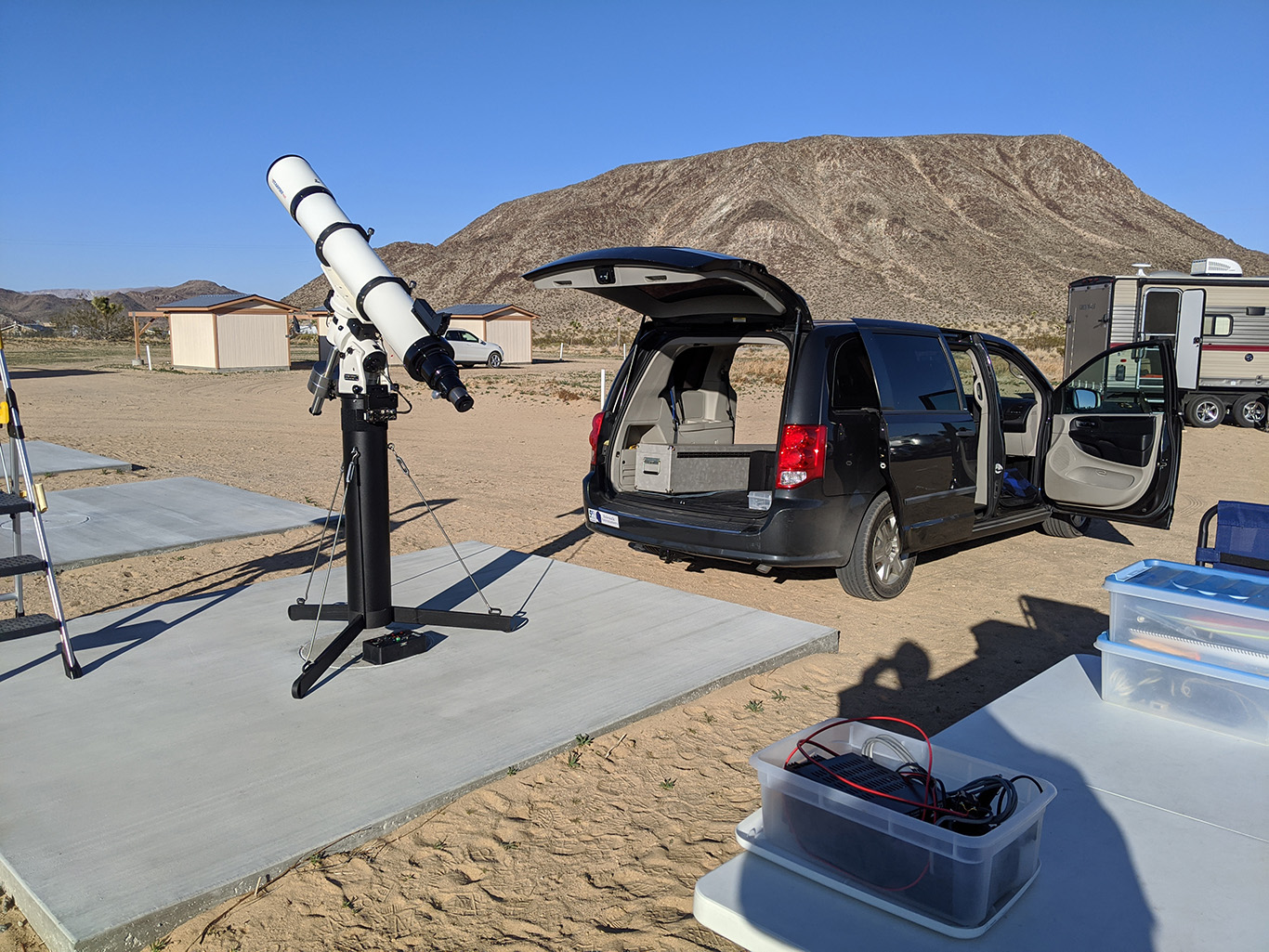
    AP180 telescope and mount.
    The AP180 EDT on its new AP1100GTO mount and portable pier.

    I arrived mid-afternoon and parked at my newly assigned pad, discovering plenty of friendly company — even some old friends from our in-town Sidewalk Astronomy group, Kay and Ken Hoevel. They were happy to help lift the telescope tube, and even insisted on feeding me marvelous grilled steak kebabs in the gorgeous evening twilight.

    I made lots of other new friends, discovering shared interests that seem common among astronomers — things like airplanes and ham radio.

    Kay told me one of her discoveries about GMARS: No matter what it is you left at home, there’s usually someone there who has one to lend you. In my case, it was a red flashlight, and a replacement 3V lithium battery. She managed to find spares of both in her kit.

    I spent a wonderful time under a clear dark sky. I had a comfortable observing chair and binoculars to enjoy the winter Milky Way while the camera was capturing ancient photons. The chatter of nearby observers was familiar and comforting.

    The new mount and old camera were both working like a dream. I was able to bounce around the late-winter early-spring sky, shooting 30 minutes of data on several old favorites for practice. I wrapped up about 1:00 a.m. by taking some flats to calibrate the data. I was ready to get out of the old. I couldn’t sleep though; I spent another few hours in my warm van doing some data reduction and stacking, relearning all my rusty skills.

    The night was beautifully clear, but the seeing matched the forecast of fairly poor. That would be evident in the large stars and soft detail in the images. I’m still delighted with the results, and excited about the prospects.

    Here are the targets for the evening:

    My first selection was a bit ambitious. With the f/6 Traveler it’s difficult to get enough pixels on small planetary nebulae to render much detail. I wanted to see how the f/9 180 would do. I chose the Eskimo, NGC 2392, in Gemini. The full field still dwarfs the little planetary, but look how much detail is visible in a full-resolution crop.
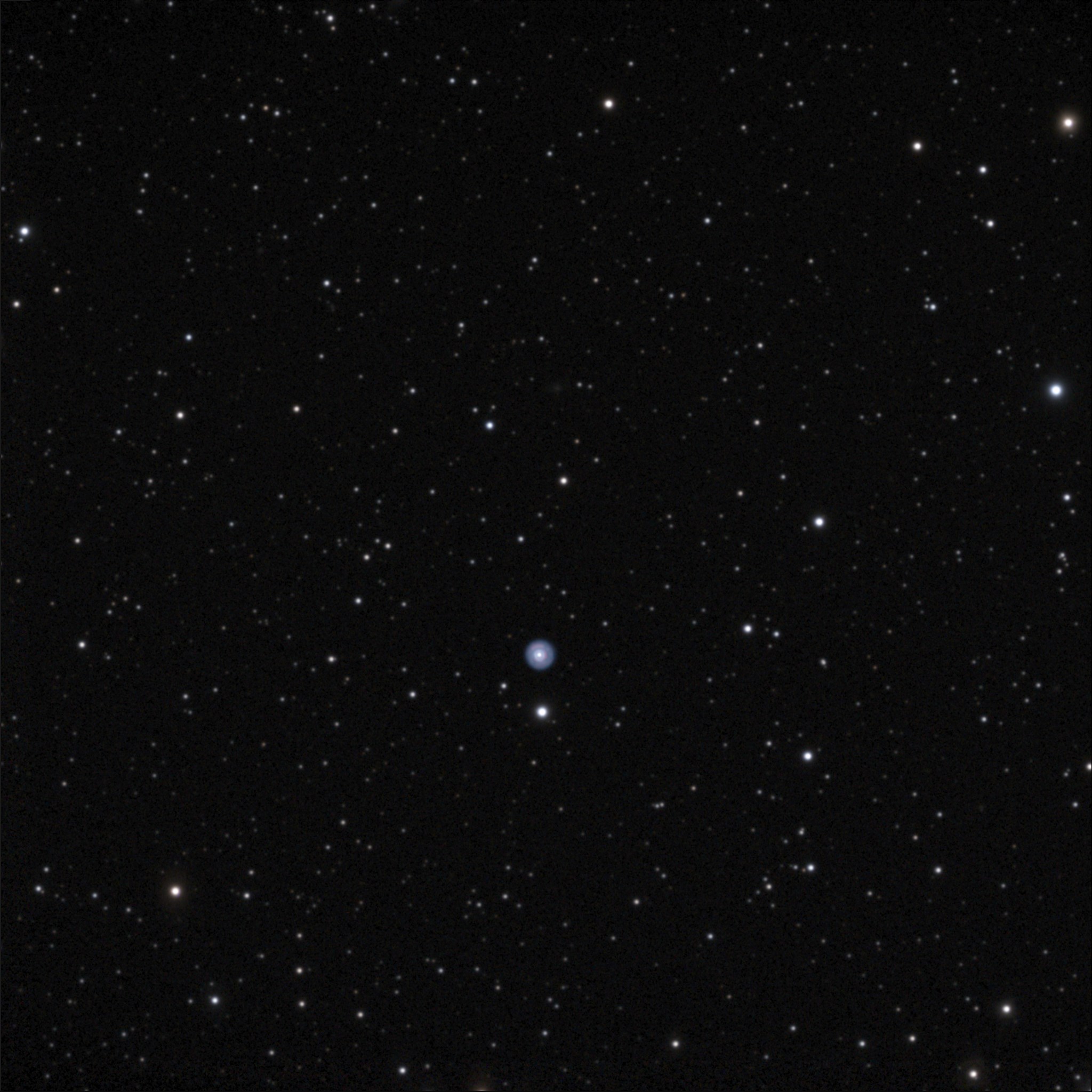
    NGC2392
    The Eskimo, NGC2392, planetary nebula in Gemini

    Here’s the cropped center of the image.
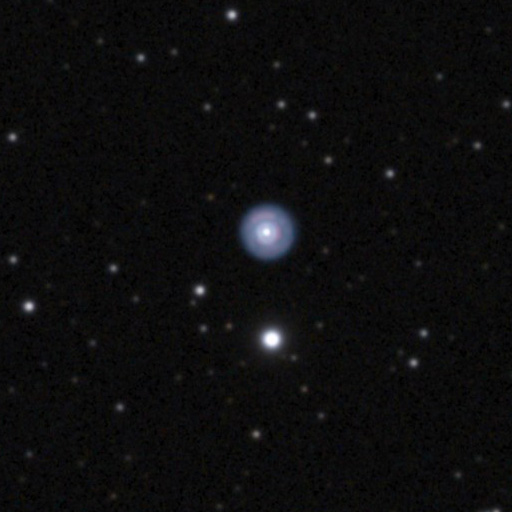
    NGC 2392
    Center full-resolution crop from the full-field NGC 2392 above, showing the interesting detail in the Eskimo.

    Ursa Major was in prime position, so I thought I’d grab several favorites from there, starting with M51 the Whirlpool.
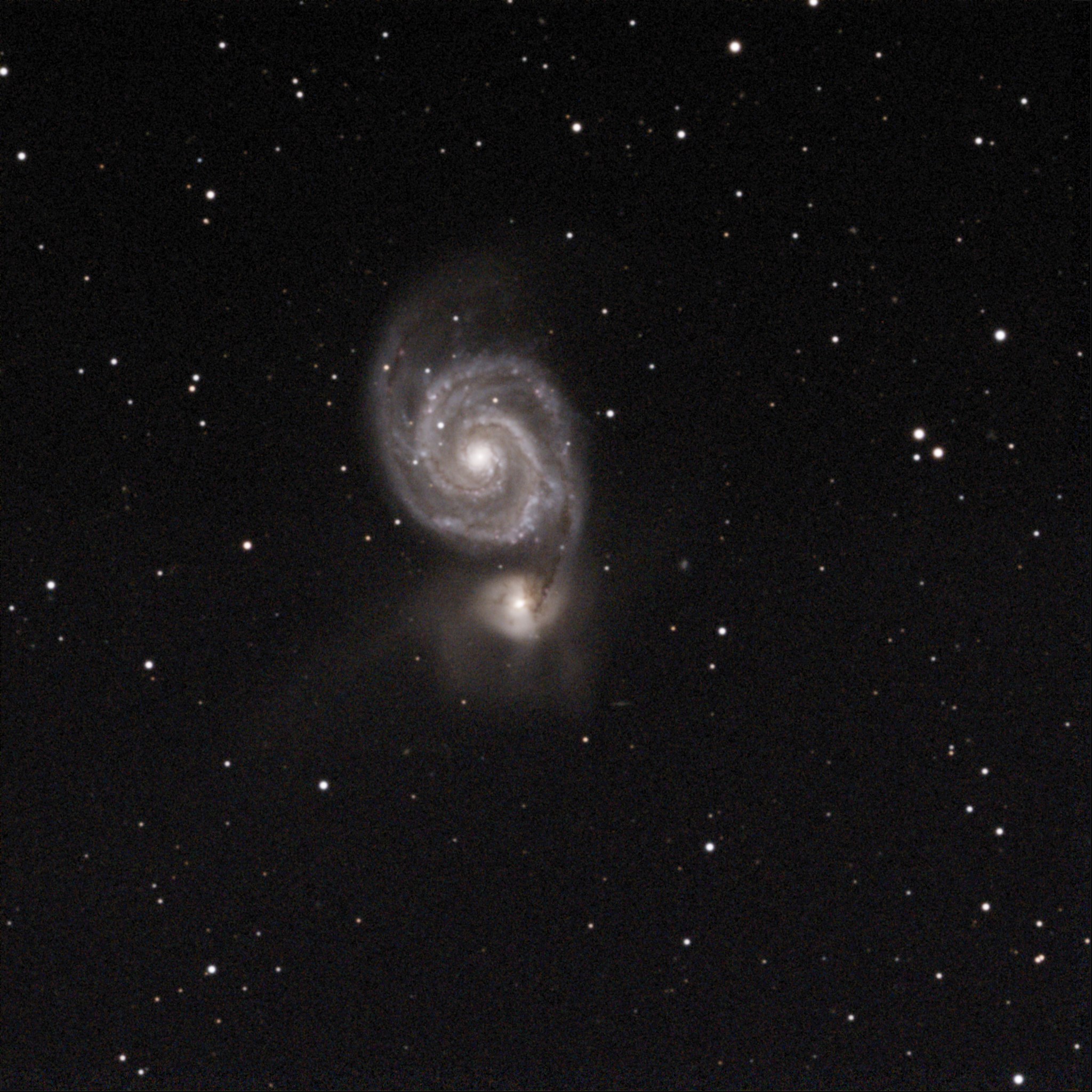
    M 51
    M51 the Whirlpool Galaxy in Ursa Major.

    In the big long-focus telescope, M81 and M82 won’t fit in a single field, so I had to capture them separately. Well worth doing. Here’s M81:
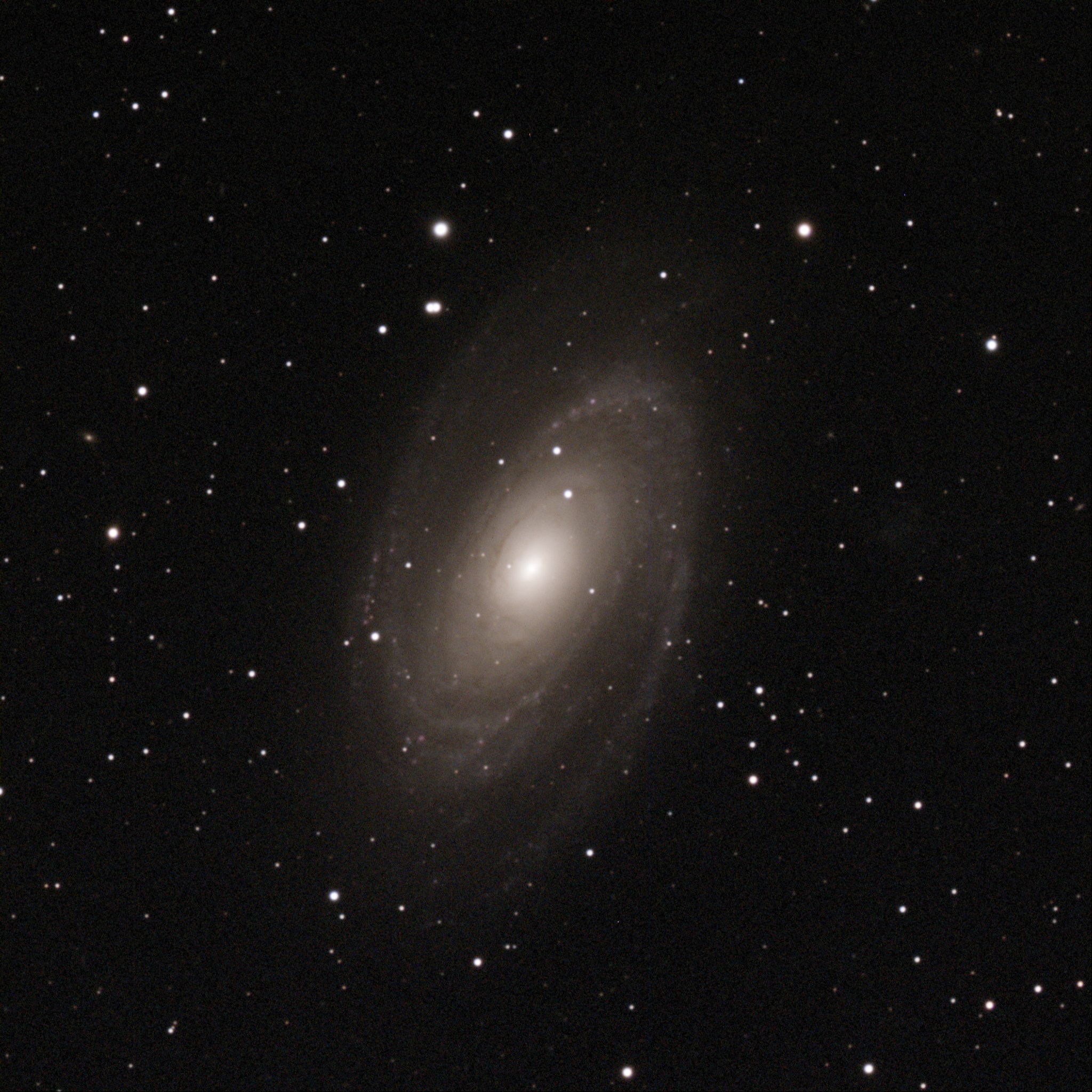
    M81
    M81 spiral galaxy in Ursa Major

    M82 also reveals lots of detail in the tangled center of this irregular galaxy:
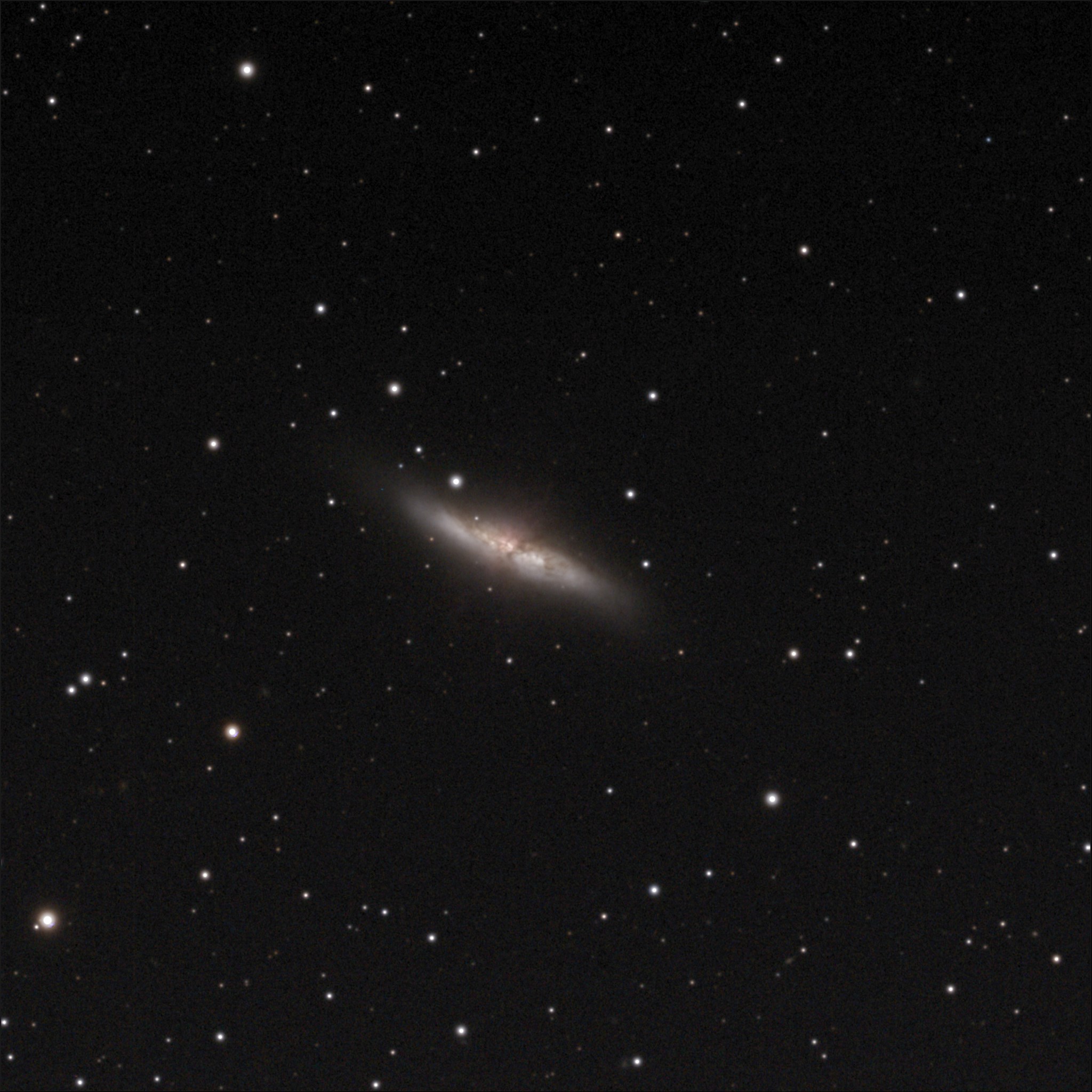
    M82
    M82 irregular galaxy in Ursa Major

    Seeing Coma Berenices rise in the dark eastern sky, I knew i had to grab the edge-on spiral NGC 4565:
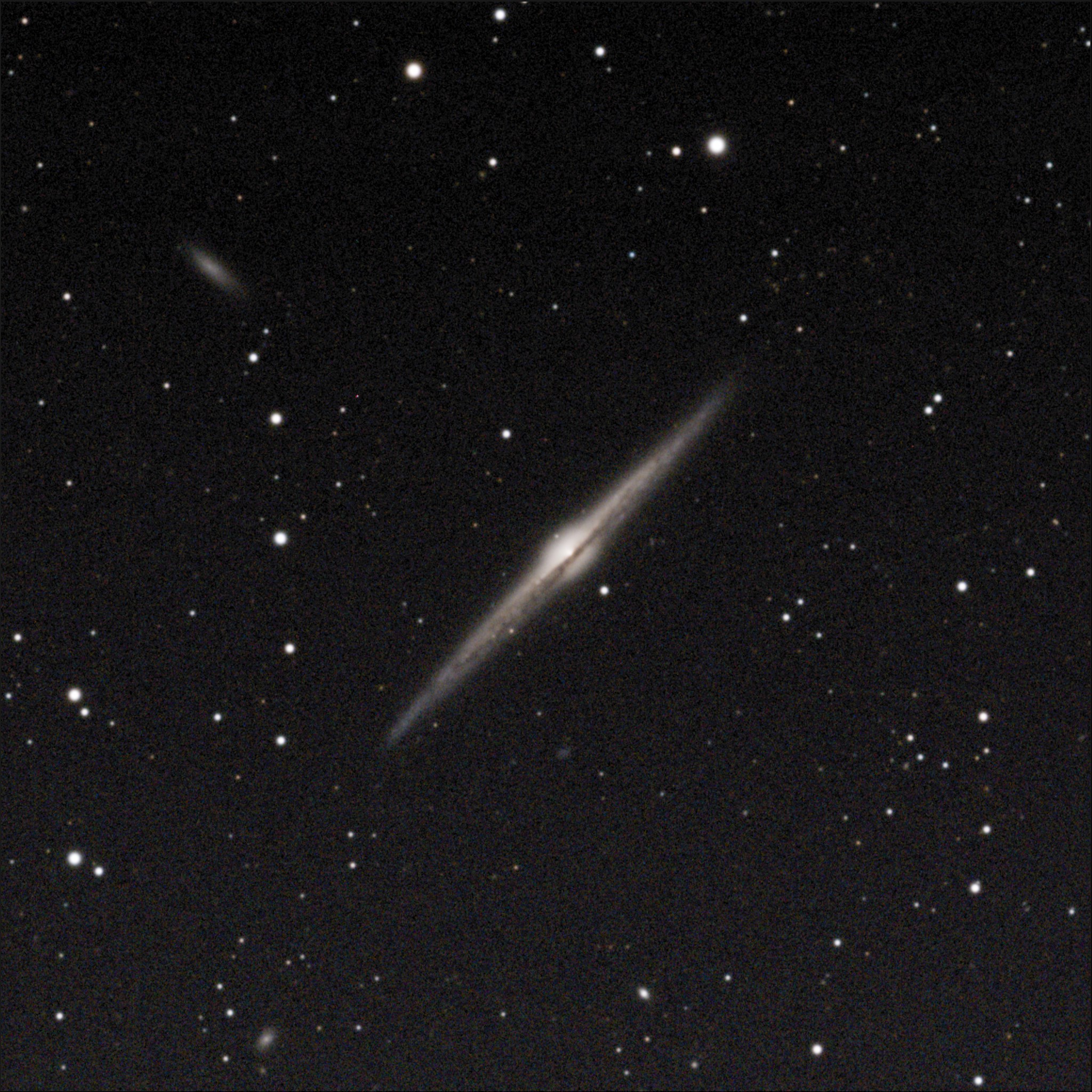
    NGC 4565
    NGC 4565 in Coma Berenices

    Clicking on any of the images above should give you the full 2048×2048 image.

  • Finally autoguiding

    Full photo album of setting up and astrophotos here at the Whiteoaks Photo Album.

    Update: Here’s Jane’s version of the same evening. 🙂

    It was another perfect new moon Saturday for a trip to our favorite spot in the Colorado Desert out I-10.

    Yes this is a very full Grand Caravan!
    Yes this is a very full Grand Caravan!

    Jane and I happily took out all the seats of the old Grand Caravan and filled it with telescopes and gear. We brought her 17.5-inch Litebox dob, and our AP180EDT f/9 refractor.

    Jane has been indulging my dabbling in astrophotography lately. I’ve been delighted that Jane is using some of my astrophotos for the What’s Up podcast, lucky that she wants imperfect images that are closer to what one might actually see in an amateur telescope.

    This 180mm f/9 refractor should be an outstanding astrograph; it’s certainly an amazing visual astronomy instrument. I dabbled with it a little last year in Anza Borrego, knowing I needed to learn a lot of operating technique to get some good results. I solved a few mechanical problems then, and ran into autoguiding calibration later. Those lessons served me well, even though it’s almost a year later.

    Early in the evening was Jupiter time, and we all spent some time soaking up the gorgeous views through a binoviewer in steady seeing. 300x on Jupiter showed lots of detail in the bands, including a nice red barge in the North Equatorial Belt, and nice little disks and color on the moons.

    I’m going to take a few paragraphs to talk shop, gadgets, problems, and solutions.

    Setting up the AP180, all ready to take flats, except theres no known focus position!
    Setting up the AP180, all ready to take flats, except there's no known focus position!

    My camera is an SBIG ST-4000XCM single-shot color CCD camera which perfectly suits my recreational needs. The big AP180 is mounted on an older 900QMD mount, a simple but stable platform without GOTO electronics or servos.

    The 900QMD mount comes with digital encoders on the R.A. and Dec axes, but having spent several years using this telescope for primarily lunar and planetary observing, those encoders went unused for the life of the mount.

    The R.A. axis encoder is removable so you can use a polar alignment scope, and the encoder shaft has a slip fit into a metal sleeve when it’s in place. Last year I discovered that this mechanical connection slips very easily, rendering the encoder useless.

    The trick I settled on, which worked again tonight, was to cut a little piece of rubber band and push it into the fitting to serve as a tightener.

    Jane aligns the Telrad on her 17.5-inch Litebox
    Jane aligns the Telrad on her 17.5-inch Litebox

    To use the digital encoders for pointing, I acquired a BBox from JMI, connected that to a USB-Serial adapter, and used Software Bisque’s TheSky 6 to serve as my controller. I’ve learned by experience (at Fremont Peak observatory) that the alignment doesn’t need to be 100% perfect. I’ve learned the trick of syncing the software and encoders to a bright star near my target, then doing an accurate short slew to my actual target.

    (One problem I haven’t quite solved yet is play in the polar scope. I haven’t figured out how to tighten the polar scope in position, in the correct orientation, so it doesn’t wiggle.)

    So with a not-quite-perfect polar alignment, autoguiding becomes my essential partner. CCDSoft can be tricky software to work with when calibrating the autoguiding. The error messages and manual don’t really help solve problems like “Illegal motion in X-axis, error 352.” I thought I might even be dealing with a problem in the mount mechanics. In retrospect, I think I also hadn’t learned the correct switch settings on the QMD controller. (“Guide” and “.5” works much better than the 16x slew mode for visual!)

    On perusing the Software Bisque support forum last week, I was able to learn that their autoguiding calibration depends entirely on there being only one bright star in a large region of the guide imager. While I could see the guide motions working perfectly and orthogonal, the software doesn’t do matching of the star field, only looking for the one significant guide star.

    Having discovered that, I was finally able to successfully calibrate the autoguider. And with one successful calibration (remembering to set the current declination), I could autoguide on different targets successfully for a long time.

    (The Software Bisque manuals hint that there’s a way to link to TheSky so CCDSoft knows the declination of its target, but I haven’t figured that out yet.)

    M74 two 15-minute exposures, SBIG ST-4000XCM, 180mm f/9, October 17, 2009
    M74 two 15-minute exposures, SBIG ST-4000XCM, 180mm f/9, October 17, 2009

    Pisces was high overhead, and I love M74, so I decided as a first target to revisit that favorite. I settled on 15-minute exposures. The first one came out “double vision” when the autoguider momentarily lost track during the exposure, but that was the only time that happened during the evening.

    NGC7541 in Pisces, 15 minutes
    NGC7541 in Pisces, 15 minutes

    A visit to the Night Sky Observers Guide suggested NGC7541 as a Pisces “showpiece,” and I love galaxy groups. This one was gorgeous in Jane’s 17.5-inch, too.

    NGC7640, 15-minute exposure
    NGC7640, 15-minute exposure

    Jane showed me NGC7640 in her 17-inch, a really lovely look, and I thought it would be a great target. We’re starting to enjoy comparing visual and imaging views.

    NGC253, 2x15minute exposures
    NGC253, 2x15minute exposures

    I admit I get impatient when I’m imaging, and want to collect more targets rather than more exposures on the same target. As a result, I have a little more noise in my images, but I’m having fun anyway. That said, I couldn’t resist spending some time on NGC253, the Silver Coin galaxy. I had a tantalizing glimpse of this target last year at Anza Borrego when I hadn’t yet learned how to make the autoguiding work. This time I got two lovely 15-minute exposures. Well worth it.

    Pre-dawn crepuscular rays at Chuckwalla Bench
    Pre-dawn crepuscular rays at Chuckwalla Bench

    After a few hours sleep, we were greeted with lovely pre-dawn crepuscular rays, Venus, and Saturn making its return after solar conjunction. Not to worry, the telescope was capped, and about to come down into its box, anyway. (You can see the box ready to be loaded with telescope.) Jane paused to take this lovely picture.