Mojo's blog banner

Tag: Pegasus 1

  • Double your pleasure …

    Chuckwalla Bench, Colorado Desert, California, 29 October 2011

    As promised, last weekend was the first of two excellent dark sky weekends this month. The weather turned out to be perfect for this one as well.

    Jane and I went to our old favorite spot off I-10, Chuckwalla Bench, on BLM land south of Joshua Tree in the Colorado Desert. We were joined by Dave Hasenauer and his dob.

    Bad news about Red Cloud Rd., the dirt road we take to our favorite spot. The road is sadly in need of some maintenance. Portions of the road are very treacherous with deep ruts and deep sand. We didn’t encounter any problems this trip, but it will be a worry.

    We had crystal clear skies all night, with temperatures around 85°F at sunset, dipping close to 50°F in the wee hours.

    The evening twilight featured Venus in its new evening apparition setting in the west, Mercury just below, with Jupiter one day after opposition rising in the east.

    Early in the evening while spotting satellites, we managed to catch a bright fireball meteor (7:22 p.m.) probably around magnitude -10. I saw a double terminal burst from the fireball, which traced from Cassiopeia through Triangulum. It left a persistent train that was visible for several minutes in binoculars and Dave’s telescope.

    Jane even indulged in a little afocal astrophotography capturing some splendid crescent moon shots on her point-and-shoot camera.

    I had a couple of “firsts” in my astrophotography accomplishments, doing my first successful drift alignment when my polar alignment was slightly off, and finally successfully capturing useful “flats” for image calibration in the morning twilight.

    I also had a brainstorm about how to process the color data from bright targets without data being clipped in the bright areas. With that in mind, first let me revisit my M31-M32-M110 the Great Galaxy in Andromeda from last week, this time in full color.
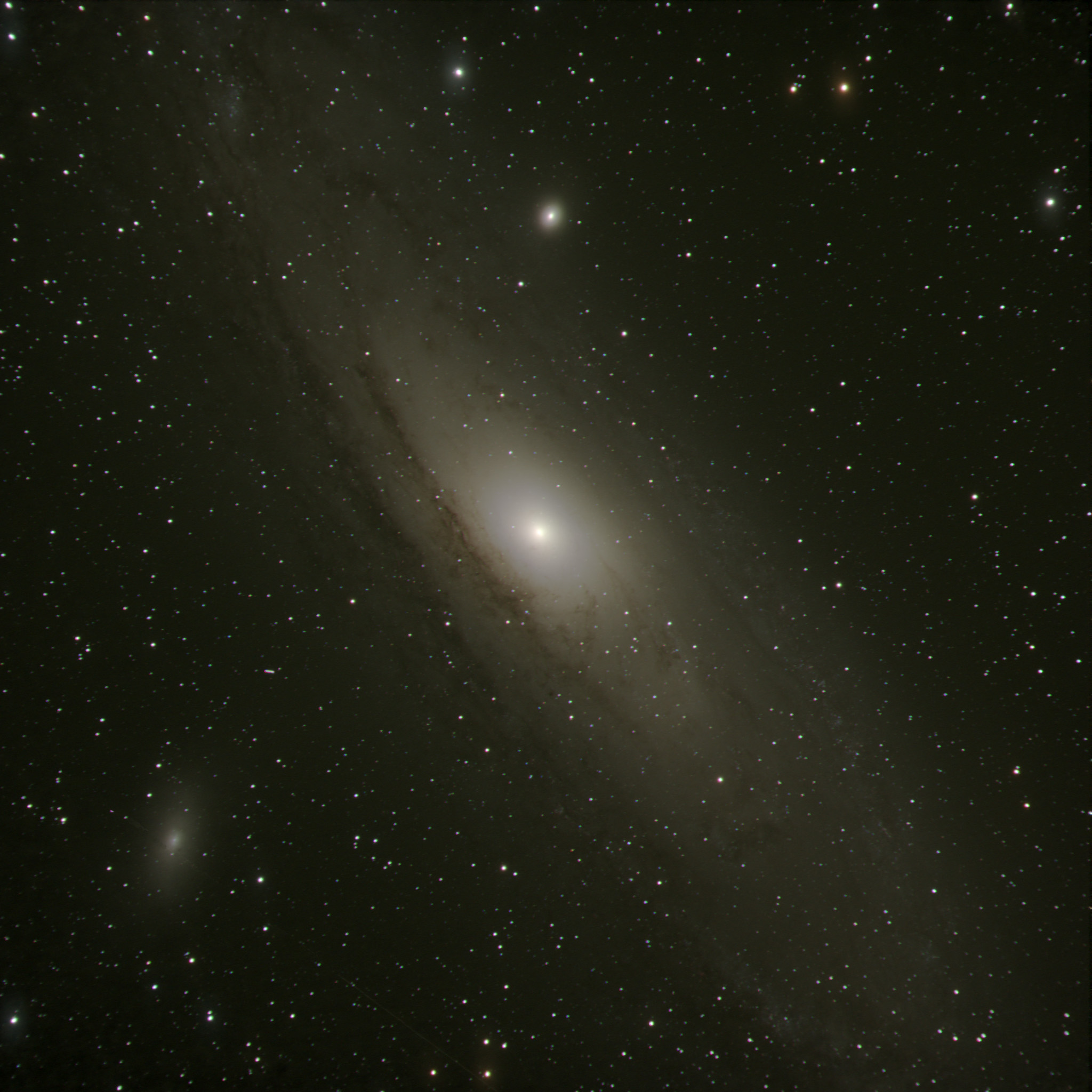
    M31 - M32 - M110, the Great Galaxy in Andromeda
    M31 from 22 Oct. 2011, 4×15 minute exposures

    (For all the images, click the image for the full-resolution version.)

    And I promised to revisit the Pegasus 1 galaxy cluster, this time giving it an hour of exposure, which it fully deserved. Here’s the full field first.
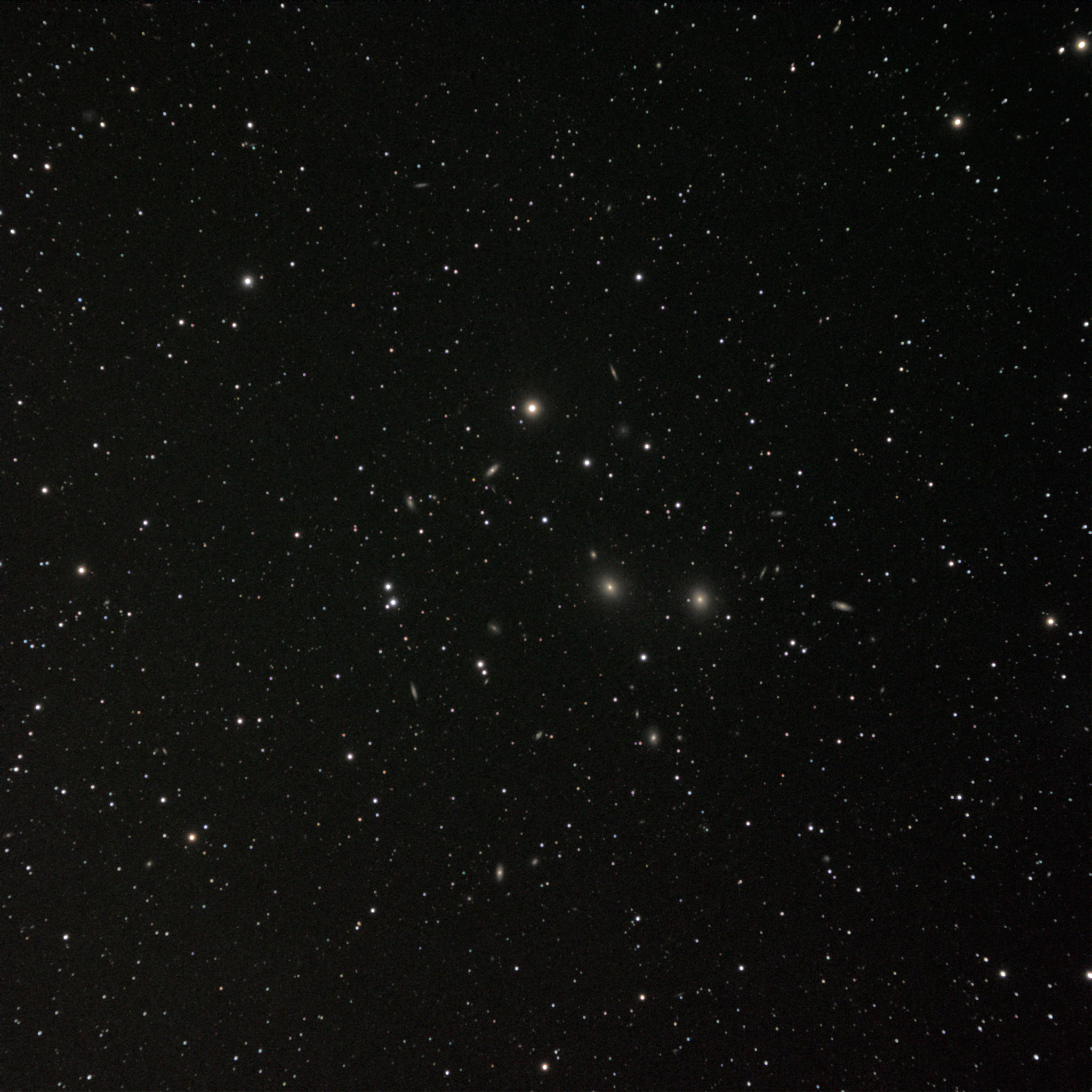
    Pegasus 1 Galaxy Cluster
    Pegasus 1 Galaxy Cluster, click for full-resolution.

    The one-hour exposure time cuts down the noise nicely, and calibrating it with a good flat field removes the vignetting. Check out this detail from the center of the cluster at full resolution:
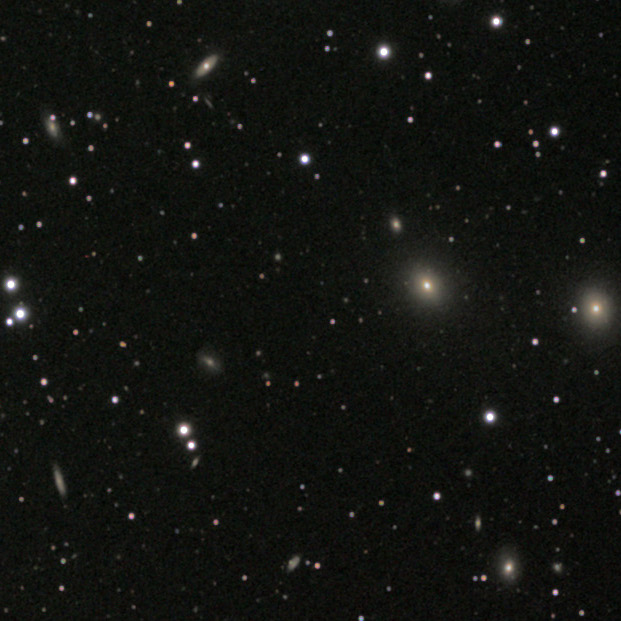
    Pegasus 1 galaxy cluster detail
    Pegasus 1 galaxy cluster detail

    Jane was observing this delightful face-on S-shaped spiral galaxy, NGC7479. It was such a small target that I didn’t think my short-focus 4-inch would do it much justice. It turned out to be a delightful crop with lots of detail.
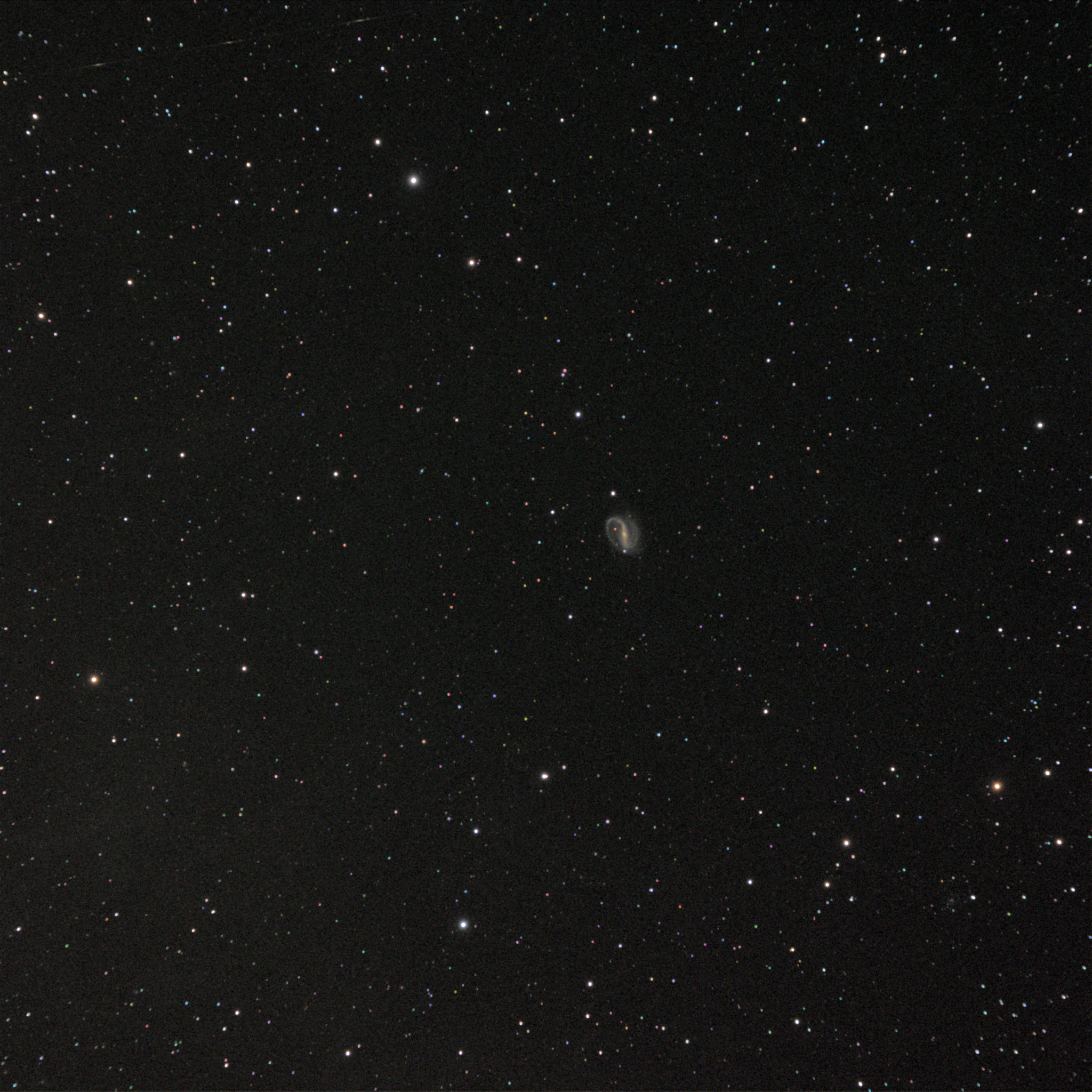
    NGC7479
    Detail of NGC7479, click for the full field, 15-minute exposure

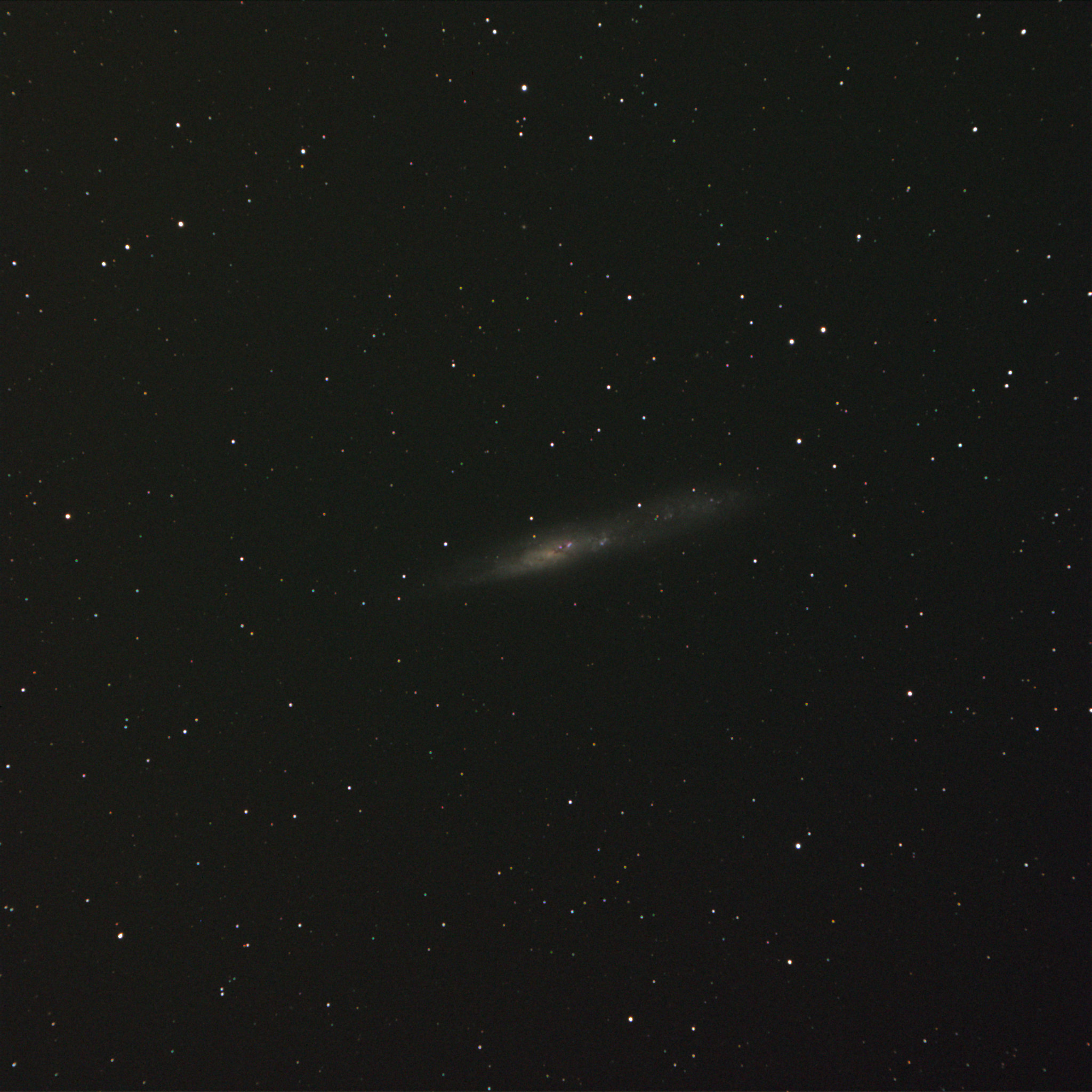
    Another surprisingly good image came from NGC55, a fabulous extended galaxy, so far south in the sky that it’s rare to be seen by northern-hemisphere astronomers. Complicating matters is a light dome from Inland Empire cities that encroaches on our southern horizon. Nevertheless, my 15-minute exposure was worth passing on. The full-resolution shot is very nice with lots of detail.
    NGC55
    NGC55, one 15-minute exposure, through a bit of "foreground" light pollution.

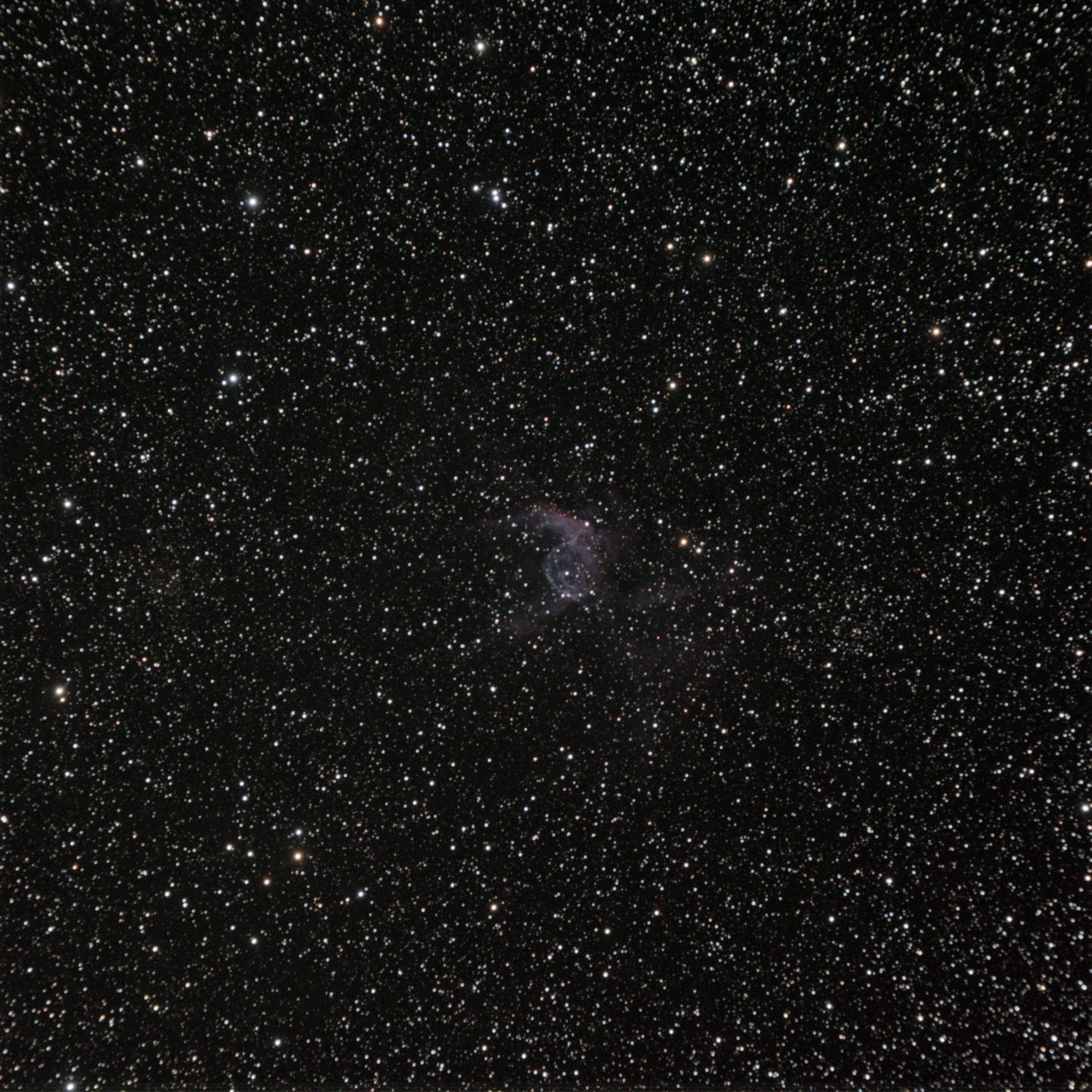
    Jane also suggested one of her favorite difficult winter visual targets, NGC2359, known as “Thor’s Helmet.” I collected an hour’s worth of photons. Here’s the detail from the center of the field, click for the whole thing.
    NGC2359 "Thor's Helmet"
    NGC2359 "Thor's Helmet," 4×15 minute exposures, detail from the center of the field.

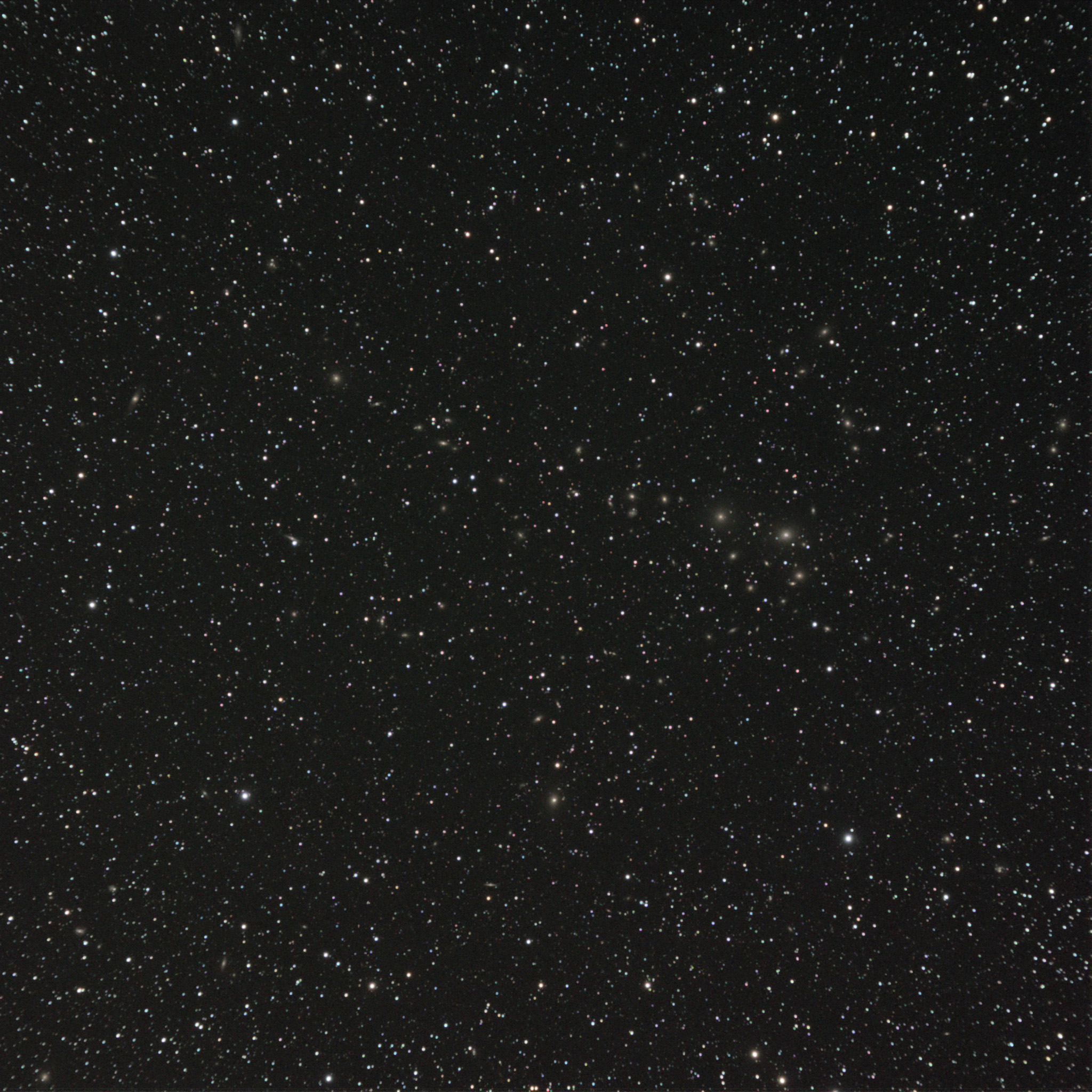
    I’ve long been fascinated with distant galaxy clusters, and they’re very difficult visual targets. Some find them to be uninteresting photography targets. I opted to try 30 minutes on Abell 426, a massive distant galaxy cluster in Perseus. Here is some detail from the center, but the full field is full of easter eggs.
    Abell 426 Galaxy Cluster
    Detail from the Abell 426 Galaxy Cluster in Perseus. Click for the full field.

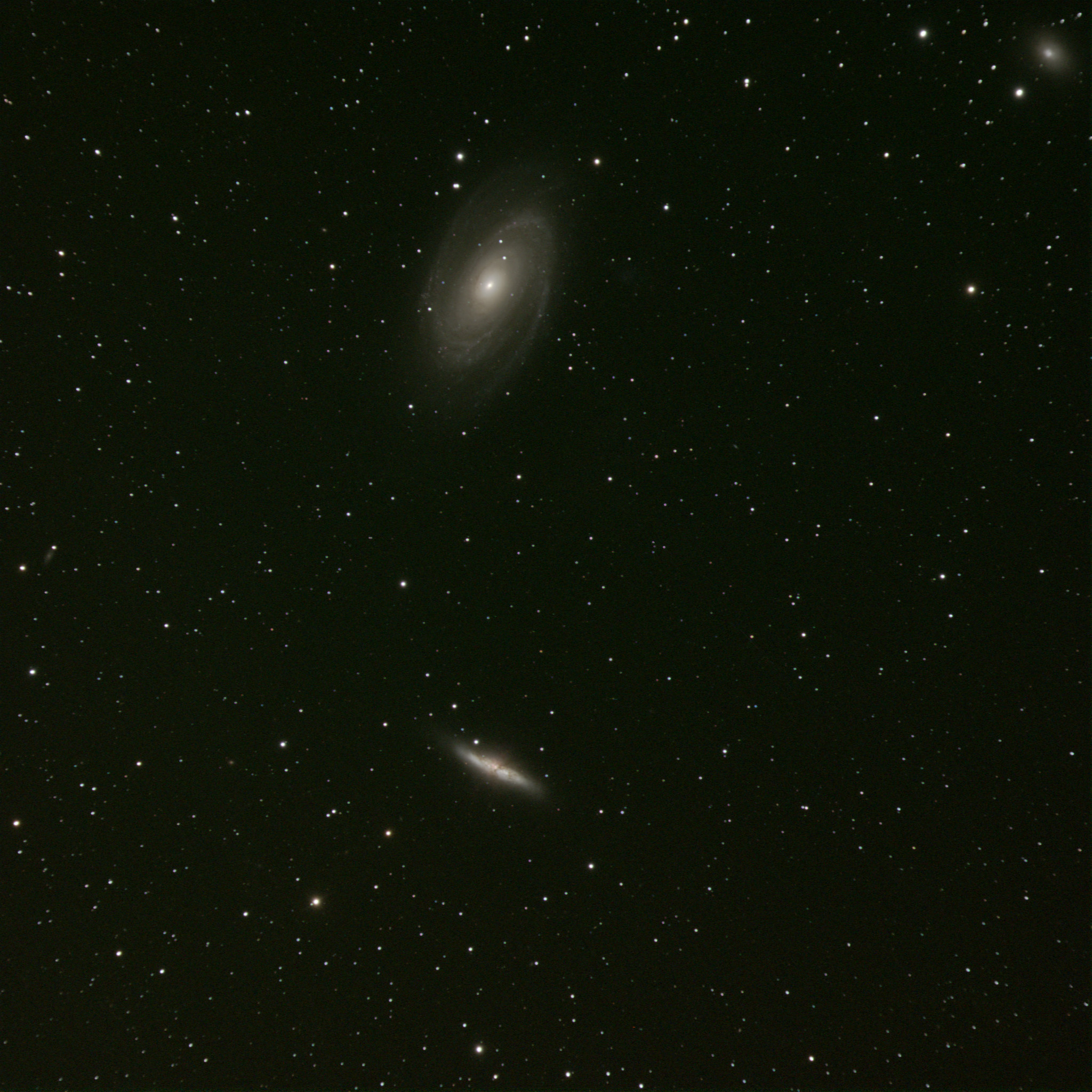
    My last target of the evening was to be an indulgent treat, the M81-M82 galaxy pair in Ursa Major. My mount battery finally quit just at the end of the second exposure, and morning twilight was about to arrive. A fabulous end to the evening.
    M81 - M82
    M81 the spiral (a.k.a. "Bode's Nebula"), and M82 a peculiar active galaxy, in Ursa Major


  • Observing at Amboy Crater

    Observing report, October 22, 2011

    Full photo album with site pictures here.

    Amboy Crater National Natural Landmark
    It's very easy to miss this sign from National Trails Highway, the delightful old U.S. Highway 66.

    This month is blessed with two very good dark sky observing weekends, and we opted to take the first one at a spot we’ve been thinking about for a couple of years now.

    Amboy Crater National Natural Landmark is a volcano crater in California south of I-40, near the town of Amboy, CA. We first visited the site in the spring of 2010. The hike to the crater was fabulous, and the wildflowers were stunning.

    Our regular site at Chuckwalla Bench is also a Bureau of Land Management (BLM) site, but unlike Chuckwalla Bench, Amboy Crater features a paved road, pit toilets, parking spots, and picnic tables. Here’s a Google Maps link to the landmark and its facilities.

    The downside is that the drive is about 25 miles longer than the trip to Chuckwalla Bench. It makes for about three-and-a-half hours driving each way.

    Astronomically, Amboy Crater is one of the darkest locations in the state, with frequently clear skies and sometimes overly hot conditions.

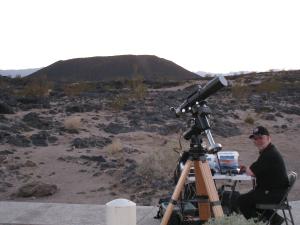
    Mojo with Amboy Crater
    Mojo set up for astrophotography with Amboy Crater in the background.

    This past Saturday evening had a nearly perfect forecast. We arrived on a hot dry afternoon, and enjoyed shirt-sleeve or light jacket conditions all evening with a crystal clear sky. We were joined by one other astrophotographer (Robin), and two seasoned visual observers (Cliff and Steve).

    My astrophotography is extremely casual. Living in the midst of Los Angeles county, I have no desire, nor is there much reason to, have a permanent observatory of any kind. We’ve both become adept at hauling our portable observatory to locations that offer good dark skies.

    Actually we have quite an advantage over astronomers in the eastern half of the U.S. The California deserts offer excellent astronomy, and are within a few hours drive of home.

    My telescope is an Astro-Physics Traveler, 105mm aperture (about 4 inches) with a short f/6 focal length. The mount is an Astro-Physics Mach-One GTO “go to” mount, and my camera is an SBIG ST-4000XCM, the perfect camera for my style of casual astrophotography. It’s a “one-shot color” camera, meaning I can shoot and process color images in a relatively short time, with extra processing to extract the data from the Bayer matrix. It wouldn’t be the best sensor for doing astrometrics or narrow-band imaging with specialty filters, but it’s great for playing around and taking pretty pictures (or trying to!).

    I had shot M31, the Great Galaxy in Andromeda, before, probably with my Canon 20D DSLR, but I wanted to take advantage of my wide field and gather an hour or so of data and see what I could get.

    I enjoyed watching twilight fade and set up with a very good polar alignment. By now I’ve managed to learn the quirks of Software Bisque’s CCDSoft, and was able to calibrate the autoguiding with great success.

    After returning home, I discovered that my first 15-minute exposure was not useable! The brighter stars in the image were fogged, probably by condensation on the CCD sensor glass. I have this mental image of bringing a telescope full of relatively moist L.A. basin air out to the desert, cooling the chip down to -5° C, and having every drop of moisture in that air condense on the chip.

    After the first exposure, the combination of the imager fan and the dessicant plug mounted next to the chip managed to pull out all that moisture and leave me with a dry and clear chip. The dry desert air kept me clear for the rest of the evening.

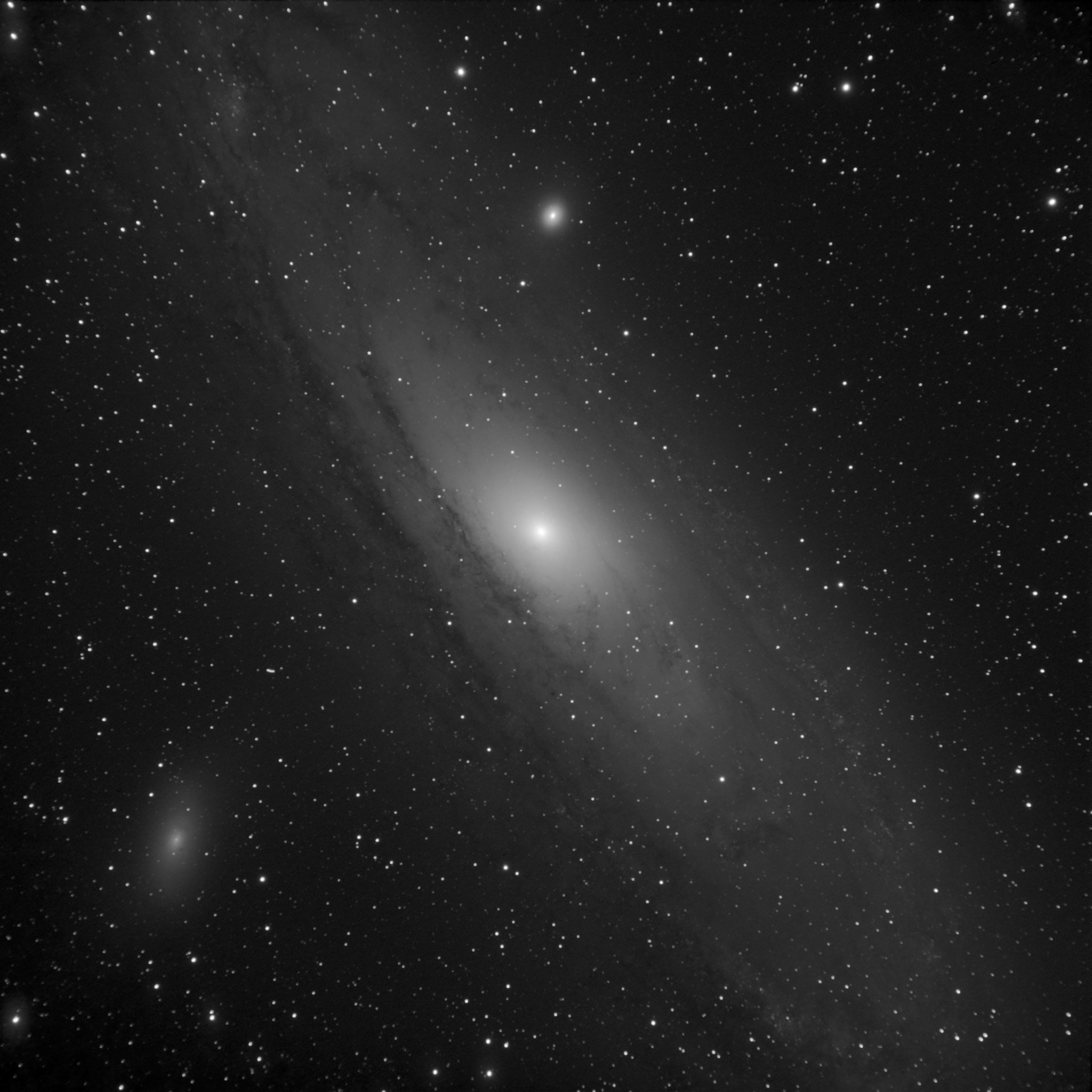
    Here is a luminance-only (monochrome) rendition of my M31 the Great Galaxy in Andromeda

    M31 the Andromeda Galaxy
    The Great Galaxy in Andromeda, M31, with M32 and M110 nearby. 3×15 minute exposures, luminance only. (Click for full 2048×2048 resolution).)

    Now after going to all the trouble of having a one-shot color camera, why am I presenting a monochrome rendition of M31?

    I have a processing problem with the color version that I haven’t resolved yet. This galaxy has an enormous dynamic range, and this monochrome image is compressed down from a 16-bit master luminance image.

    I’m only able to process the color information with 8-bit dynamic range. And my processing skill isn’t yet strong enough to preserve the color data when compressing it down to computer range. Here is the color version of this image. Note that the galaxy core is completely clipped to white in the color data, and I’m left with an ugly yellow ring around the core.

    It’s an interesting problem, and I’m sure that I can find a way to do some “high dynamic range” (HDR) techniques to recover that color data near the core.

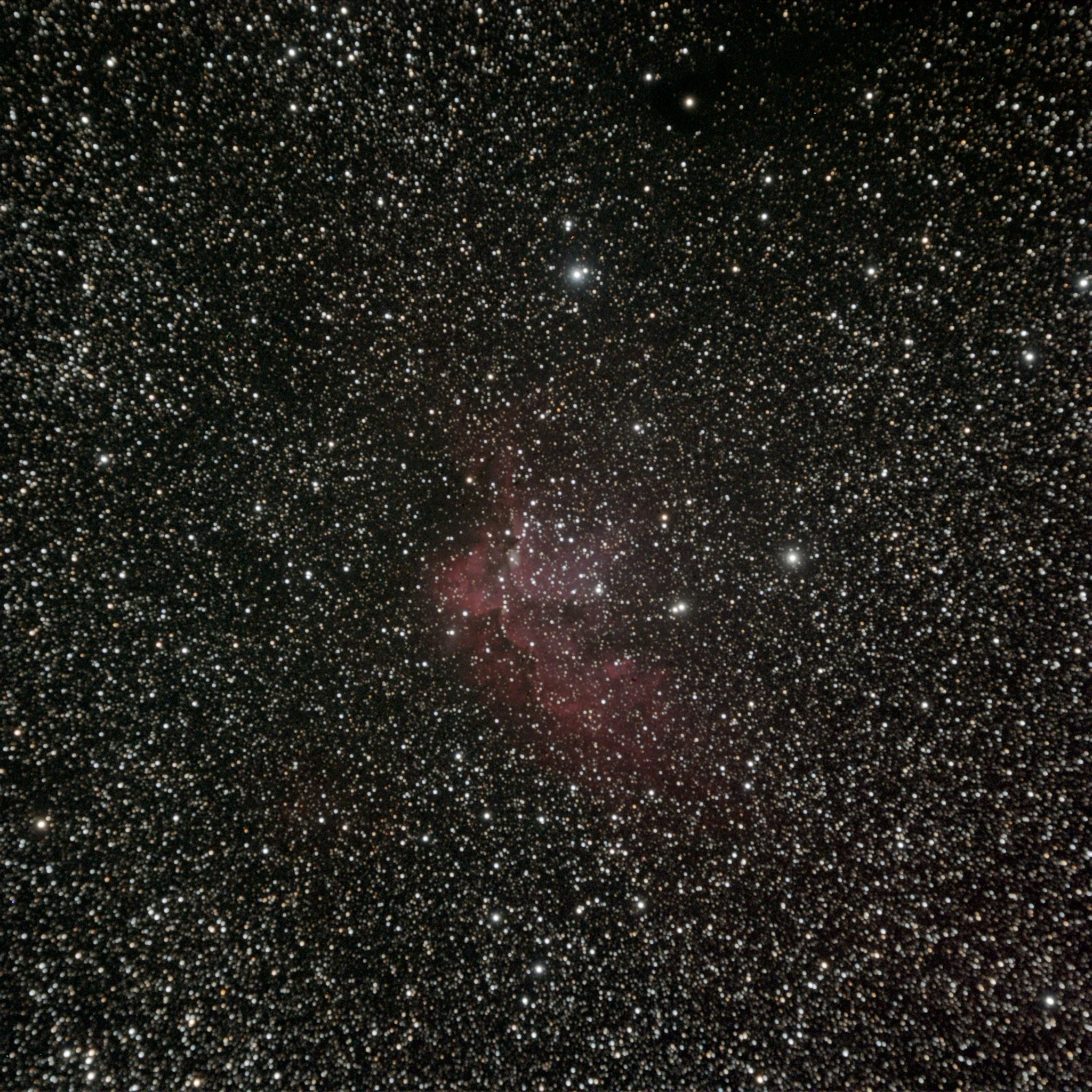
    At that point, Jane called me over to see an interesting emission nebula she was observing visually in her 17.5-inch dob. The nebulosity was just detectable visually, and I really wanted an image to compare. Fun object, full of Milky Way stars, the nebula, and even some dark nebulosity in the upper right.

    NGC7380
    NGC7380 emission nebula and cluster, 3×15 minute exposures

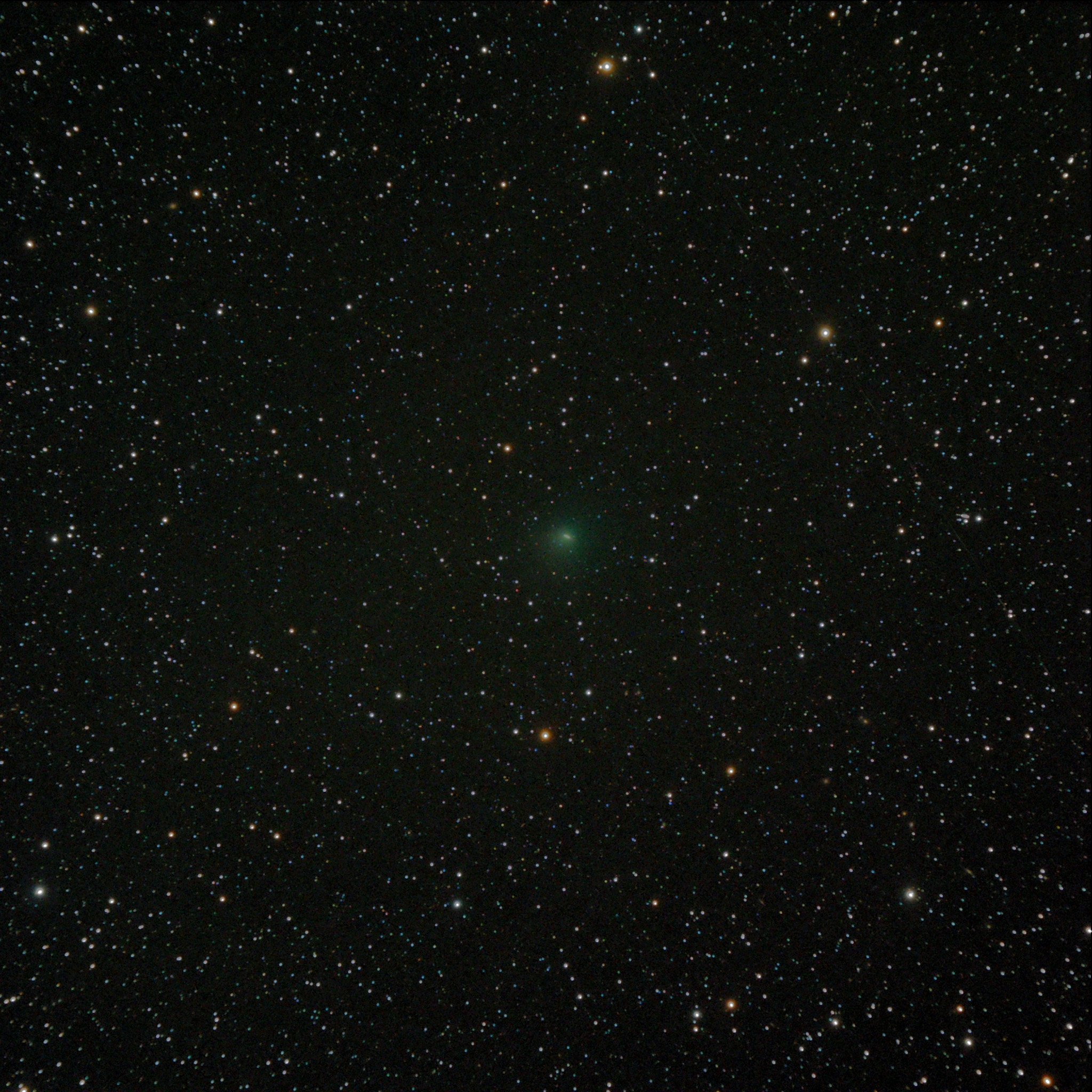
    Jane hunted down comet C/2010 G2 (Hill), a magnitude 10 interloper. It was a very difficult visual observation, but she nailed it, and I saw it as well.

    C/2010 G2 (Hill)
    10th magnitude comet C/2010 G2 (Hill)

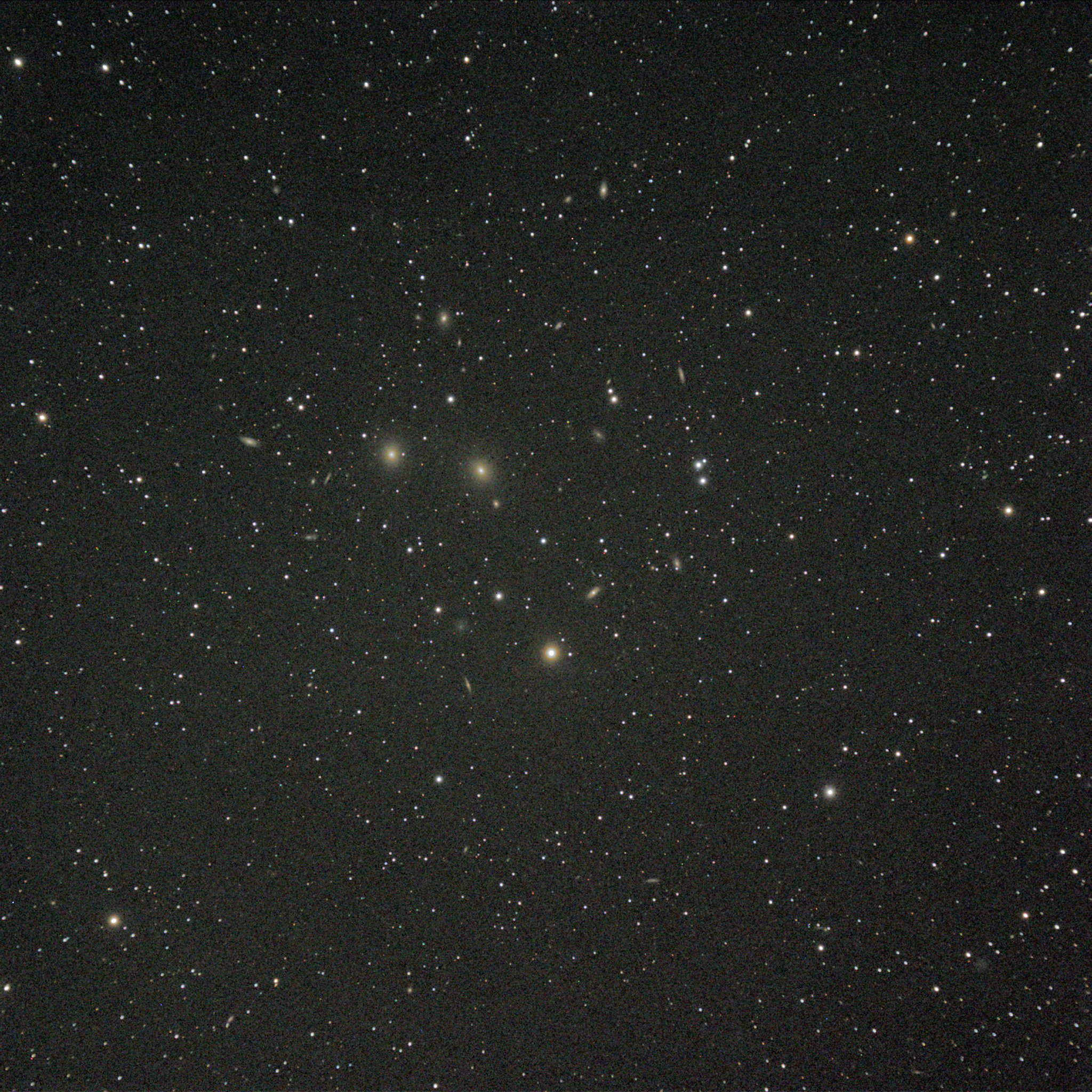
    Meanwhile Jane was also tracking down interesting galaxy groups, and had fun searching the fairly distant Pegasus 1 galaxy cluster in her 17.5-inch. I couldn’t resist imaging this as well.

    My own misfires only left me with one usable 15-minute exposure of this fascinating galaxy group. Even with just one 15-minute exposure and lots of noise, it’s fun to see how many galaxies you can find in the full-resolution image. The two brightest members are magnitude 12.

    Here we go from a relatively nearby solar system object, comet Hill, to a 200-million light-year distant galaxy cluster!

    Pegasus 1 galaxy cluster
    The Pegasus 1 galaxy cluster, one 15-minute exposure. Click for the full-resolution version, and see how many galaxies you can find in the somewhat noisy image.

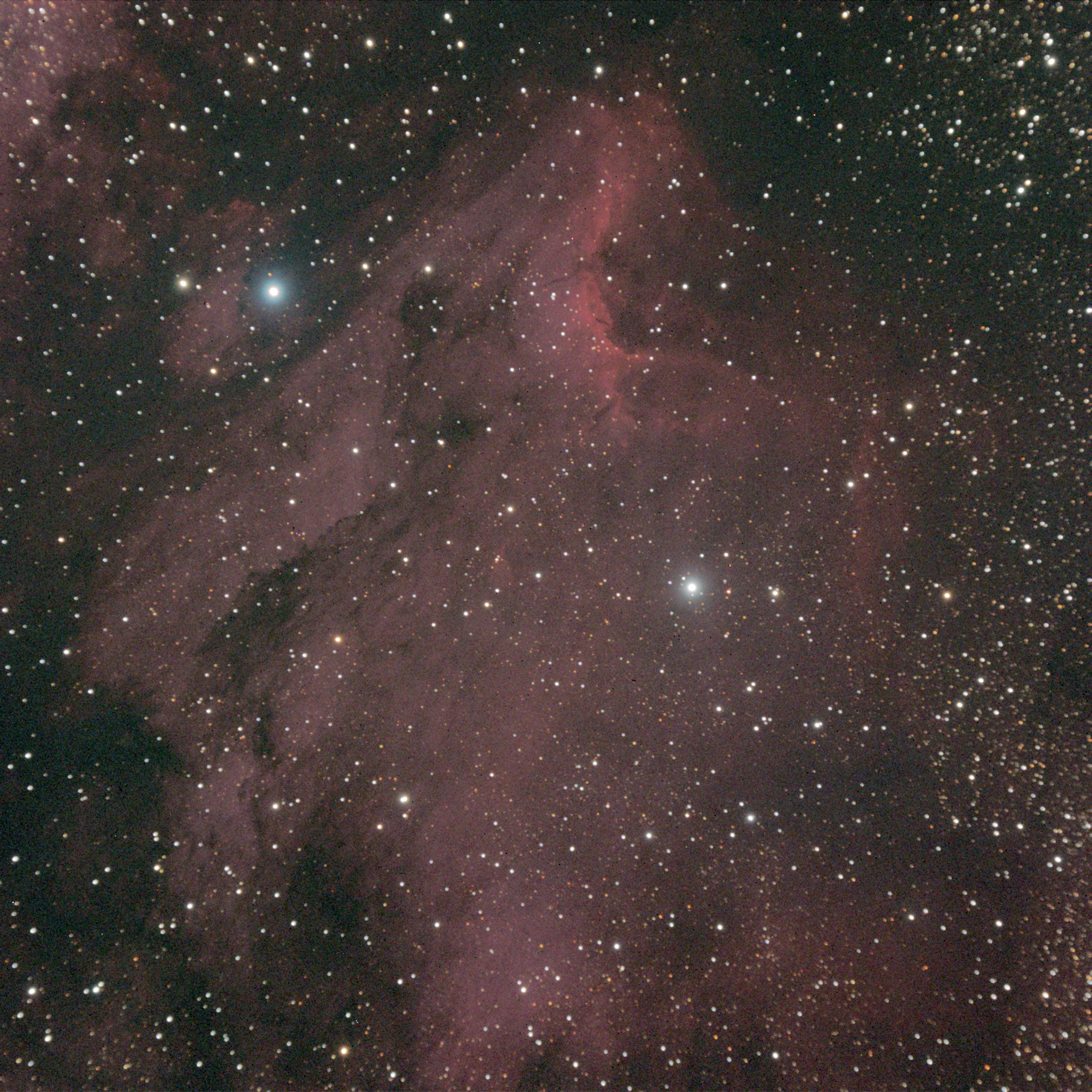
    Now I was just playing around. As it turns out, the Pelican Nebula was well placed, and The Sky 6 told me it would just fit in my field of view. This emission nebula is most famous for being “that thing next to the North America Nebula.”

    The Pelican Nebula
    The Pelican Nebula, one 15-minute exposure

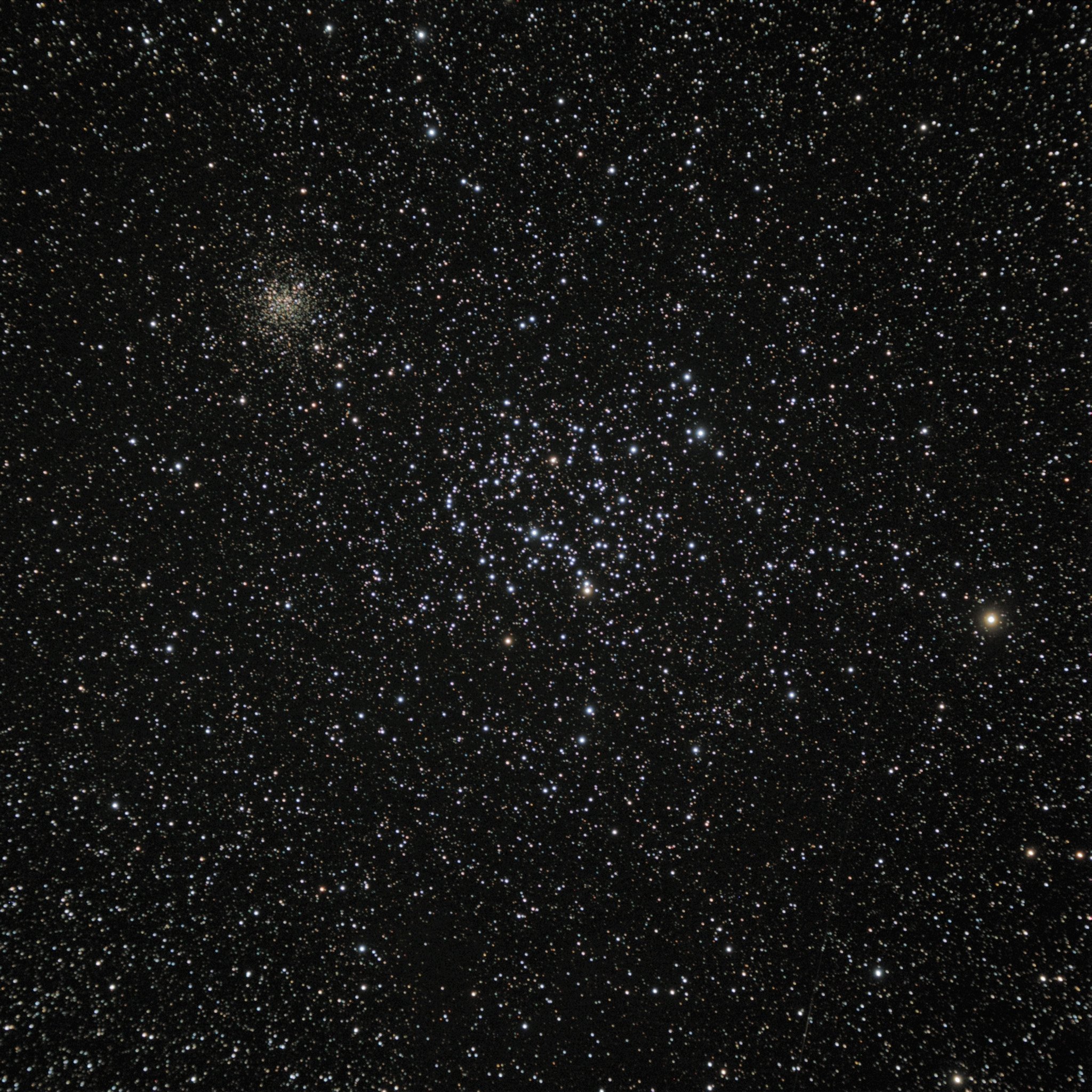
    One of my favorite visual targets is the enormous nearby open cluster M35 in Gemini in the winter Milky Way. Part of its appeal as a visual target is seeing the ten-times more distant open cluster NGC2158 which is about the same actual size as M35. The image didn’t disappoint.

    M35 with NGC2158
    Open cluster M35 in Gemini with distant sister cluster NGC2158. 2×15-minute exposures.

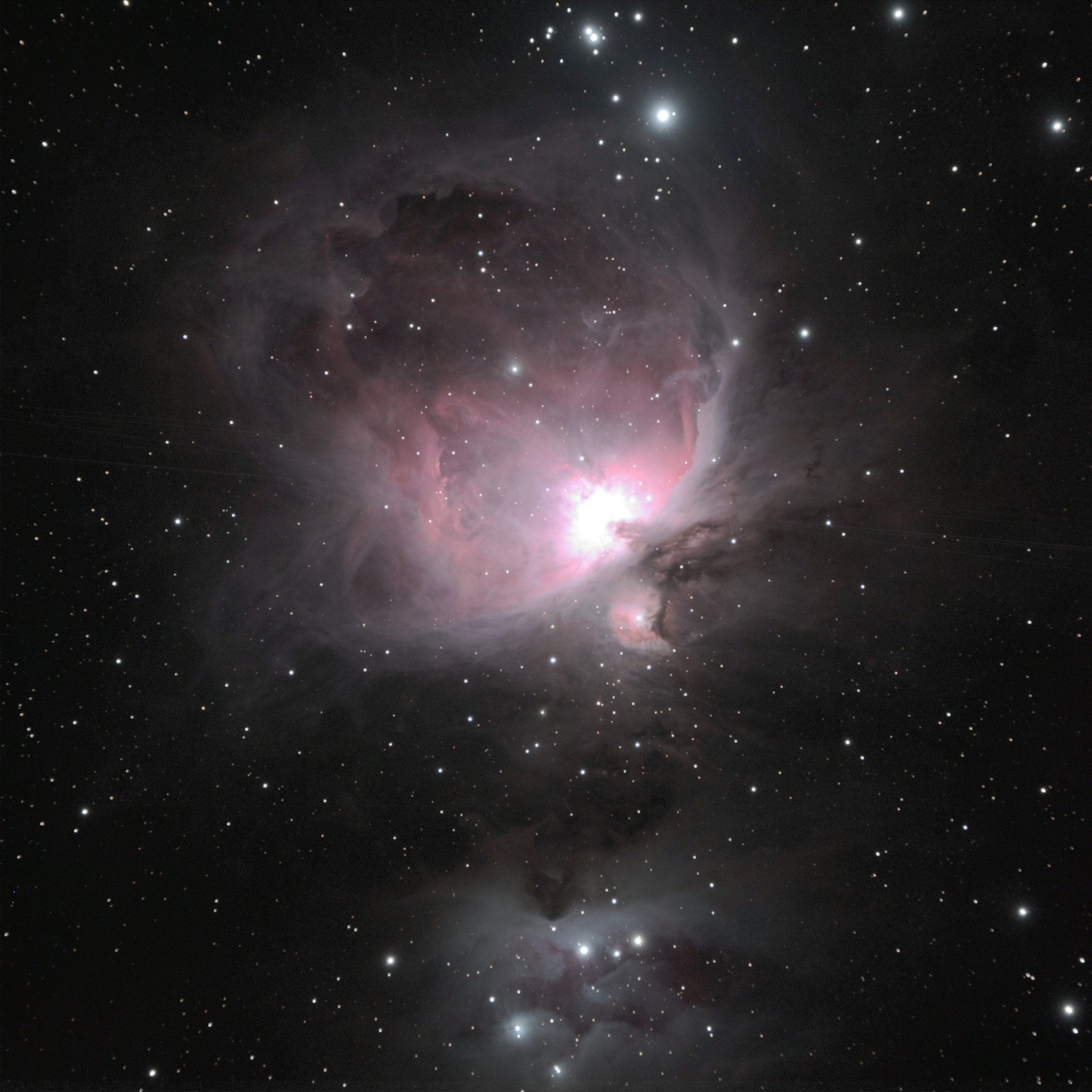
    Finally, even though it’s almost cliché, I had to see what I could do with M42 the great Orion Nebula. It actually turned out to be a delightfully pleasing image. Sure the trapezium area is blown out to white, and maybe I can work out a way to recover that, but it sure is a fun picture. B^)

    M42 the great Orion Nebula
    M42 the great Orion Nebula, 2×15-minute exposures