Mojo's blog banner

Category: Astronomy

  • Sky full of planets and lightning

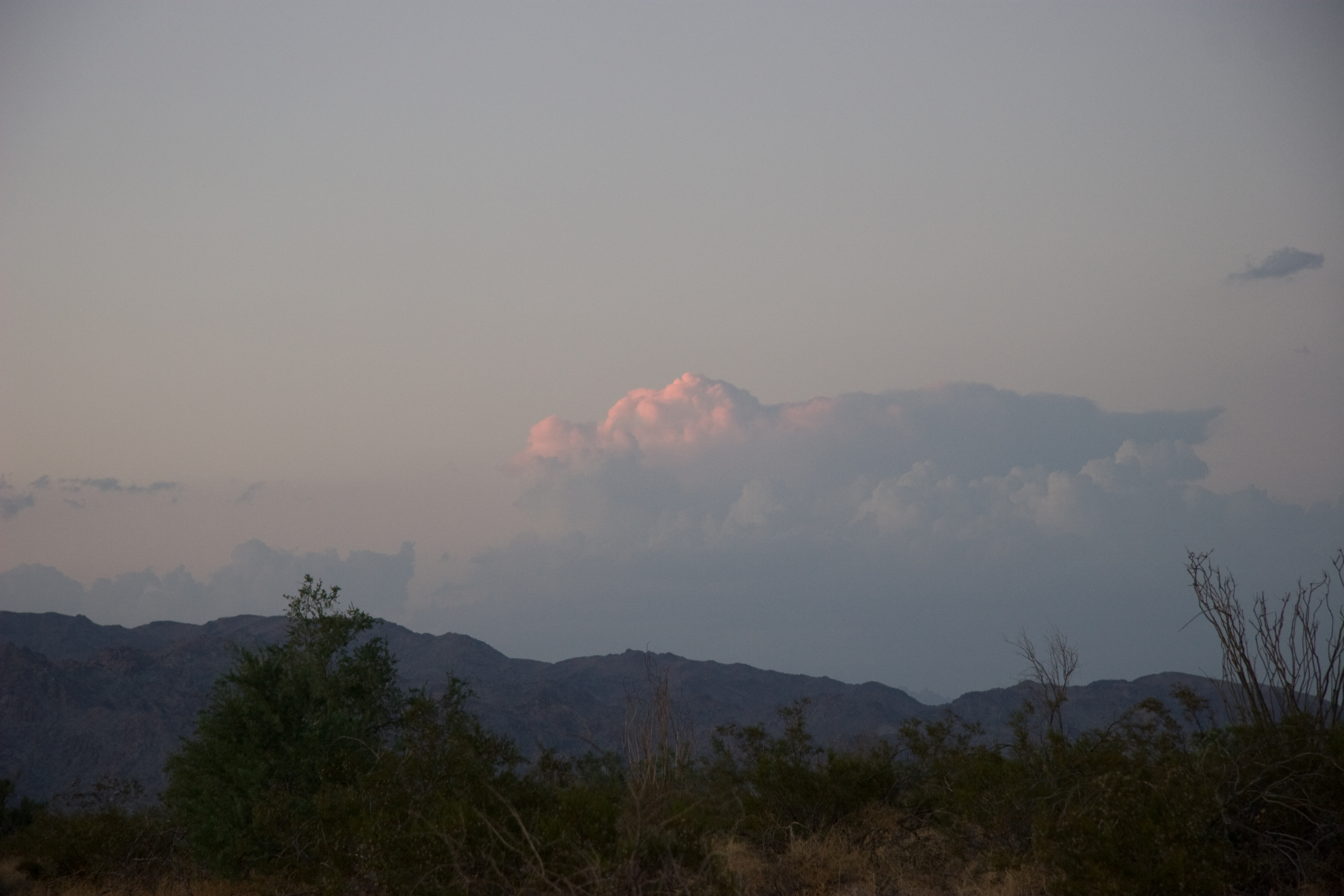
    Distant cumulus clouds catch sunset rays
    These cumulus clouds were nearly stationary all evening, making quite the light show with an electrical storm

    Observing report, August 7, 2010

    Chuckwalla, CA

    We hadn’t expected to be able to observe during this part of the summer from Chuckwalla Bench in the High Colorado desert south of Joshua Tree, but this August night’s forecast at Desert Center looked very inviting. The forecast high there was 101°F with a low of 74°F. I believe our actual location is at a higher altitude; it always seems at least a couple of degrees cooler.

    It was forecast to be breezy though, and that can make it uncomfortable to observe as well as blow telescopes and tripods around. We did have some periods when the wind was a nuisance, but for the most part it was pleasant t-shirt and shorts weather all night long.
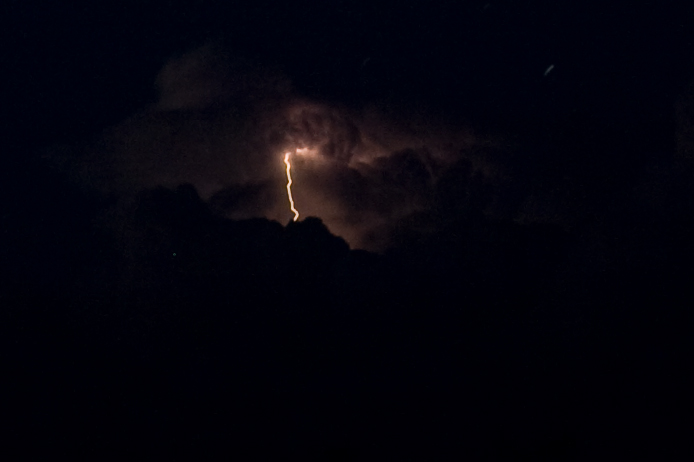
    Lightning in the desert
    I caught this great lightning bolt from the distant electrical storm, with the camera on a small tripod and the bulb left open for a while.

    We had crystal clear transparent skies overhead all night, with a great sugary Cygnus Milky Way transiting high overhead mid-evening, but there was an interesting weather phenomenon happening some number of miles north-northeast of us.

    As the sun was setting, we had this great view of some towering cumulus clouds catching the sunset glow to the northeast. Over dinner I thought I saw a lightning flash in the clouds. As it turned out, throughout the evening all the way to 2:00 a.m. we were entertained by a sometimes massive electrical storm that seemed to be nearly stationary. I caught this one good lightning strike off in the distance. The full-res version is a crop from the center of a very large picture.

    It was also to be a fun evening to see a planet grouping in the west, following the sun to the horizon. I caught this great shot of bright Venus, with Saturn to the upper right, and Mars to the left. To the far left is the bright star Spica. Click to see the great full-resolution picture. In binoculars, Mercury was also visible, but deep in the red sunset glow well out of the field of this picture. In a few days the crescent moon will join the trio for another good picture.
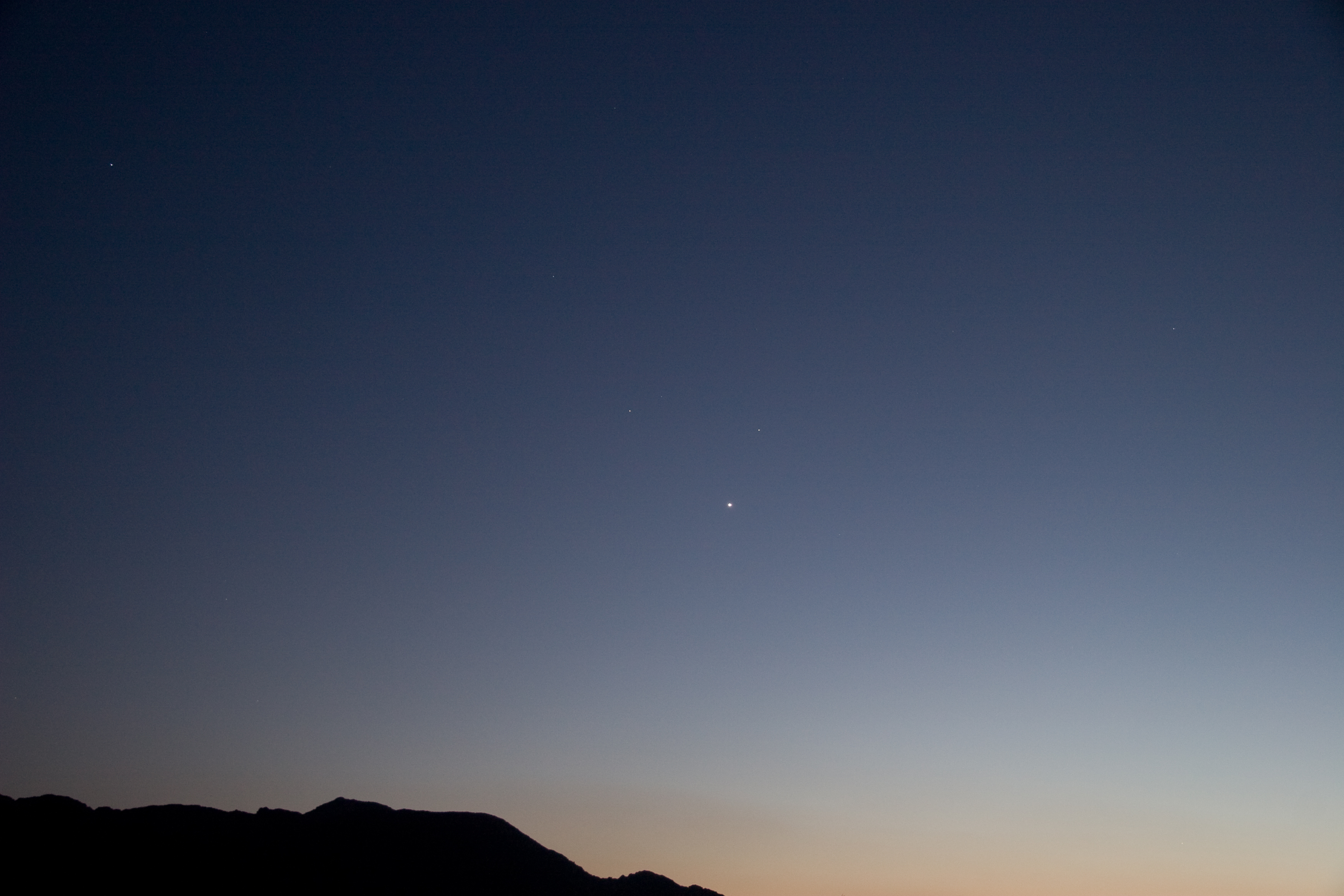
    Venus, Mars, Saturn
    Bright Venus grouped with Mars (left above) and Saturn. Click for the full 4MB experience.

    I did take a couple of interesting piggyback Milky Way pictures. My focus wasn’t perfect, and the white balance doesn’t seem quite right. They are mostly untouched except for some slight darkening of the blacks. They are both five-minute exposures on my stock Canon 20D. I think if this camera were modified to remove the deep red filter, the red hydrogen-alpha glow of the North America nebula would show more.
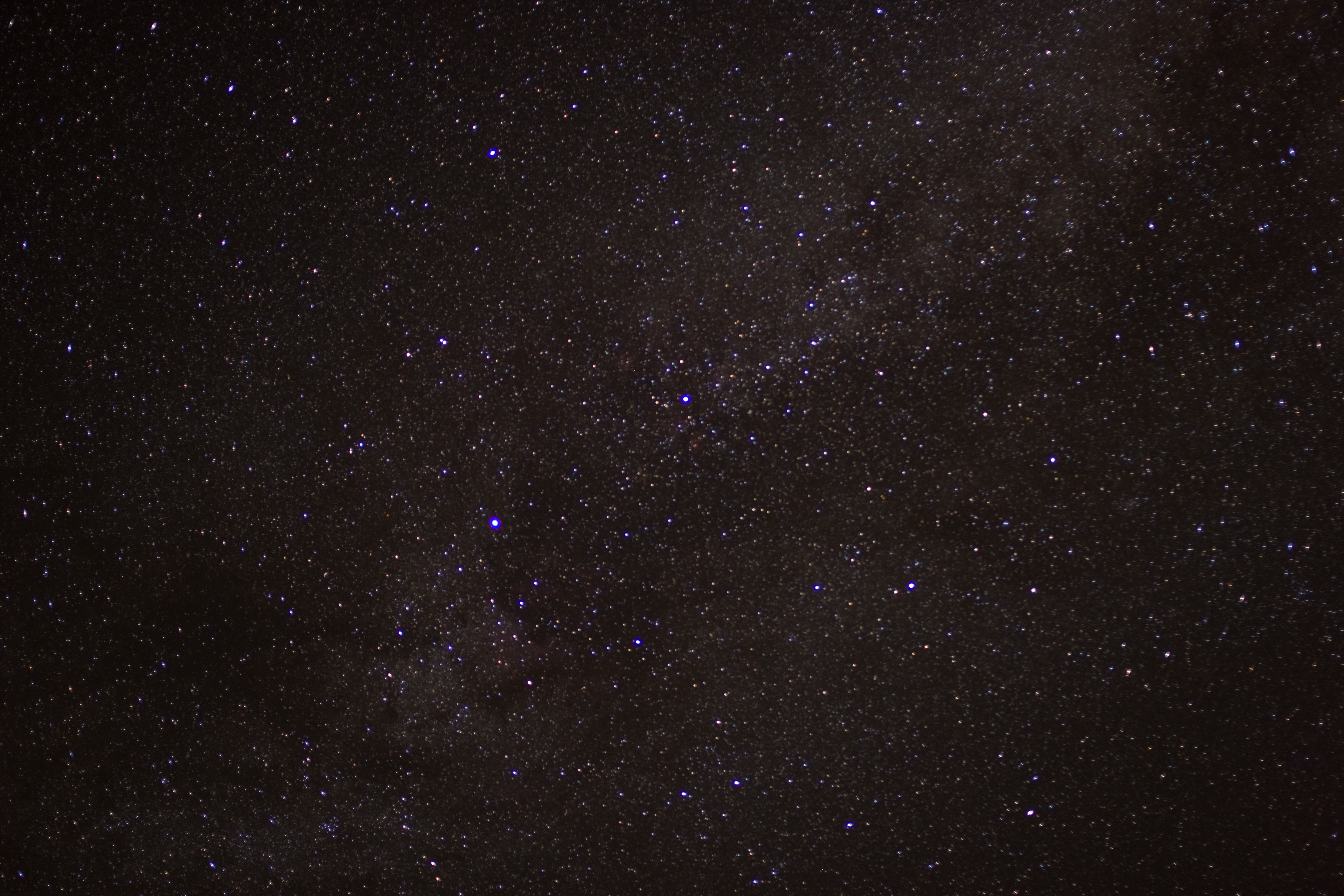
    Cygnus Milky Way
    Cygnus Milky Way, north with bright Deneb to the lower left from center.

    And here is a late-night shot of Cassiopeia.
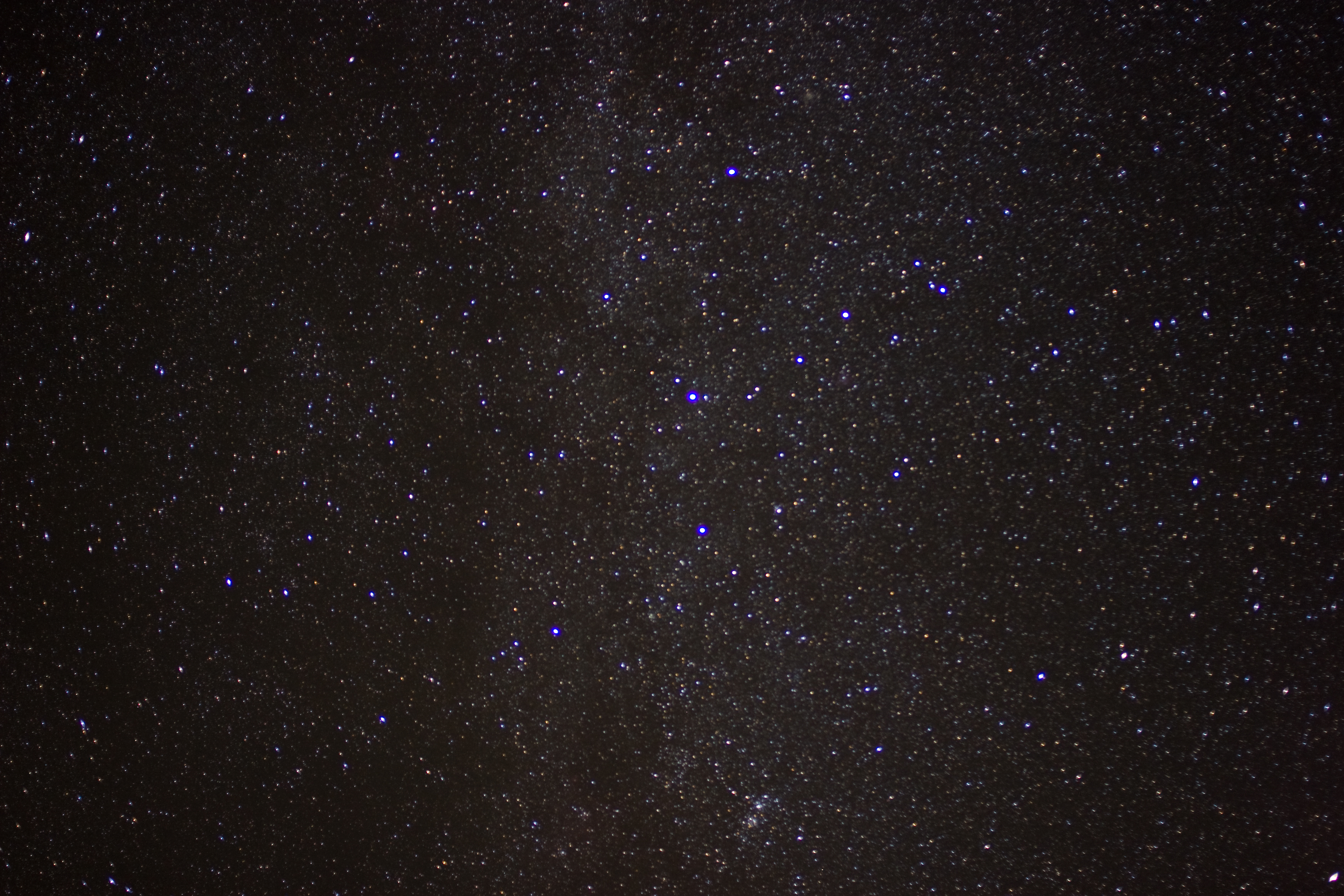
    Cassiopeia
    Cassiopeia reclines in the summer Milky Way. The "double cluster" is visible near bottom center.

    And of course I did some exposures through the Astro-Physics Traveler as well. Here is the Swan Nebula, M17, four ten-minute exposures, ST-4000XCM one-shot color camera. Click on each for the full-resolution image.
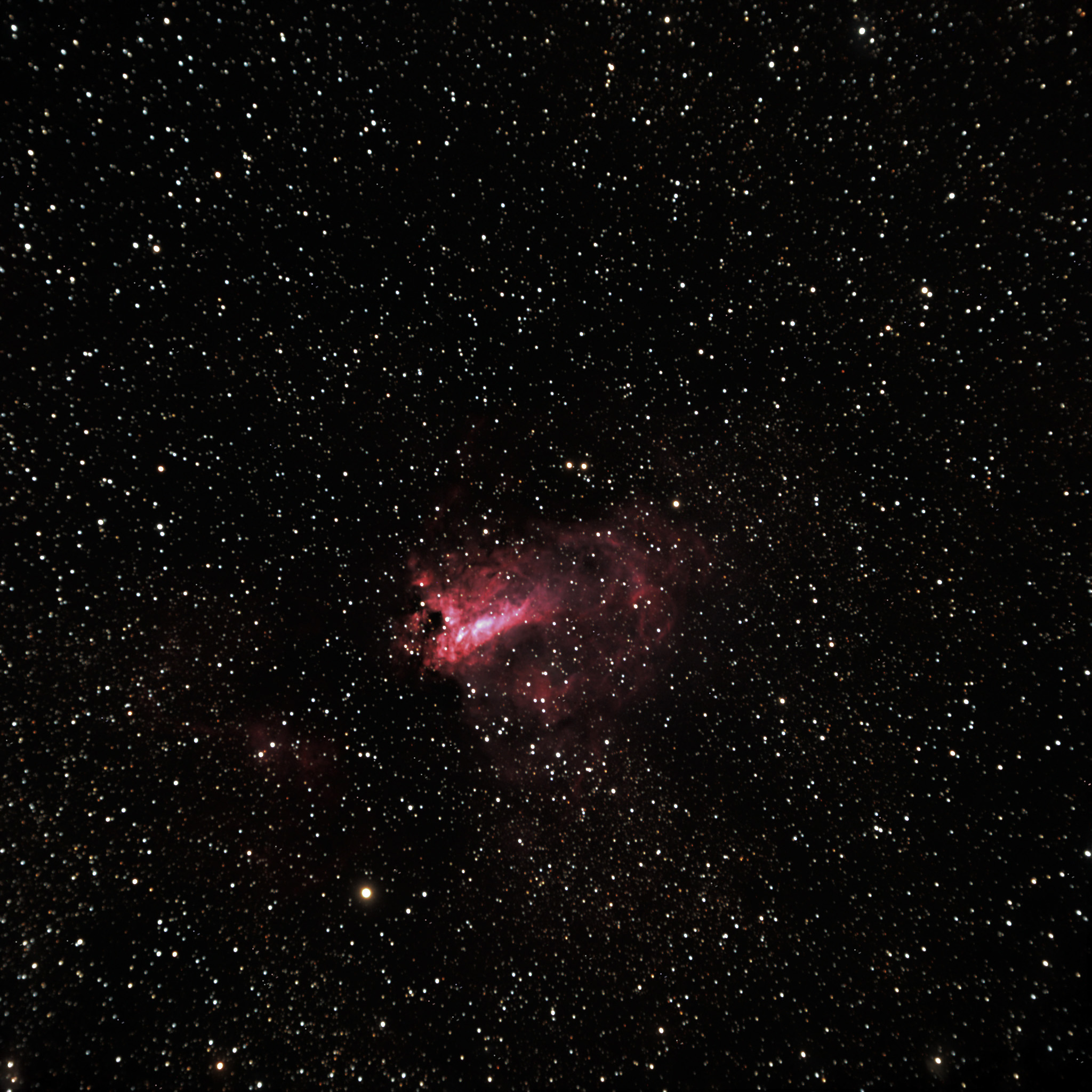
    M17
    M17 also known as the Swan Nebula or Omega Nebula.

    I knew that the Ring Nebula, M57, would be an almost silly target for a telescope with this wide field of view. It would appear as a tiny donut swimming in a field of Milky Way stars, just as it often does visually in a telescope. Of course that made it irresistable. Here is the full field:
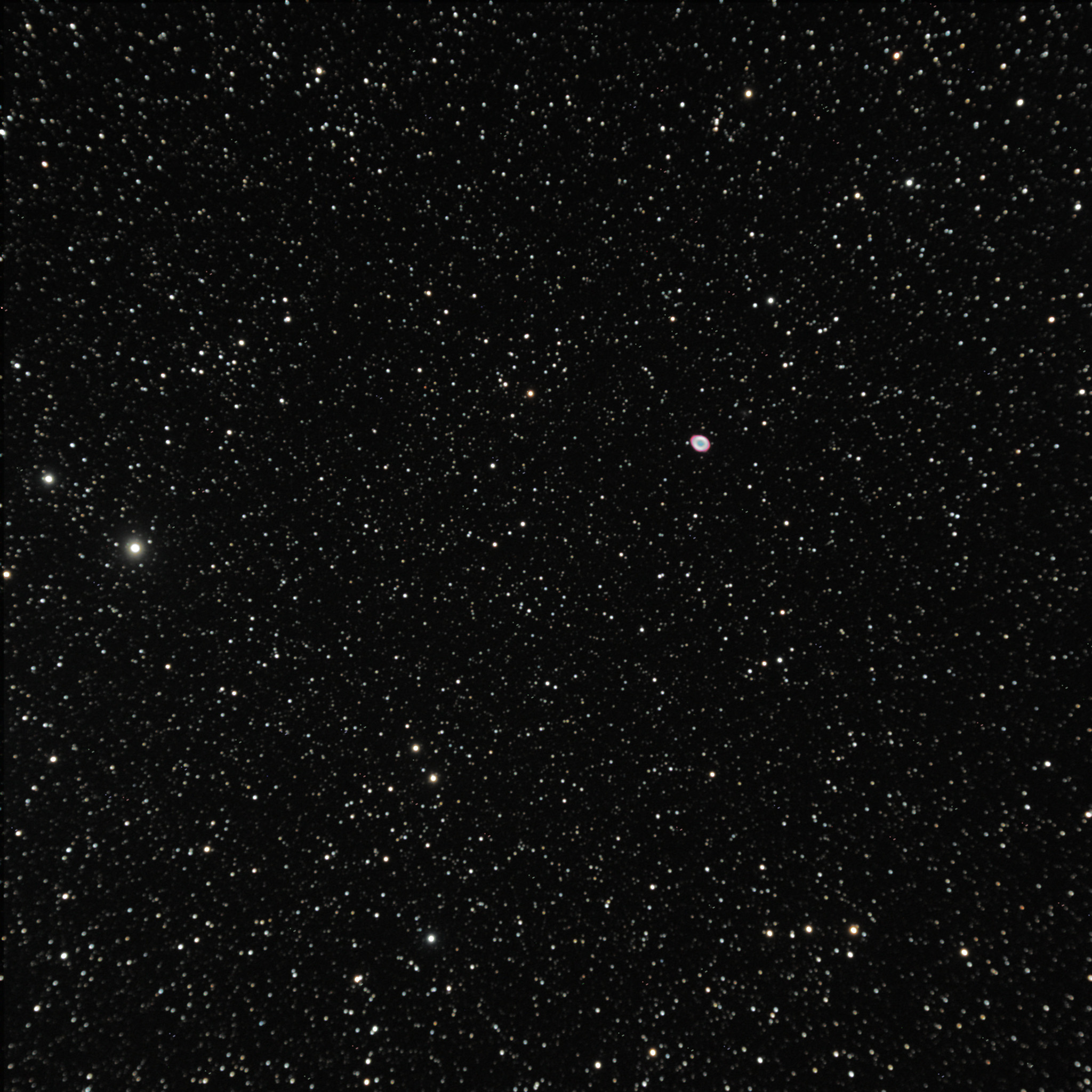
    M57
    There's the Ring Nebula, M57, just right of center.

    And now as you can see in a crop at full resolution, it’s not a bad image at all. This is three ten-minute sub-exposures (30 minutes total).
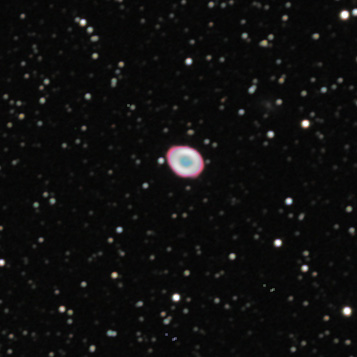
    M57
    Full-resolution crop from the wide field above, M57 the Ring Nebula.

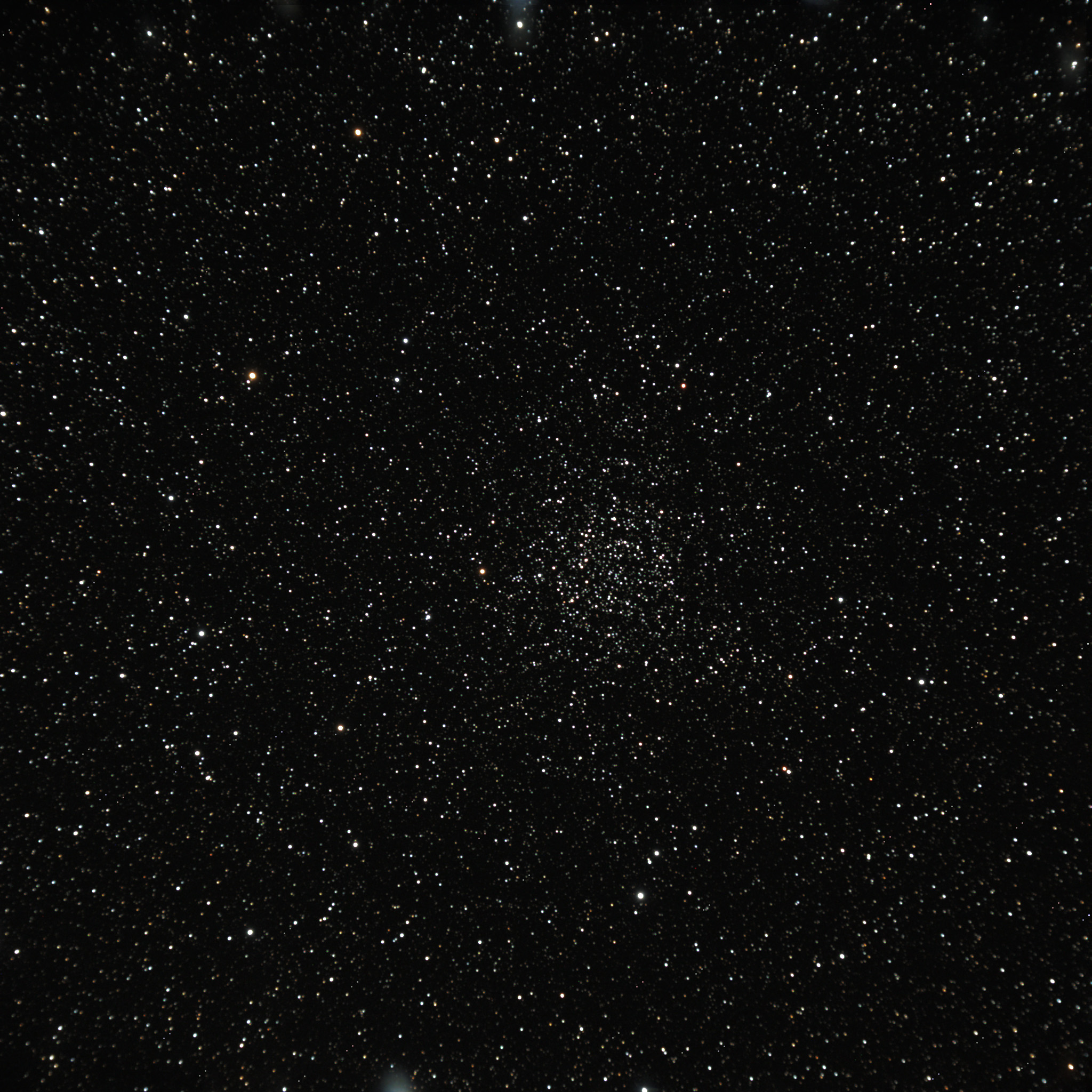
    Finally I wanted to get one of Jane’s (and my) favorite Cassiopeia star clusters, one discovered by Caroline Herschel, and known as the Magnificent Cluster, NGC7789. This scaled down version is not terribly impressive, but the full-res image is a treat to swim around in.
    NGC7789
    The Magnificent Cluster, NGC7789, in Cassiopeia

    On a techy note, for the first time I started to have some issues with haze forming on the chip. Given the presence of those nearby cumulus, I guess I can’t always count on the desert air to be completely water-free. 🙂

    Besides the great deep sky and planets, of course we also had lots of meteors from the forward edge of the Perseid meteor shower. Jane did some great counts, and I enjoyed some bright meteors while the shutters were open.

    ‘Til next time …

  • Just another full moon

    Almost-full moon rises over I-210 in Pasadena
    Almost-full moon rising over I-210 in Pasadena at 8:00 p.m., July 24, 2010.

    It was about 8:00 p.m. Saturday night. Jane and I were driving home from having just seen Salt in Pasadena. This beautiful moon was rising above the Foothill Freeway, with dark blue earth shadow just below it.

    I realized in this one picture was a whole astronomy lesson.

    The first thing I realized is that this moon had to be several hours away from exactly full.

    How did I know that? Notice that the moon is a few degrees above the line of the earth’s shadow. If you were to see the rising full moon at exactly the moment when the moon is directly opposite the sun in the sky (full moon) it should be directly on that line.

    Upon checking with an ephemeris, the moon seen is actually 22-1/2 hours away from full. It will travel about 22 diameters before reaching that moment of exactly “full.” It certainly appears closer than 22 diameters, but two things are in effect: one is the slight motion blur making the moon appear bigger, and two is that it will move in a line that’s quite a diagonal in this photo.

    The next thing I realized is that about one-half orbit ago (about 15 days), this moon was eclipsing the sun in a total eclipse. That means that now this moon must again be within a few degrees of crossing the ecliptic.

    That puts this moon as close to directly opposite the sun as it can be, short of actually passing through the shadow of the earth (a lunar eclipse).

    At the time Jane snapped this picture, the freeway had just turned from due east to a few degrees toward the south. That would match nicely with the sun having just set a few degrees to the north. Not as far north as last month, since we’re now about one month into summer.

    All fun realizations from a simple beautiful full moon rising. The geometry of the solar system is right there in the sky to see.

  • Short summer night

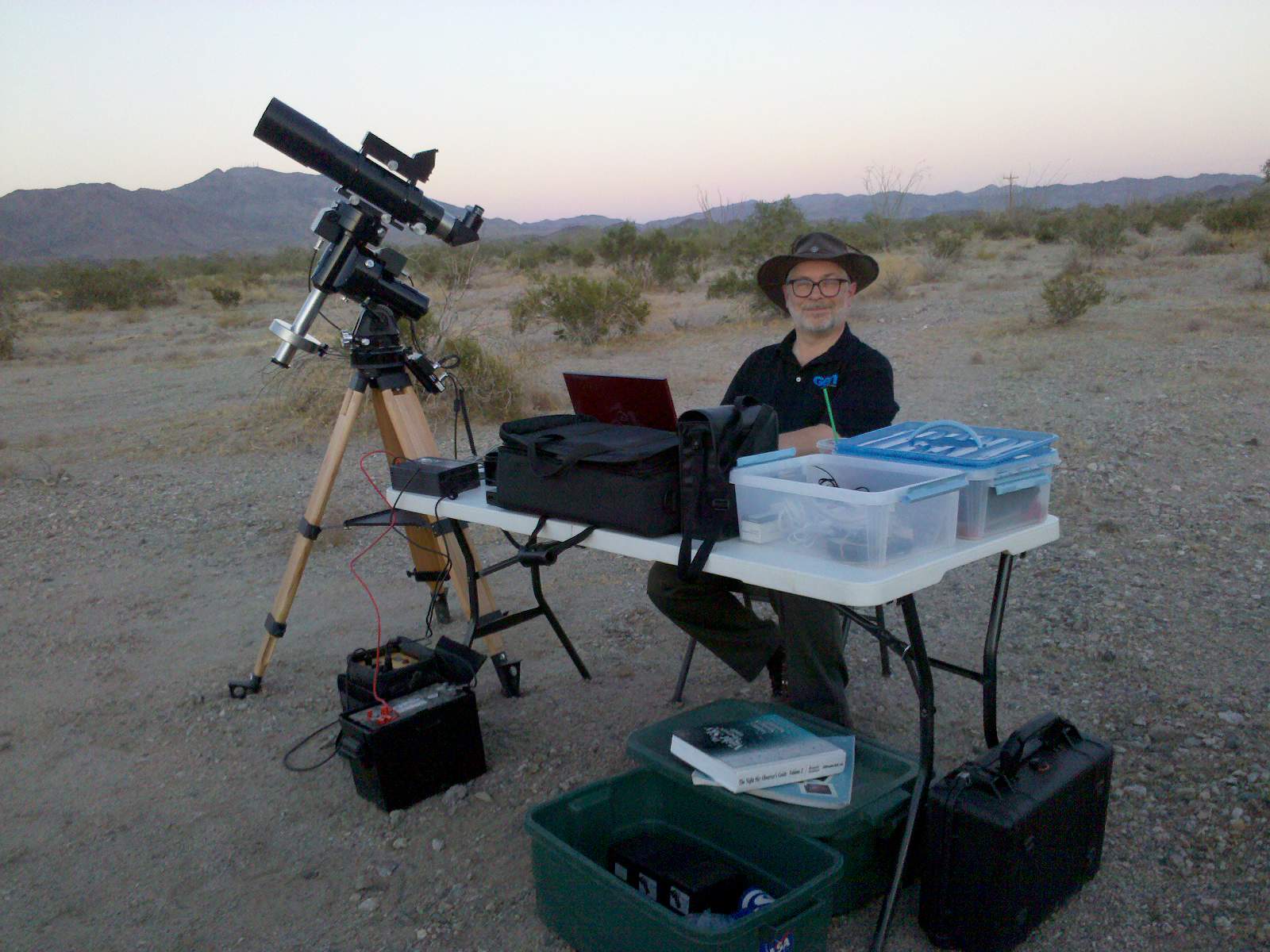
    Mojo in the desert
    Jane snapped this shot of me shortly after sunset, squinting into the bit of wind we had.

    Happy Independence Day!

    This weekend wasn’t our usual dark sky new moon weekend; there would be a third-quarter moon rising just at midnight. With summer sunset at 8:00, and no real dark sky until about 9:00, we were looking at a really short (for us) desert observing session of about three hours. Next week is when all the big June star parties are being held.

    The weather was fair, not too awfully hot, or too awfully windy, just a little of both. The sky was brilliantly clear, and seeing was not particularly good. Sometimes we just say WTF. 🙂

    This was one occasion when I was glad to be living “in the future.” I somehow managed to completely wedge the ASCOM driver that lets my laptop communicate with the telescope mount. That’s the kind of thing that really eats up the clock when the moon is about to chase away your dark sky!

    Right there in the middle of the desert, I was connected to the net by USB tether to my Motorola Droid. (Thank you PDANet!) I posted a plea for help on the Astro-Physics User Group mailing list. The author of the driver responded to my post and helped me set it right within an hour.

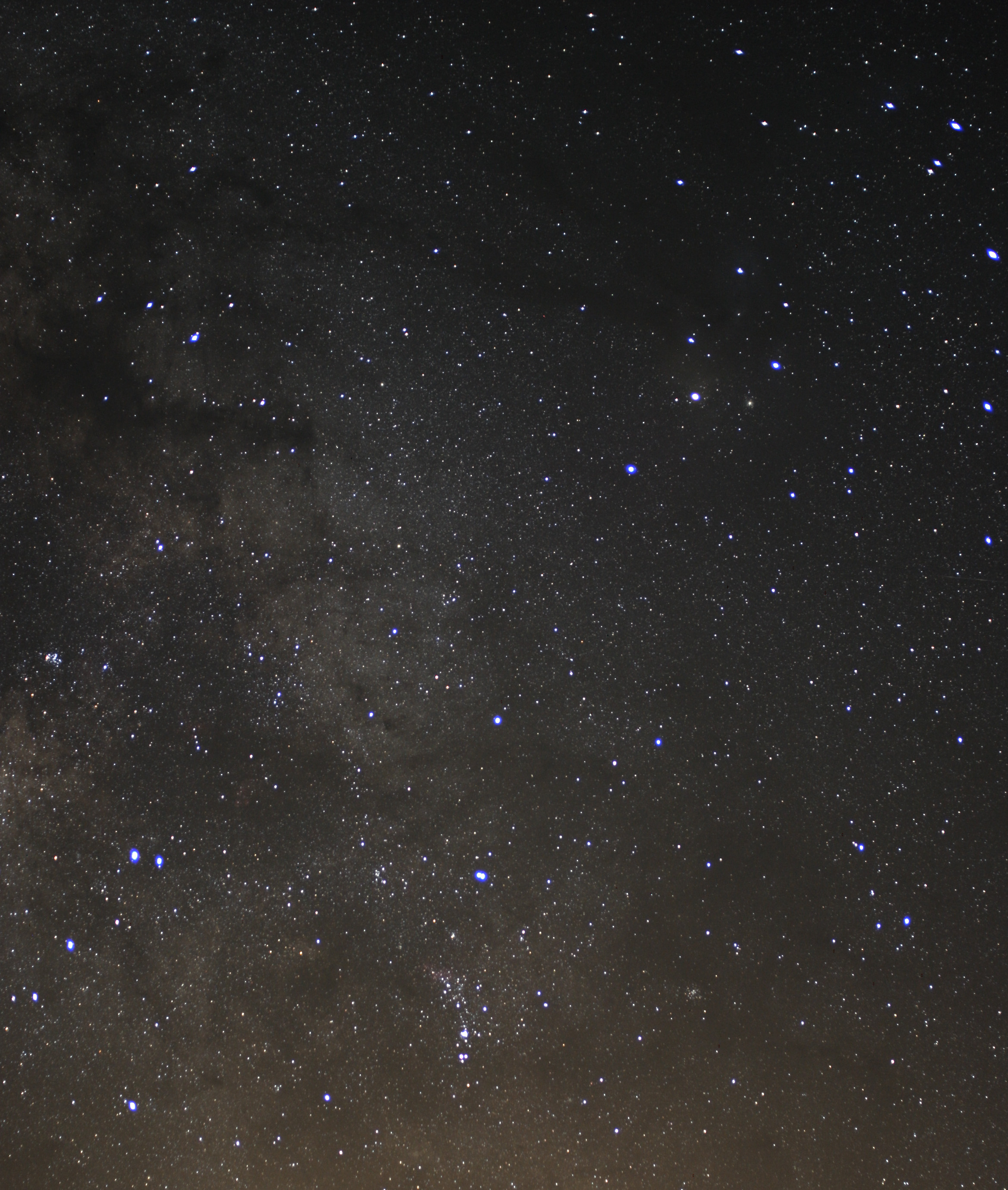
    I had time for maybe two short exposures of a couple of objects, and Jane badly wanted a piggyback shot of Scorpius. That would be my first priority, and I had fun shooting it. I used a fixed-focus 35mm f/2.0 lens on my Canon 20D, and the big constellation just barely fit in the frame. We have a fairly strong light dome to the south from the Inland Empire. I cropped the shot just below the constellation where the light is strongest.

    Scorpius
    The fishhook of Scorpius fills the frame, with lots of Milky Way and dark nebulae throughout. Some light glow to the south.

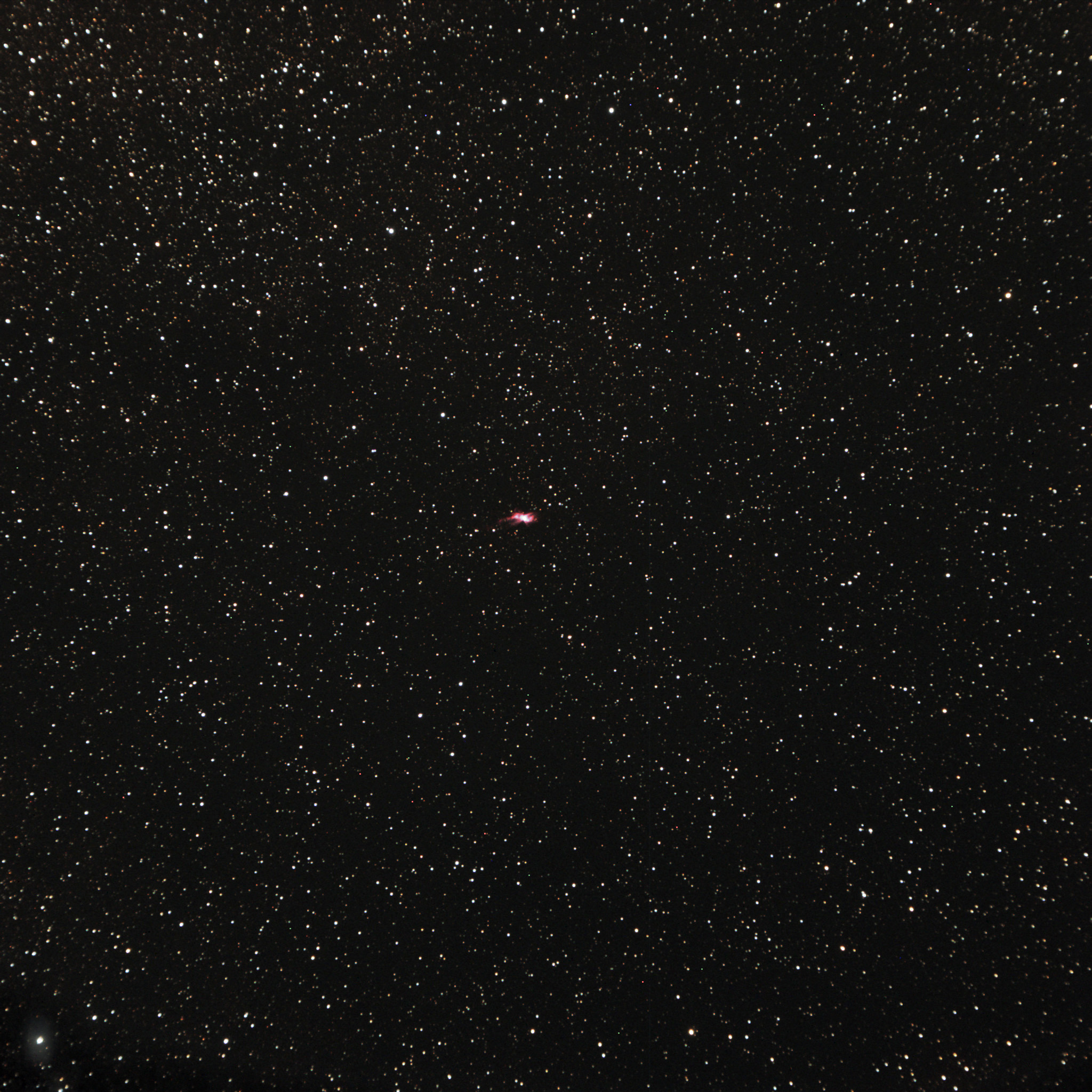
    Jane had the “Bug Nebula” NGC6302 on her observing list, and I tried a shot of it myself. It’s a tiny thing relatively speaking, so there’s not much to see in the full field. There’s one interesting object in the lower left corner which could be another planetary, or possibly an artifact of my own creation. It only shows up well in one of my two sub-exposures.

    NGC6302 region
    That little red blob in the middle is the "Bug Nebula." There might be another planetary in the lower left corner, that or an imaging artifact.

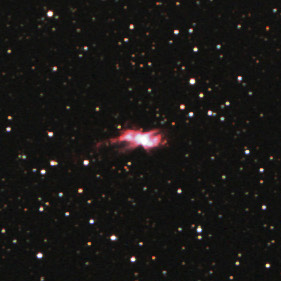
    Here’s a cropped version at full resolution of the bug itself. Jane’s view in her big dob was actually very nice.

    Cropped detail of the Bug Nebula
    Not very impressive, but it somewhat resembles the visual view we had through Jane's big dob, minus the red color

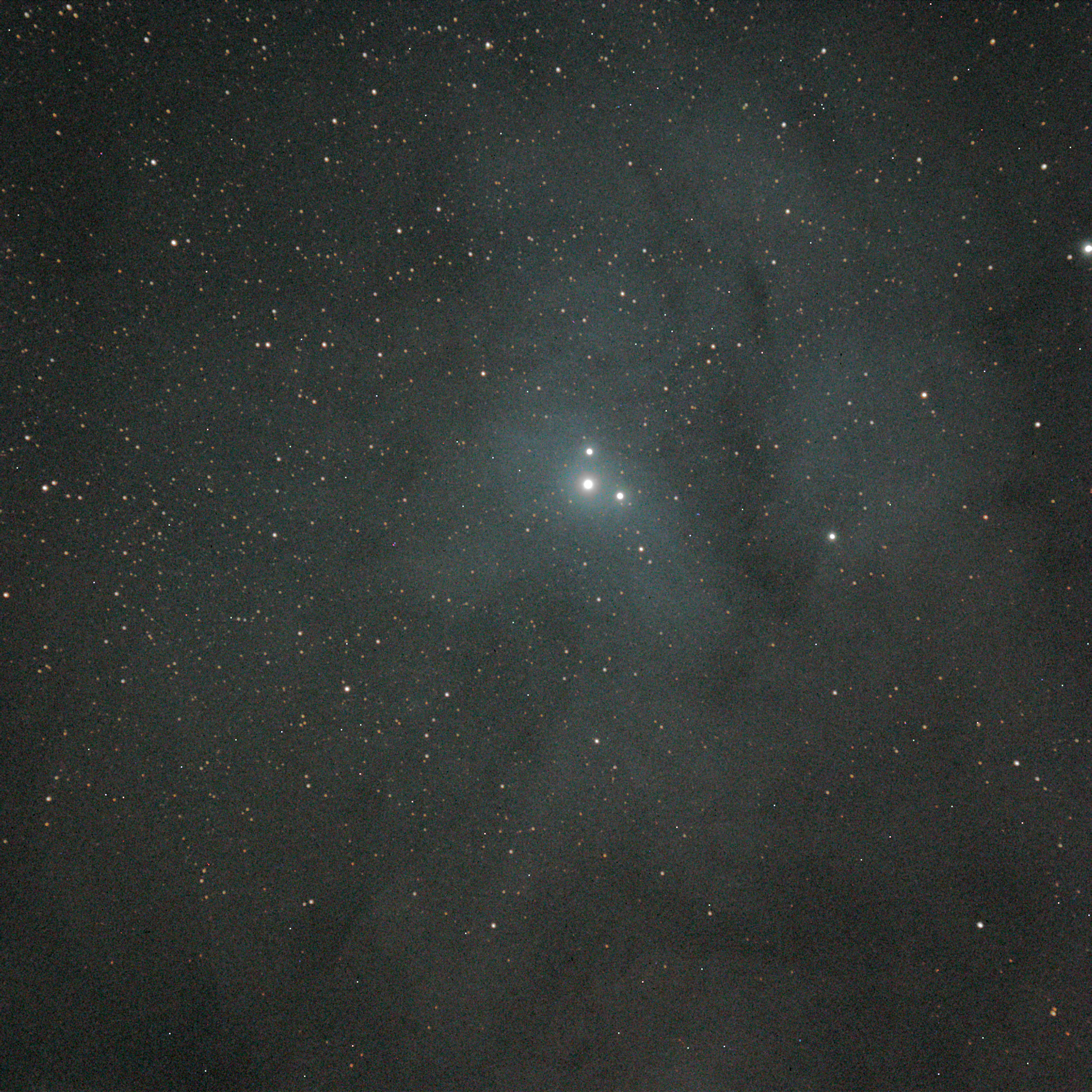
    With only a little time left before moonrise, I wanted to see what I could get of the nebula around Rho Ophiuchus. It’s only one ten-minute exposure, and you’ll find lots of impressive images of this region out there on the net. I’m still tickled with what I was able to capture.

    Rho Ophiuchus nebula
    One ten-minute exposure of the Rho Ophiuchus region

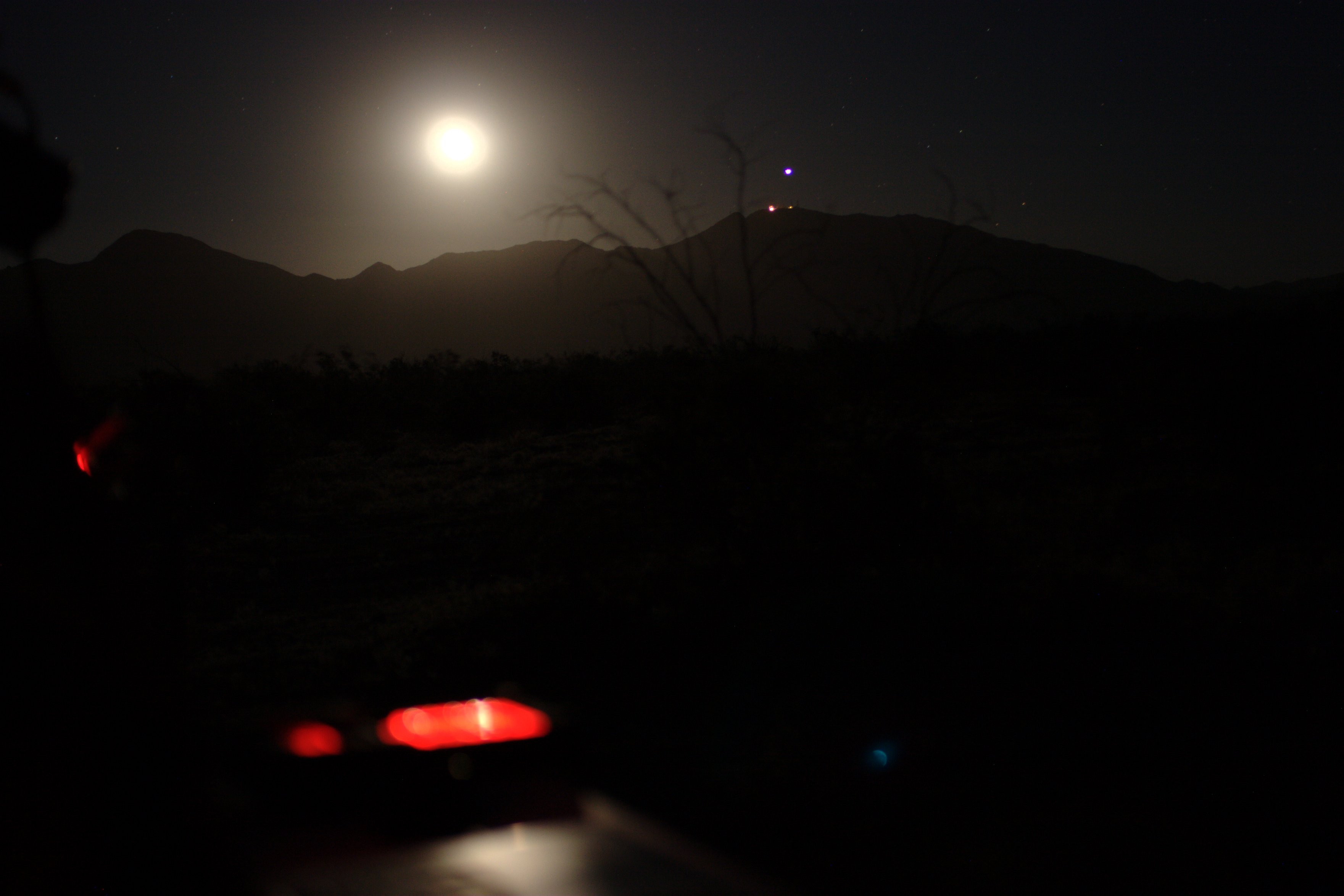
    Finally the moon put an end to the dark sky observing, but moonrise itself was quite an event. The moon was joined quickly by Jupiter to the south. Jane has a great afocal shot taken through the eyepiece of her Televue Ranger. You’ll have to see that one on her observing report!

    Moonrise over Chuckwalla Mountain
    Moonrise with Jupiter over Chuckwalla Mountain. There's a light from the microwave station on Chuckwalla Mountain just below Jupiter to the right of the moon.
  • Observing report, dark desert June skies

    Old Town Sidewalk Astronomers
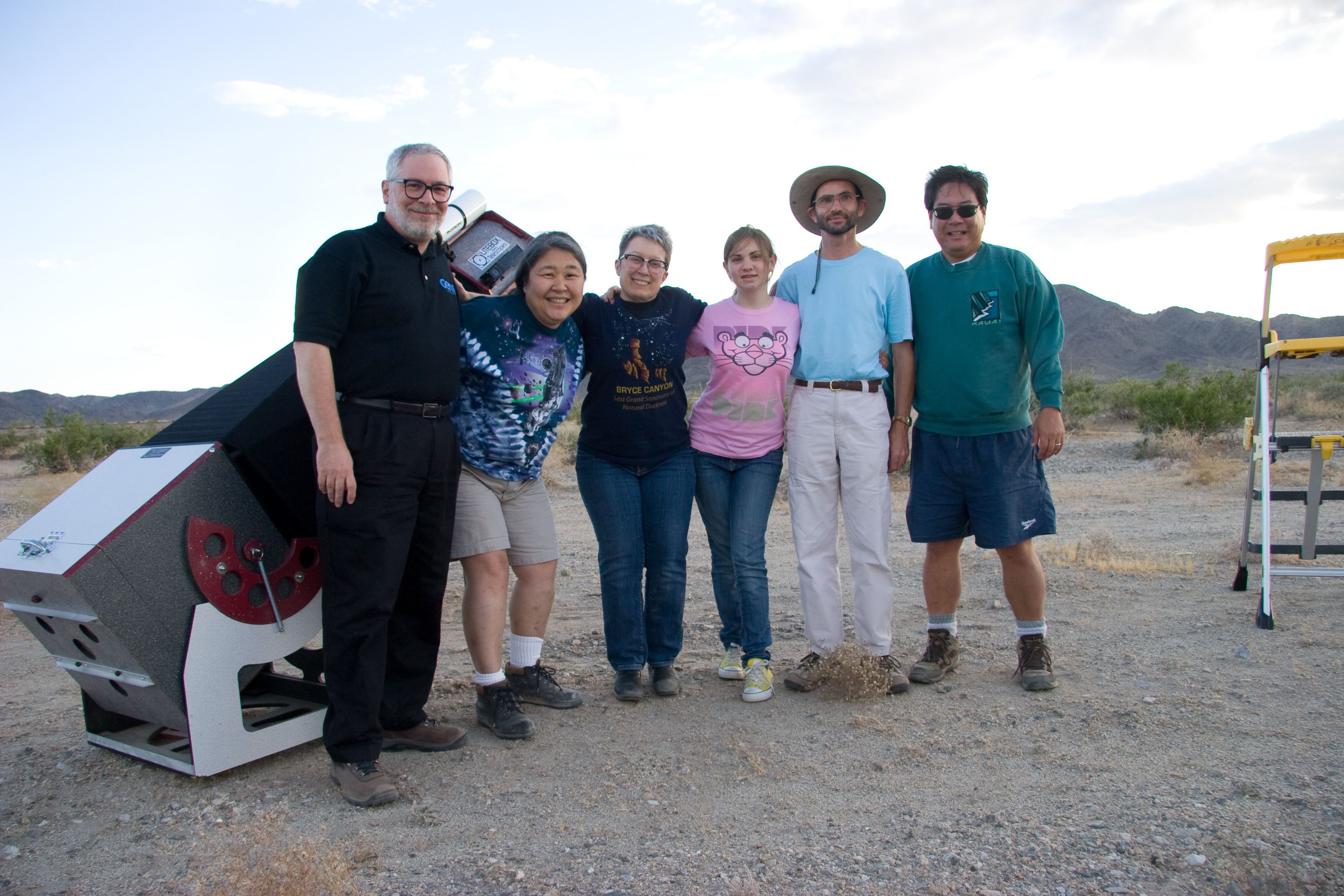
    Mojo, Caroline, Jane, Catherine, Gary, and Todd

    Update: Jane wound up using most of my astrophotos below in her July NASA What’s Up podcast. Check it out!

    The forecast was for a very temperate desert evening, so six of the Old Town Sidewalk Astronomers headed off to the Colorado Desert to play outside all night. Seeing was forecast poor, but actual conditions seemed much better.

    Jane packed her 17.5-inch dob, and I loaded the Astro-Physics Traveler 102mm f/6 refractor to do some astrophotography. The highlight of the evening promised to be comet McNaught 2009R1, but it wouldn’t be available until the pre-dawn hours. That left me with late spring galaxies and summer Milky Way targets. (Jane also had a great target which she’ll be writing about!)

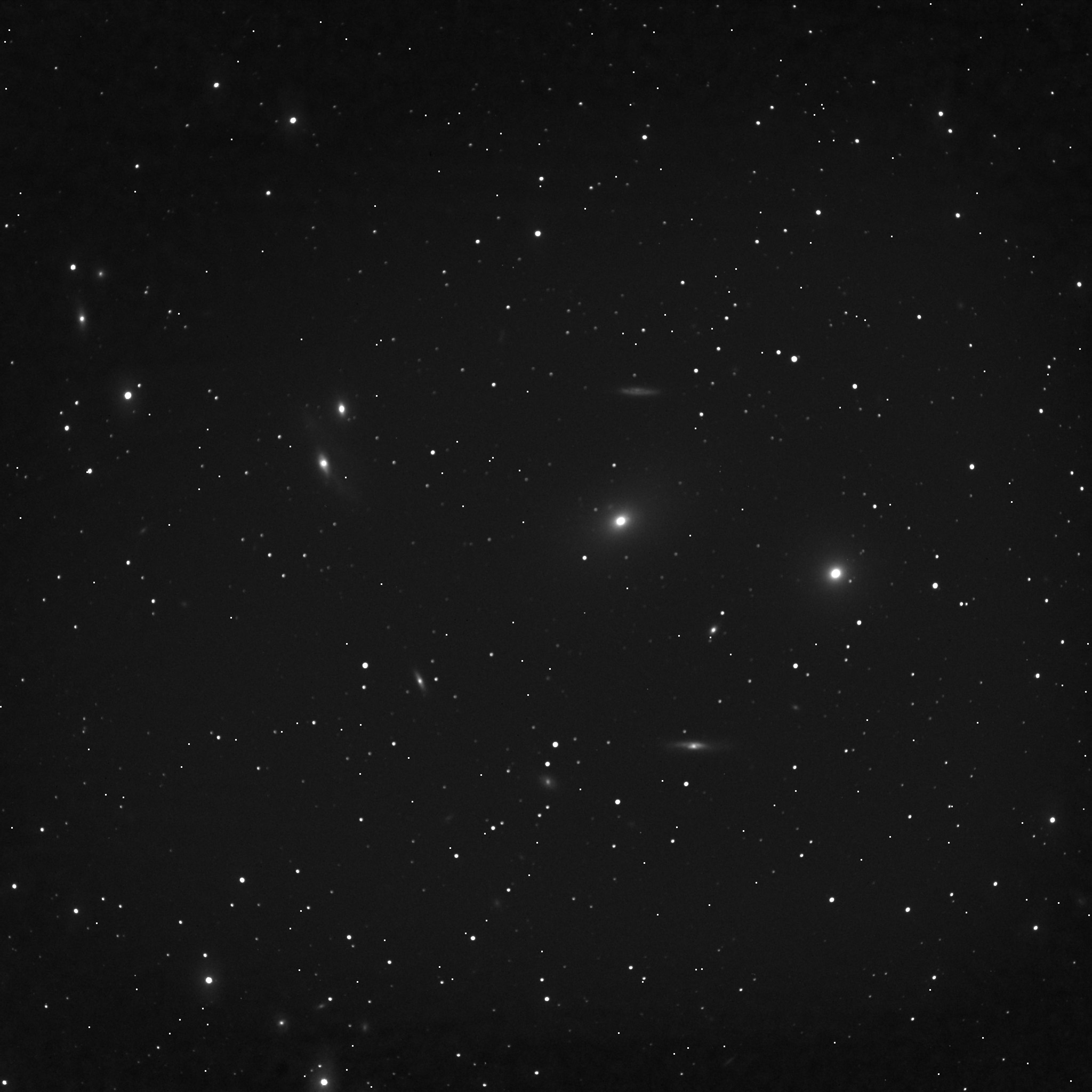
    I tried the M84-M86 region of Virgo last month with the AP180, but the field of view was too narrow. I knew it’d be a good warm-up for tonight. The grey scale version looks better to me than the color rendition.

    M84-M86 region in Virgo, "the Nine Gals"

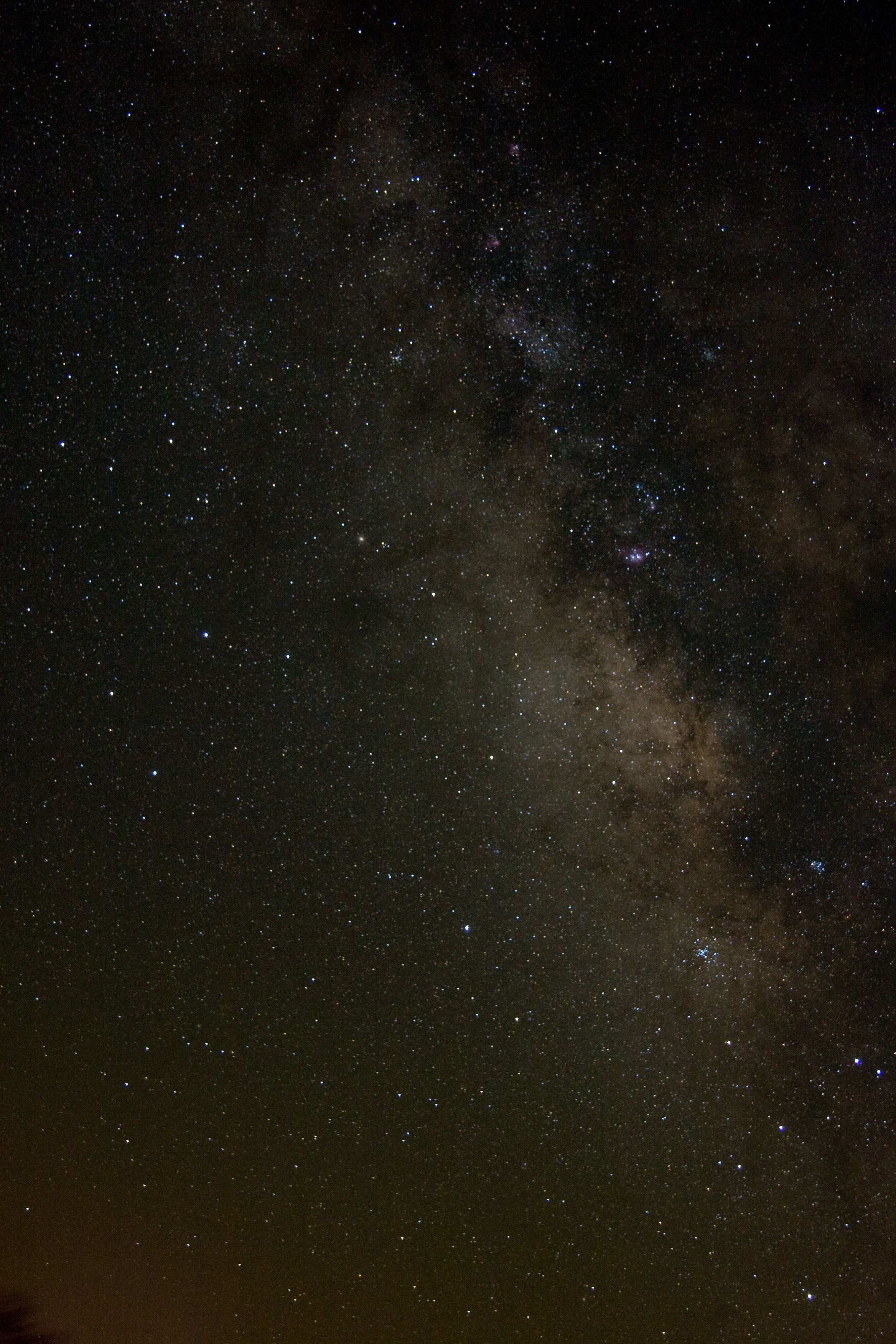
    Jane and I both love piggyback pictures, taken at “naked eye” scale. This is one of “the teapot” and the Sagittarius Milky Way. The full-size image isn’t bad, but it looks better scaled back a bit. Click for the really big version. It’s fun looking through all the dark nebulae and bright clusters.

    Sagittarius Milky Way
    Looking towards the center of our galaxy.

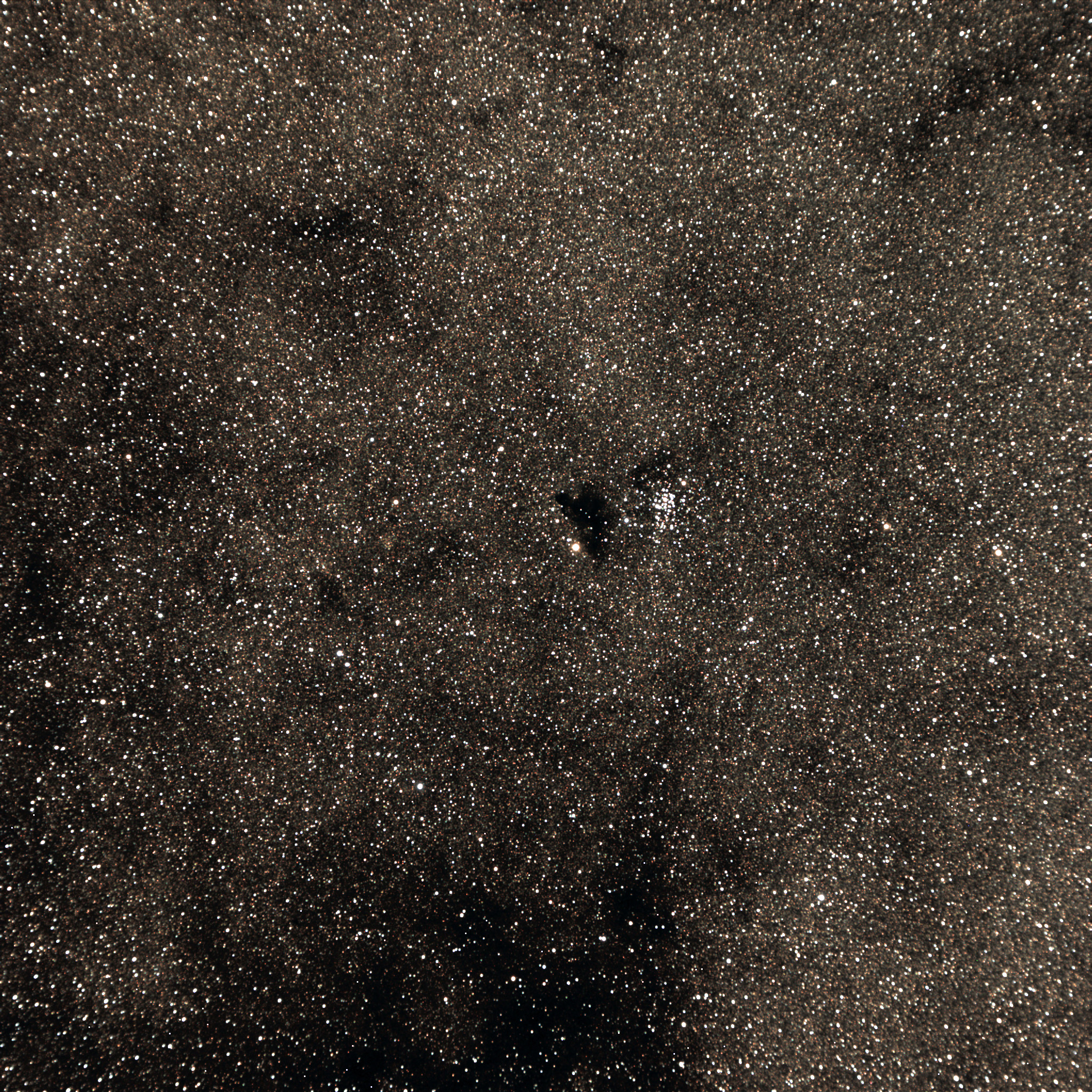
    Deep in the Milky Way just above the spout of the teapot is Barnard’s famous “Ink Spot” dark nebula, B86.

    Barnard 86 "The Ink Spot"

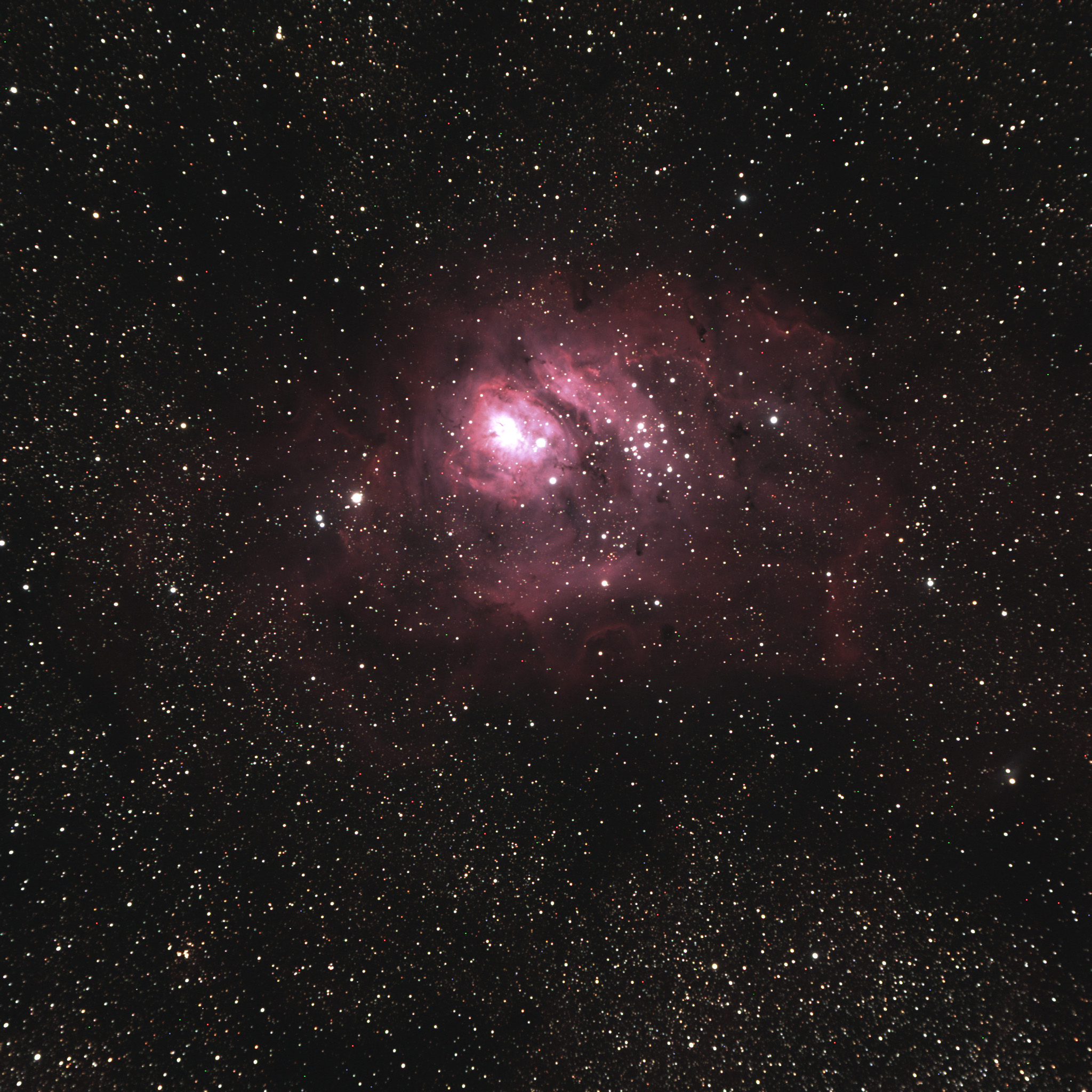
    I started out trying to fit M8 “The Lagoon Nebula” in the same field as the nearby Trifid Nebula, but they wouldn’t quite fit. So I did 15 minutes just on M8, and love the result.

    M8 The Lagoon Nebula
    M8 The Lagoon Nebula and cluster

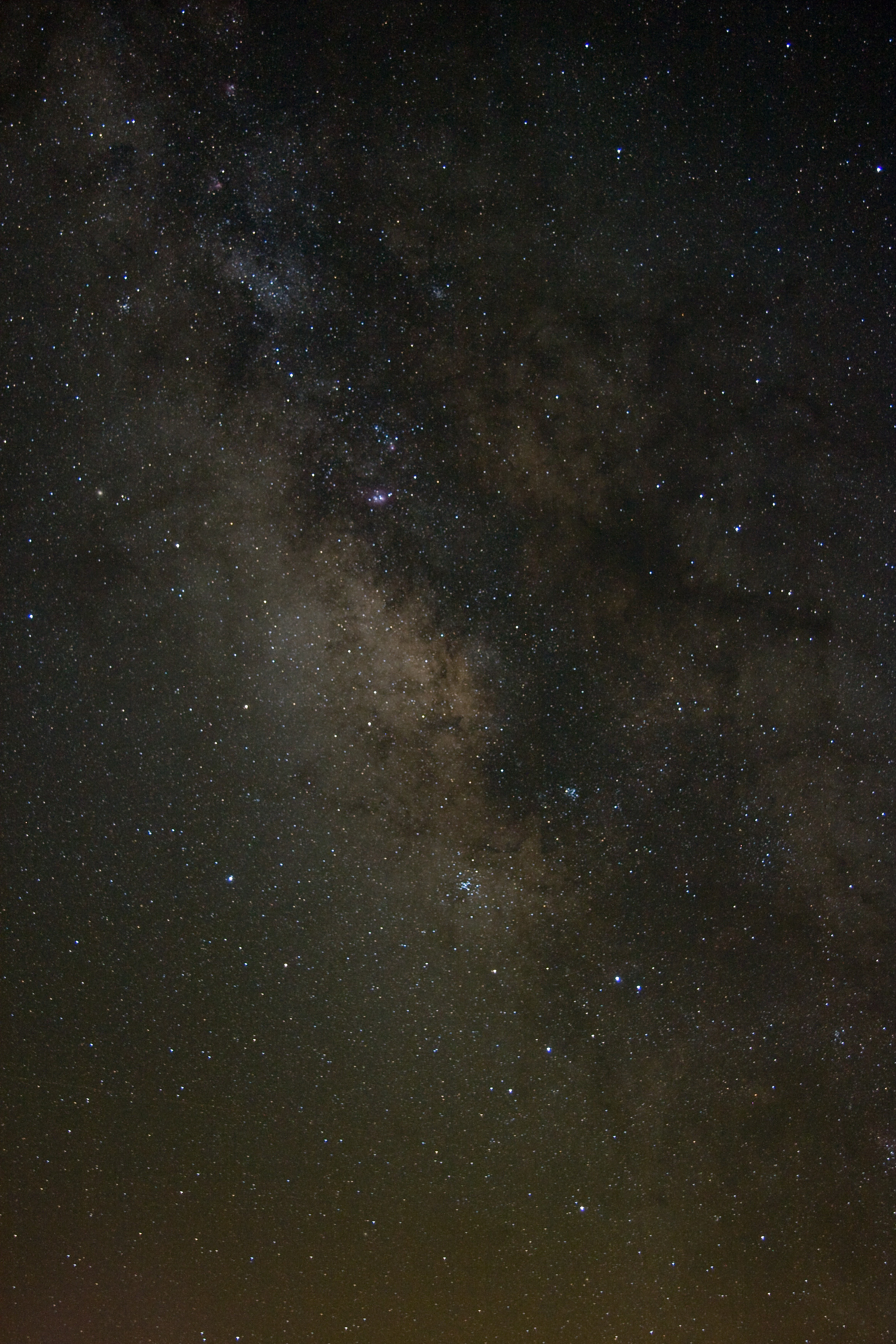
    I love hunting for the Pipe Nebula, a huge dark nebula best seen in binoculars. Seeing the Pipe is a portent of great transparency and dark skies. The detail photo here is centered on the Pipe, taken piggyback with the 20D. Click for the full field, see if you can find the Pipe there.

    Pipe Nebula detail
    Do you see the pipe outlined here? Click for the full field.

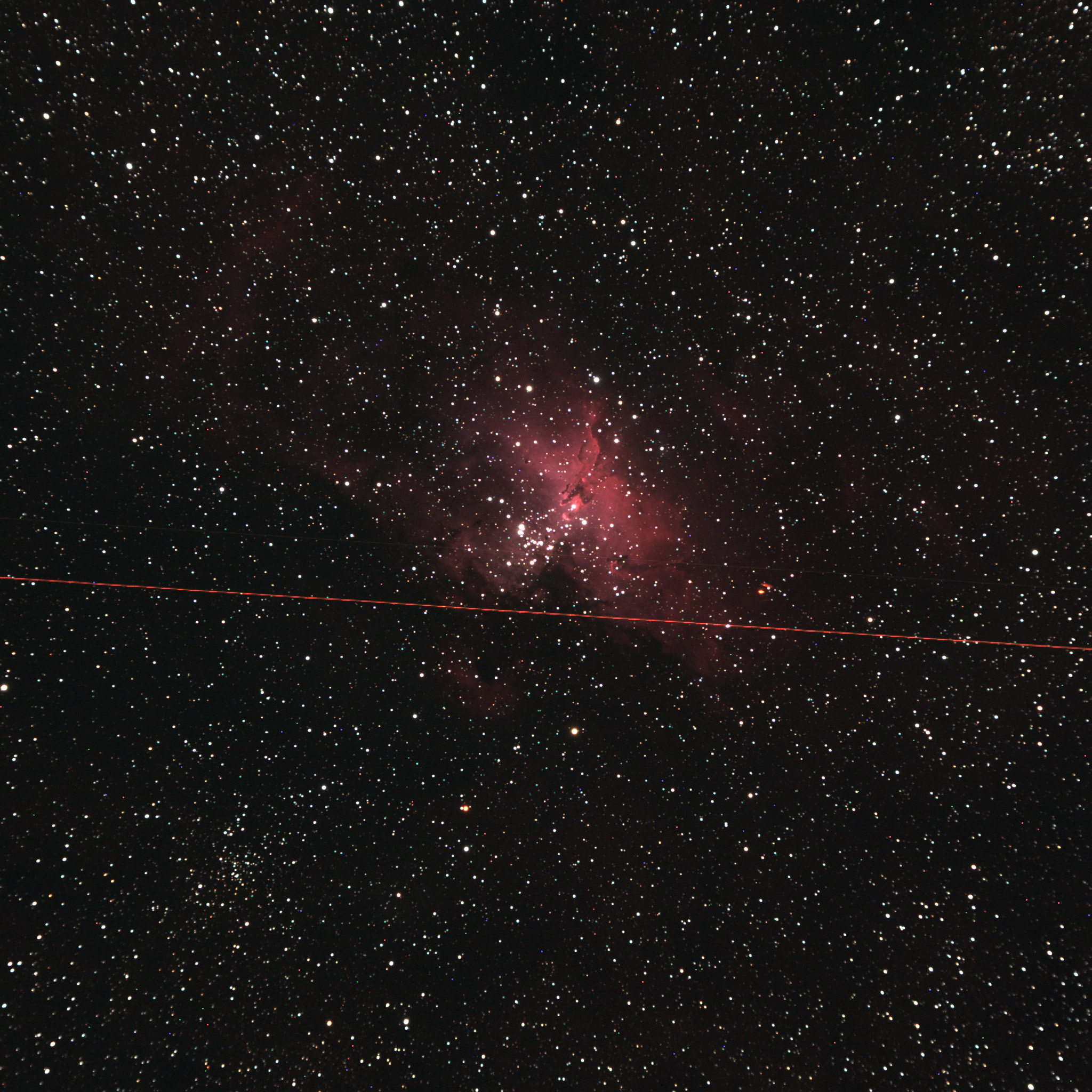
    Ever since I started doing astrophotography, I’ve been waiting for the opportunity to shoot M16 The Eagle Nebula. This nebula is famous for its Hubble Space Telescope image showing the embedded dark nebulae as stellar nurseries, the “Pillars of Creation.”

    I only did one fifteen minute exposure. By then it was getting quite late, and I need to catch a couple hours of sleep before getting up to catch comet McNaught. Naturally that means I had an airplane fly through the image! Should I wipe it out with Photoshop? Naaaah.

    M16 The Eagle Nebula
    M16 The Eagle Nebula and cluster. Plus United flight 2037. (Just kidding!)

    Jane and I napped for a couple of hours, with alarms set to catch comet McNaught in the early hours

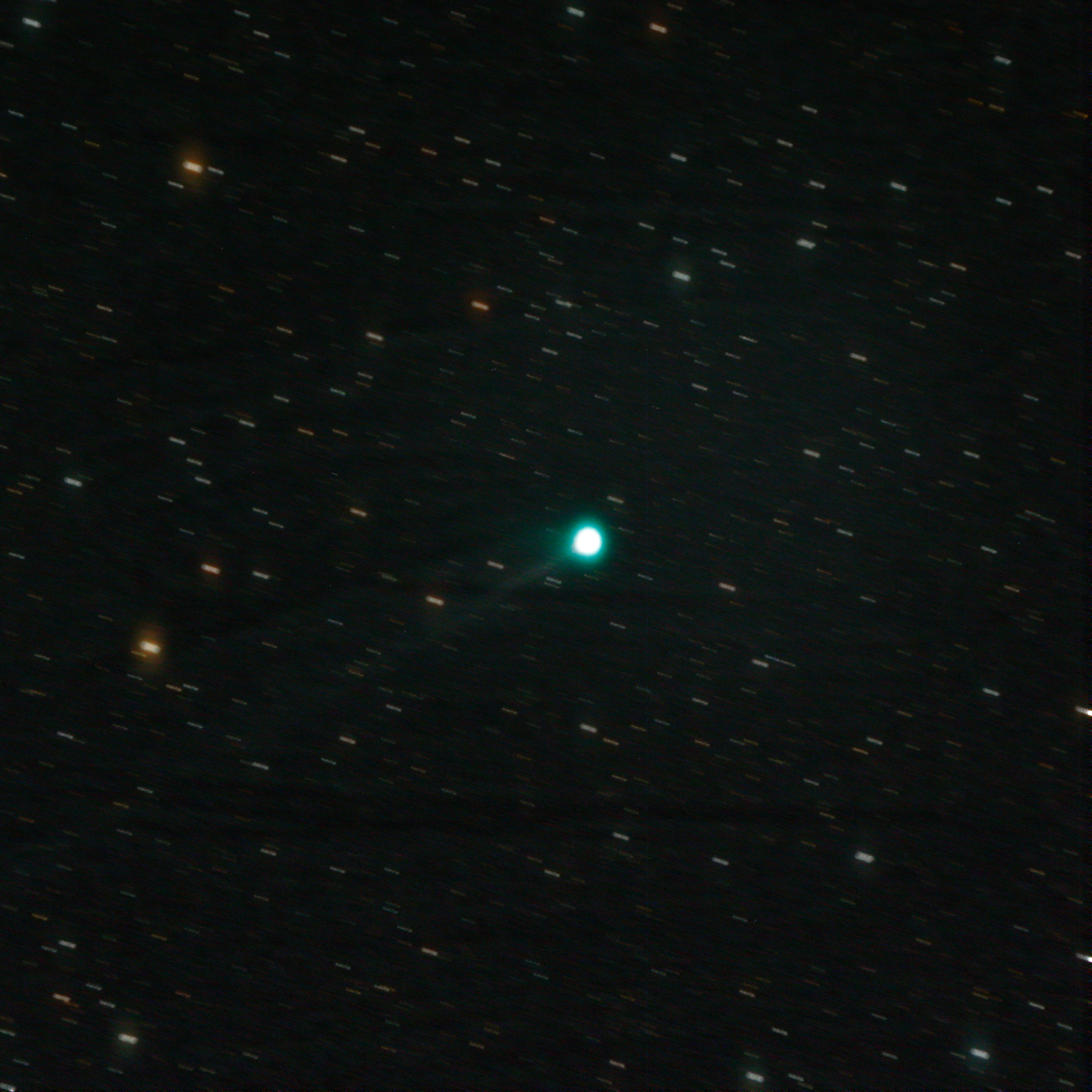
    This image of McNaught is made from ten one-minute exposures. They’re stacked with the comet centered, so the background stars are streaked. It looks out of focus, but it’s actually just the motion of the comet you see.

    Comet 2009R1 McNaught
    Comet 2009R1 McNaught, ten one-minute exposures stacked and centered on the comet.

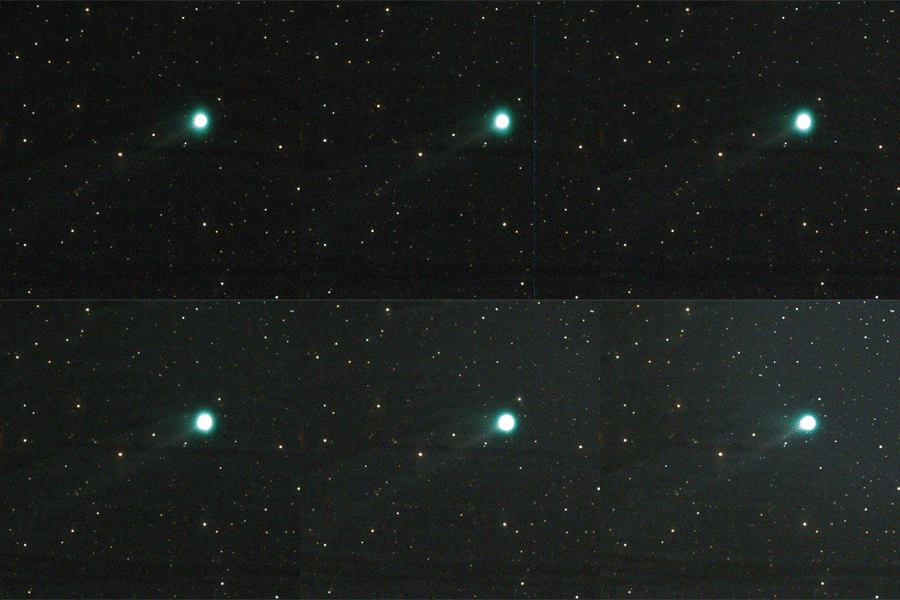
    I also took my ten comet pictures and made a little animation that shows the motion of the comet against the background stars over the course of 15 minutes or so.

    McNaught animation
    Comet McNaught moves against background stars over fifteen minutes. The sky is also brightening with dawn towards the end.

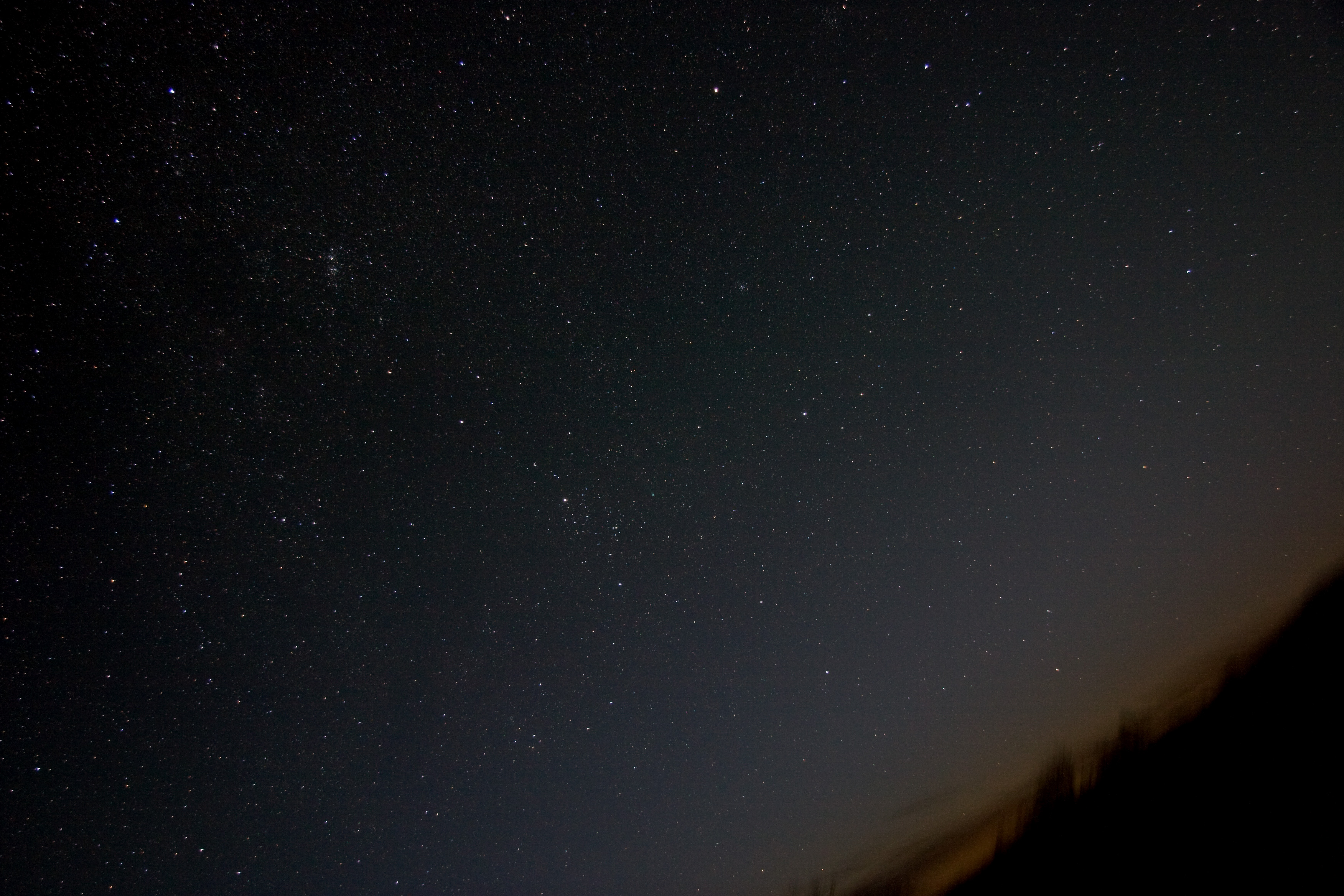
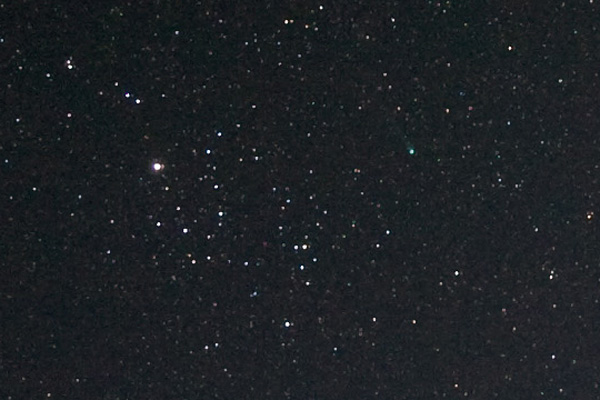
    I was also taking piggyback images of the sky where McNaught was lurking. Can you find the little green dot near the center?

    Perseus and field
    This is the "naked eye" view of the sky where Comet McNaught can be found. The horizon is tilted as an artifact of the way the mount holds the telescope and camera mounted piggyback. Click for the full scale version.

    Here’s a little close up of the beautiful binocular cluster Collinder 39 in Perseus with the green dot of McNaught just to the right. The color was evident in binoculars even.

    McNaught with Collinder 39
    This is somewhat the view in a pair of binoculars of large open cluster Collinder 39. See the green dot of comet McNaught slightly up and right of center.

    What a fabulous night of astronomy! Shirt sleeves or light jacket all evening.

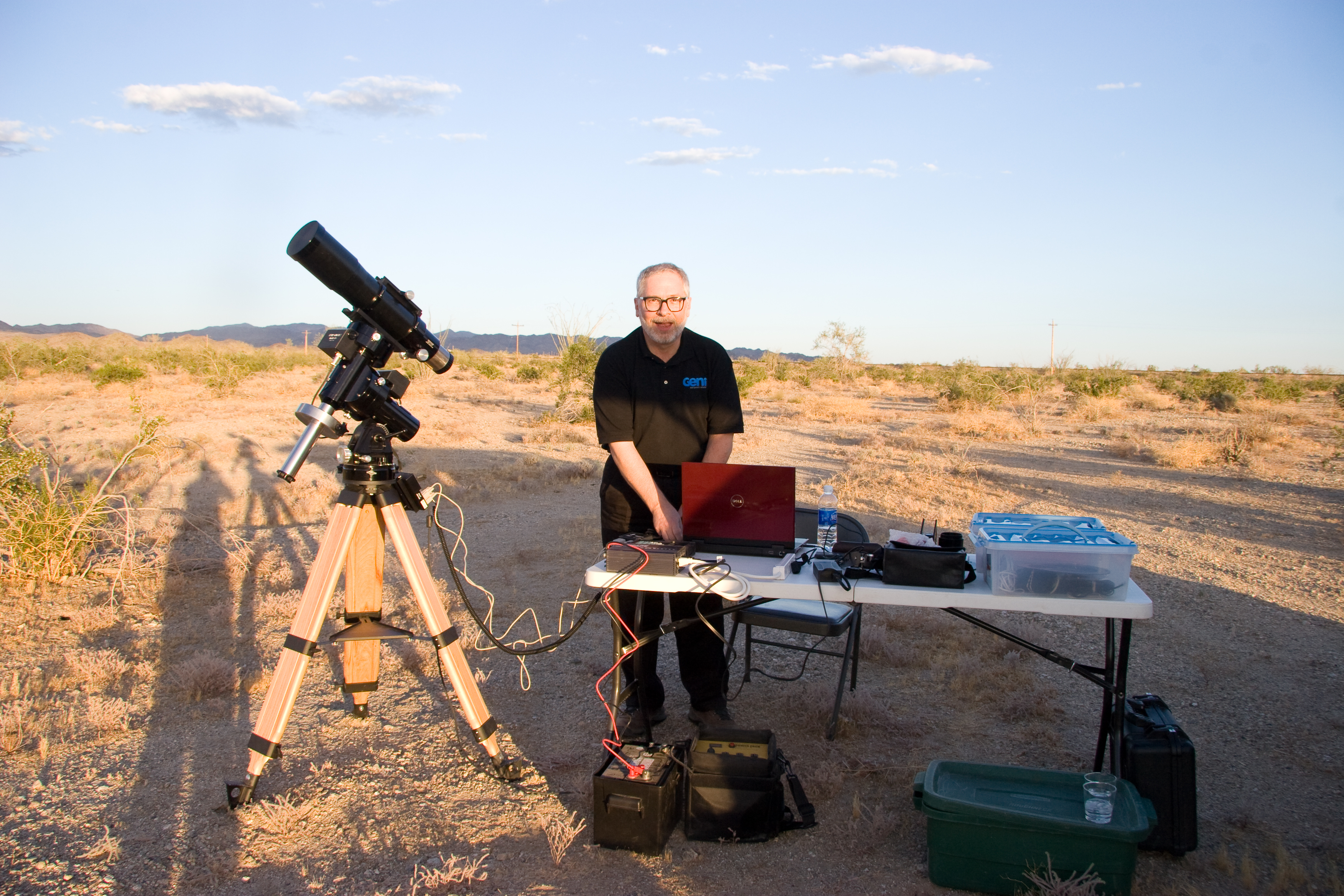
    Mojo setting up for astrophotography
    Mojo setting up his "desert office" for some astrophotography

    Equipment notes: The telescope shots were taken with an SBIG ST-4000XCM one-shot color CCD camera, at prime focus of an Astro-Physics Traveler 105mm f/6 refractor. The mount is an AP Mach 1 GTO on a wooden tripod. The piggyback photos were taken with an unmodified Canon 20D digital SLR camera.

    Update: Be sure to see Jane’s A Ten Planet Night report from the same evening!

  • A galaxy from the inside

    Sometimes it’s the simplest thoughts that have the most profound effect on your visitors to the telescope.

    This past weekend we spent two clear dark nights in Mojave National Preserve sharing our big telescopes with about fifty park visitors and the MNP Conservation Association.

    This time of year, the sky is full of galaxies. We were showing spirals, ellipticals, irregulars, edge-on, face-on, every which way. All along I would explain how these are galaxies like the Milky Way that we live in.

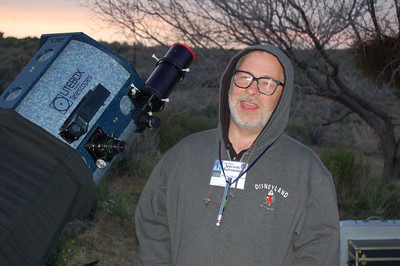
    Me and my 14.5" Litebox dob at Mojave National Preserve
    Photo by Gary Spiers

    Now these were mostly people who had ventured into the wilderness before, and they were familiar with the Milky Way. At least they thought they were. They knew the milky river of light crossing the sky on late summer evenings.

    At least one visitor could not make the connection.

    At one point I said, “We will never see our galaxy from the outside.”

    The dark around the telescope was almost lit by the light bulb going on in someone’s head. I heard, “OH! We’re inside it! We only see it from the inside!”

    I was rewarded with a “thank you” and “That was a profound thought.”

    It reminded me of a question I’d had some twenty years earlier from my mother at one of my early experiences in Yosemite at a Glacier Point star party.

    Mom was looking up at a starry sky and asked, “So of these stars we see, how many of them are in our galaxy?” Of course, the answer is obvious (all of them), but it doesn’t diminish the simple profound nature of the question, and I still enjoy relating the story and asking the question to visitors under a dark starry sky.

  • Pinwheels, Horseheads, and Flaming Stars

    Photo from Feb. 2009 of the Astro-Physics Traveler getting ready for a night of imaging at Chuckwalla Bench
    Photo from Feb. 2009 of the Astro-Physics Traveler getting ready for a night of imaging at Chuckwalla Bench

    Jane and I were by ourselves for the dark sky weekend of November 14, 2009. We set up at our usual spot at Chuckwalla Bench. Unlike the past two months, this night featured a cold air mass that required bundling up well. It also implied that the seeing from our desert location might not be perfect.

    Jane brought her 12.5-inch Litebox dobsonian, and I opted for the 4-inch Traveler refractor (seen in my heading photo).

    The night turned out to be beautiful. The seeing was good, and we were able to enjoy a few early Leonid and Taurid meteors as well. My goal was to try getting more exposure minutes on some classic targets, and try to get some piggyback constellation photos as well.

    M33 and Triangulum region

    Triangulum, Aries, and Andromeda, piggyback naked-eye resolution
    Triangulum, Aries, and Andromeda, piggyback naked-eye resolution

    The famous Pinwheel Galaxy, M33, was a difficult object for me when I started out in astronomy with a classic 8-inch Celestron SCT. The face-on spiral is enormous in the sky, covering almost as much area as the nearby Great Andromeda Galaxy. But its surface brightness is low, so with a little magnification it’s possible to look right through the galaxy without seeing it. I later learned that it sometimes shows up better in binoculars than a telescope.

    If you click on the naked-eye resolution photo nearby, you can find M33 as a faint smudge just to the left of center. M31 the Andromeda Galaxy bright core is in the upper left.

    The three bright stars of Triangulum are in the lower third, just left of center. The bright stars of Aries are also in the lower third, to the right of center. (Might be fun to use Flickr’s photo tagging feature to highlight the features.

    M33 the Pinwheel Galaxy
    M33 the Pinwheel Galaxy

    Again “click to embiggen” as Phil Plait would say. This image is a stack of four 15-minute exposures with the AP Traveler and the SBIG ST-4000XCM one-shot color CCD camera. I love seeing the famous red star-birth regions sprinkled through the arms of this nearby galaxy.

    In terms of technique, I used a Bahtinov focusing mask for the first time. It saved a lot of time in finding and maintaining focus. Autoguiding worked perfectly. It felt really good to have confidence to take long sub-exposures and stack them in Photoshop. This was my first true one-hour image, and the first I’m proud to have seen at full resolution.

    Auriga and IC 405

    Piggyback view of Auriga, naked-eye resolution
    Piggyback view of Auriga, naked-eye resolution

    Auriga was one of the first constellations I identified and recognized on my own as a new astronomer, so I’m always delighted to see it again.

    In the piggyback shot, the bright Auriga stars form a squashed pentagon slightly left of center. The right-most star doubles as part of Taurus. North is to the left, and the brightest star there is Capella. In the full-resolution image you can see the Milky Way open clusters M36, M37, M38, and I think that’s M35 in Gemini in the lower right.

    Jane was enjoying touring through targets in this part of the sky, and spent some time attempting to see visually the difficult target IC 405, the Flaming Star Nebula. (Her companion post on the subject is coming soon.) I was intrigued as well, and took 30-minutes of exposure time on IC 405. It’s not visible in the piggyback view, but is found in Auriga near the upper center of the picture.

    IC 405 the Flaming Star Nebula
    IC 405 the Flaming Star Nebula

    I wasn’t familiar with this target, and the 30-minutes of data here shows only the brightest areas of this faint nebula. Longer exposures and a Hydrogen-alpha filter will show the nebulosity extending out to the left and curling up like a huge comma. This was a really fun target, and I’m looking forward to Jane’s discussion of it.

    Orion, the Flame and the Horseshoe

    Orion, piggyback naked-eye resolution
    Orion, piggyback naked-eye resolution

    Finally I wanted to see if my little 4-inch refractor could possibly do justice to one of the most popular astrophotography targets. Here in my naked-eye resolution piggyback photo is the Orion constellation, with its famous bright star-birth nebula near the dead center of the photo.

    The target I had in mind wasn’t the Orion nebula itself, but two very different nebulae near the left-most belt star Alnitak (Zeta Orionis). Just to the left of Alnitak is a bright yellowish nebula called the Flame. In a telescope it shows a lot of detail, looking almost like tire tracks. The full-resolution picture of the constellation has just a hint of the flame. If you already know it’s there, you might be able to see it.

    For my piggyback photos I used my Canon 20D digital SLR camera, mounted on top of the AP Traveler. I shot 5-minute exposures, and tried to subtract a 5-minute dark frame, which doesn’t seem to make much difference.  The camera does leave behind a reddish glow which I’ve removed in Photoshop.

    Just below Alnitak is the Horsehead nebula, also known as Barnard 33. Seeing the Horsehead visually is a fun and difficult project, requiring really good transparency and a fairly large telescope. Jane observed it visually in her 12.5-inch.

    The Flame and the Horsehead in Orion
    The Flame and the Horsehead in Orion

    I never dreamed the image would turn out this nicely. The big white bright blob just above center is Alnitak. In the lower right is Sigma Orionis, one of my favorite multiple star systems. Of course the bright Flame is just left of Alnitak, and dark nebula B33 is just below center.

    Just as with M33, this image is made up of four 15-minute exposures. The telescope is a 105mm f/6 Astro-Physics Traveler, with an SBIG ST-4000XCM one-shot color CCD camera. The mount is the AP Mach-1 GTO on wooden tripod, and I did autoguiding and image capture with Software Bisque’s CCDSoft. I used SBIG’s CCDOps software to process the Bayer-matrix one-shot color pixels out to luminence and RGB components, combined the L and RGB components in Photoshop, then stacked the four color images for the final photo.

  • Finally autoguiding

    Full photo album of setting up and astrophotos here at the Whiteoaks Photo Album.

    Update: Here’s Jane’s version of the same evening. 🙂

    It was another perfect new moon Saturday for a trip to our favorite spot in the Colorado Desert out I-10.

    Yes this is a very full Grand Caravan!
    Yes this is a very full Grand Caravan!

    Jane and I happily took out all the seats of the old Grand Caravan and filled it with telescopes and gear. We brought her 17.5-inch Litebox dob, and our AP180EDT f/9 refractor.

    Jane has been indulging my dabbling in astrophotography lately. I’ve been delighted that Jane is using some of my astrophotos for the What’s Up podcast, lucky that she wants imperfect images that are closer to what one might actually see in an amateur telescope.

    This 180mm f/9 refractor should be an outstanding astrograph; it’s certainly an amazing visual astronomy instrument. I dabbled with it a little last year in Anza Borrego, knowing I needed to learn a lot of operating technique to get some good results. I solved a few mechanical problems then, and ran into autoguiding calibration later. Those lessons served me well, even though it’s almost a year later.

    Early in the evening was Jupiter time, and we all spent some time soaking up the gorgeous views through a binoviewer in steady seeing. 300x on Jupiter showed lots of detail in the bands, including a nice red barge in the North Equatorial Belt, and nice little disks and color on the moons.

    I’m going to take a few paragraphs to talk shop, gadgets, problems, and solutions.

    Setting up the AP180, all ready to take flats, except theres no known focus position!
    Setting up the AP180, all ready to take flats, except there's no known focus position!

    My camera is an SBIG ST-4000XCM single-shot color CCD camera which perfectly suits my recreational needs. The big AP180 is mounted on an older 900QMD mount, a simple but stable platform without GOTO electronics or servos.

    The 900QMD mount comes with digital encoders on the R.A. and Dec axes, but having spent several years using this telescope for primarily lunar and planetary observing, those encoders went unused for the life of the mount.

    The R.A. axis encoder is removable so you can use a polar alignment scope, and the encoder shaft has a slip fit into a metal sleeve when it’s in place. Last year I discovered that this mechanical connection slips very easily, rendering the encoder useless.

    The trick I settled on, which worked again tonight, was to cut a little piece of rubber band and push it into the fitting to serve as a tightener.

    Jane aligns the Telrad on her 17.5-inch Litebox
    Jane aligns the Telrad on her 17.5-inch Litebox

    To use the digital encoders for pointing, I acquired a BBox from JMI, connected that to a USB-Serial adapter, and used Software Bisque’s TheSky 6 to serve as my controller. I’ve learned by experience (at Fremont Peak observatory) that the alignment doesn’t need to be 100% perfect. I’ve learned the trick of syncing the software and encoders to a bright star near my target, then doing an accurate short slew to my actual target.

    (One problem I haven’t quite solved yet is play in the polar scope. I haven’t figured out how to tighten the polar scope in position, in the correct orientation, so it doesn’t wiggle.)

    So with a not-quite-perfect polar alignment, autoguiding becomes my essential partner. CCDSoft can be tricky software to work with when calibrating the autoguiding. The error messages and manual don’t really help solve problems like “Illegal motion in X-axis, error 352.” I thought I might even be dealing with a problem in the mount mechanics. In retrospect, I think I also hadn’t learned the correct switch settings on the QMD controller. (“Guide” and “.5” works much better than the 16x slew mode for visual!)

    On perusing the Software Bisque support forum last week, I was able to learn that their autoguiding calibration depends entirely on there being only one bright star in a large region of the guide imager. While I could see the guide motions working perfectly and orthogonal, the software doesn’t do matching of the star field, only looking for the one significant guide star.

    Having discovered that, I was finally able to successfully calibrate the autoguider. And with one successful calibration (remembering to set the current declination), I could autoguide on different targets successfully for a long time.

    (The Software Bisque manuals hint that there’s a way to link to TheSky so CCDSoft knows the declination of its target, but I haven’t figured that out yet.)

    M74 two 15-minute exposures, SBIG ST-4000XCM, 180mm f/9, October 17, 2009
    M74 two 15-minute exposures, SBIG ST-4000XCM, 180mm f/9, October 17, 2009

    Pisces was high overhead, and I love M74, so I decided as a first target to revisit that favorite. I settled on 15-minute exposures. The first one came out “double vision” when the autoguider momentarily lost track during the exposure, but that was the only time that happened during the evening.

    NGC7541 in Pisces, 15 minutes
    NGC7541 in Pisces, 15 minutes

    A visit to the Night Sky Observers Guide suggested NGC7541 as a Pisces “showpiece,” and I love galaxy groups. This one was gorgeous in Jane’s 17.5-inch, too.

    NGC7640, 15-minute exposure
    NGC7640, 15-minute exposure

    Jane showed me NGC7640 in her 17-inch, a really lovely look, and I thought it would be a great target. We’re starting to enjoy comparing visual and imaging views.

    NGC253, 2x15minute exposures
    NGC253, 2x15minute exposures

    I admit I get impatient when I’m imaging, and want to collect more targets rather than more exposures on the same target. As a result, I have a little more noise in my images, but I’m having fun anyway. That said, I couldn’t resist spending some time on NGC253, the Silver Coin galaxy. I had a tantalizing glimpse of this target last year at Anza Borrego when I hadn’t yet learned how to make the autoguiding work. This time I got two lovely 15-minute exposures. Well worth it.

    Pre-dawn crepuscular rays at Chuckwalla Bench
    Pre-dawn crepuscular rays at Chuckwalla Bench

    After a few hours sleep, we were greeted with lovely pre-dawn crepuscular rays, Venus, and Saturn making its return after solar conjunction. Not to worry, the telescope was capped, and about to come down into its box, anyway. (You can see the box ready to be loaded with telescope.) Jane paused to take this lovely picture.

  • A perfect night in the desert

    Observing report, dark sky weekend, September, 2009, Chuckwalla Bench

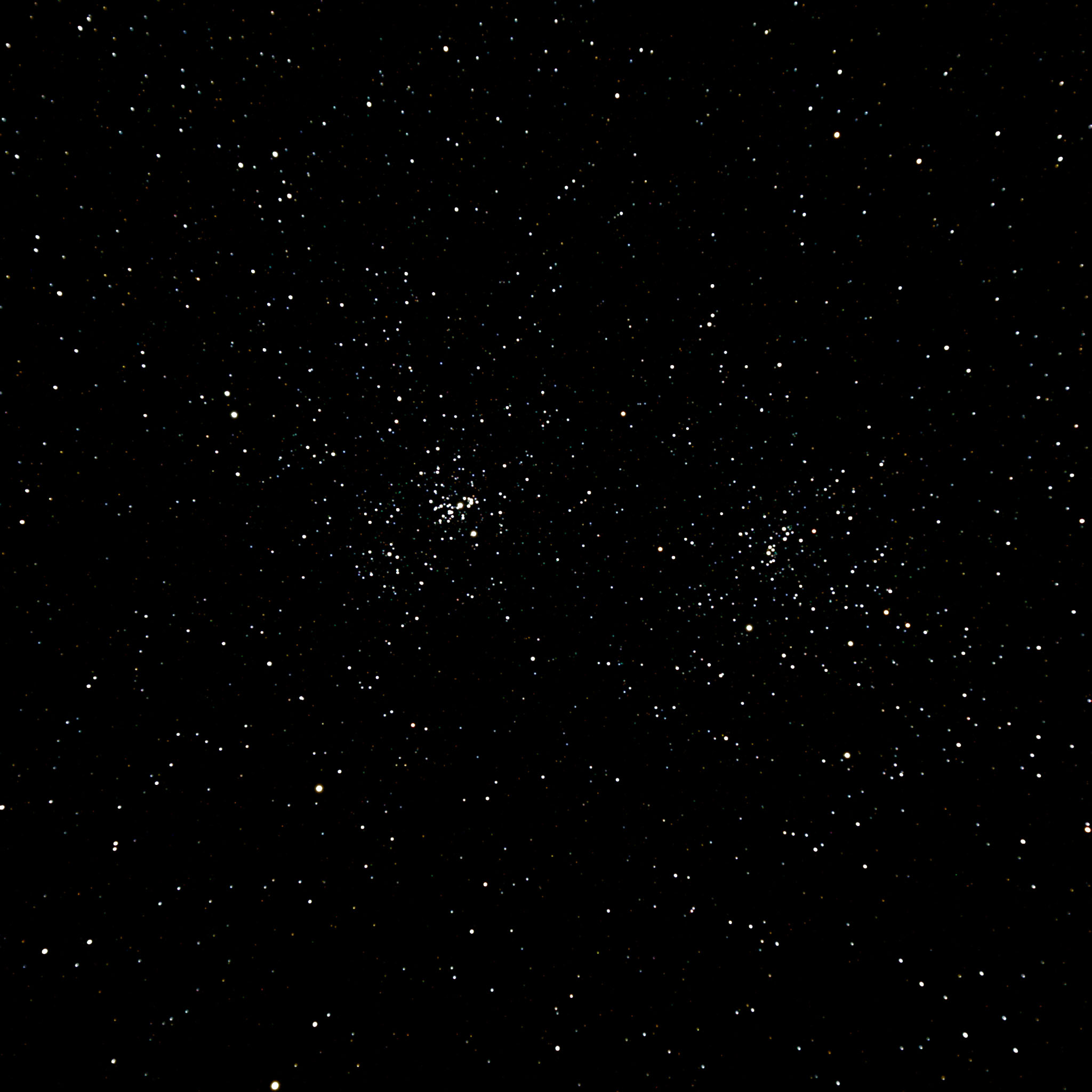
    The Double Cluster between Cassiopeia and Perseus
    The "Double Cluster" between Cassiopeia and Perseus

    The Clear Sky Chart forecast for Desert Center, CA, was dark blue all night for our favorite observing site. The NOAA forecast called for a high of 99 and low of 77. Often a night like this can have uncomfortably hot weather. Chuckwalla Bench is a little higher than Desert Center, so I was hopeful that the night wouldn’t be miserable with heat. It turned out to be lovely shirt-sleeve weather all night.

    Several of us were feeling dark-sky-deprived, so Jane and I were really looking forward to some quiet time with friends in our favorite desert location.

    I took the Astro-Physics Traveler (pictured at the top of my blog in a photo taken at Chuckwalla Bench) to attempt a little low-power astrophotography.

    As I mentioned, I was really rusty with the equipment and procedures, and am a beginner at astrophotography anyway, with a total of about four sessions under my belt. We were all out of practice; I think everyone on the trip left something at home or had some minor trouble.

    After warming up with the Double Cluster as a good focusing target, my main goal of the evening was to make my first real asteroid trail or animation. With Juno very much in mind from Jane’s What’s Up podcast, I decided it would be my second target.

    Animation of four Juno images taken over 50 minutes
    Animation of four Juno images taken over 50 minutes

    Jane and Gary were hunting down Juno visually while I was imaging it. We had a great time using a combination of images and TheSky 6 to make a positive identification of Juno. I collected four ten-minute exposures, and made my first asteroid animation above.

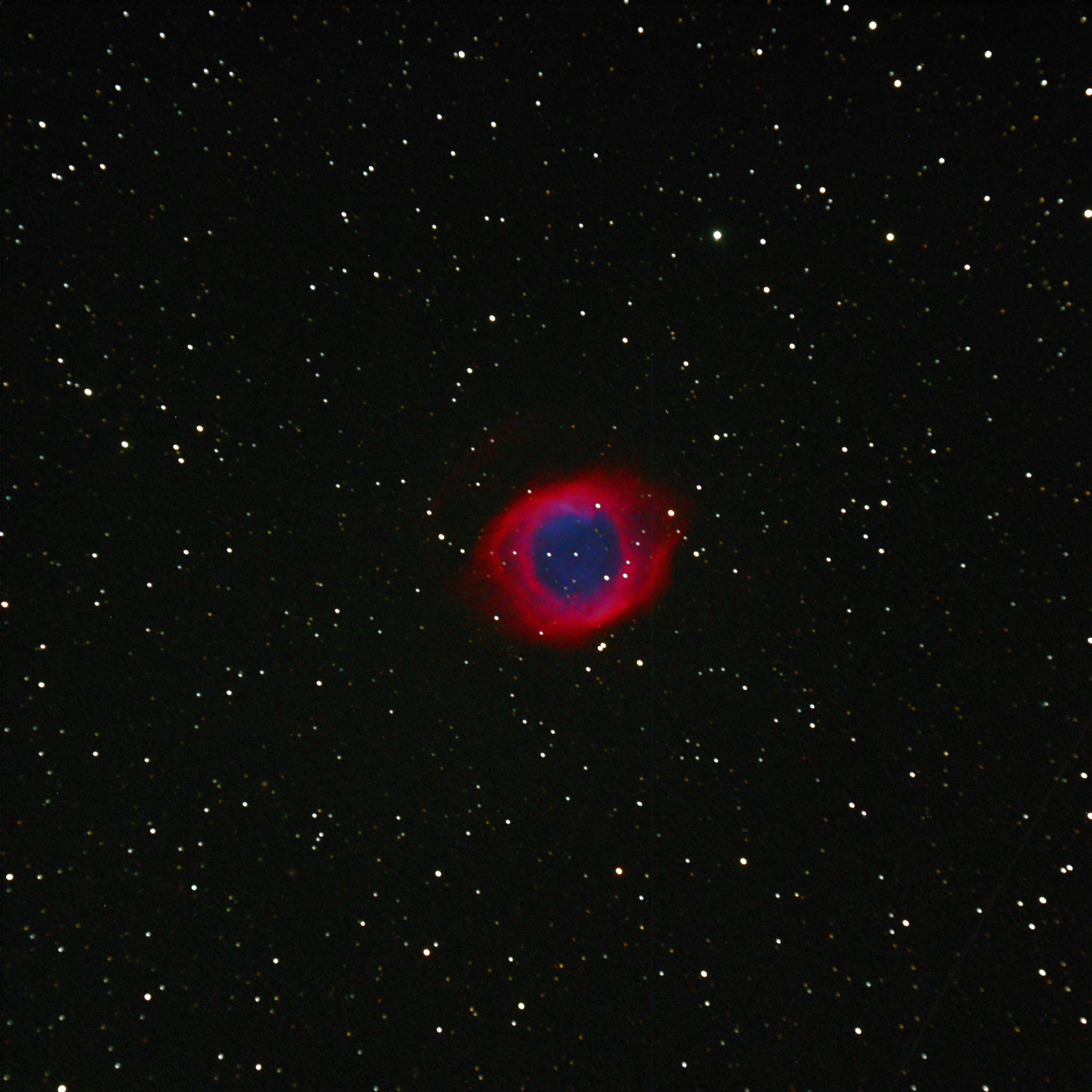
    The Helix planetary nebula, crop from full-frame image.
    The Helix planetary nebula, crop from full-frame image.

    The Helix Nebula NGC 7293 is an irresistible target for a good wide-field telescope and a color camera. I combined three ten-minute exposures. The image above is a crop — click to see the full field image.

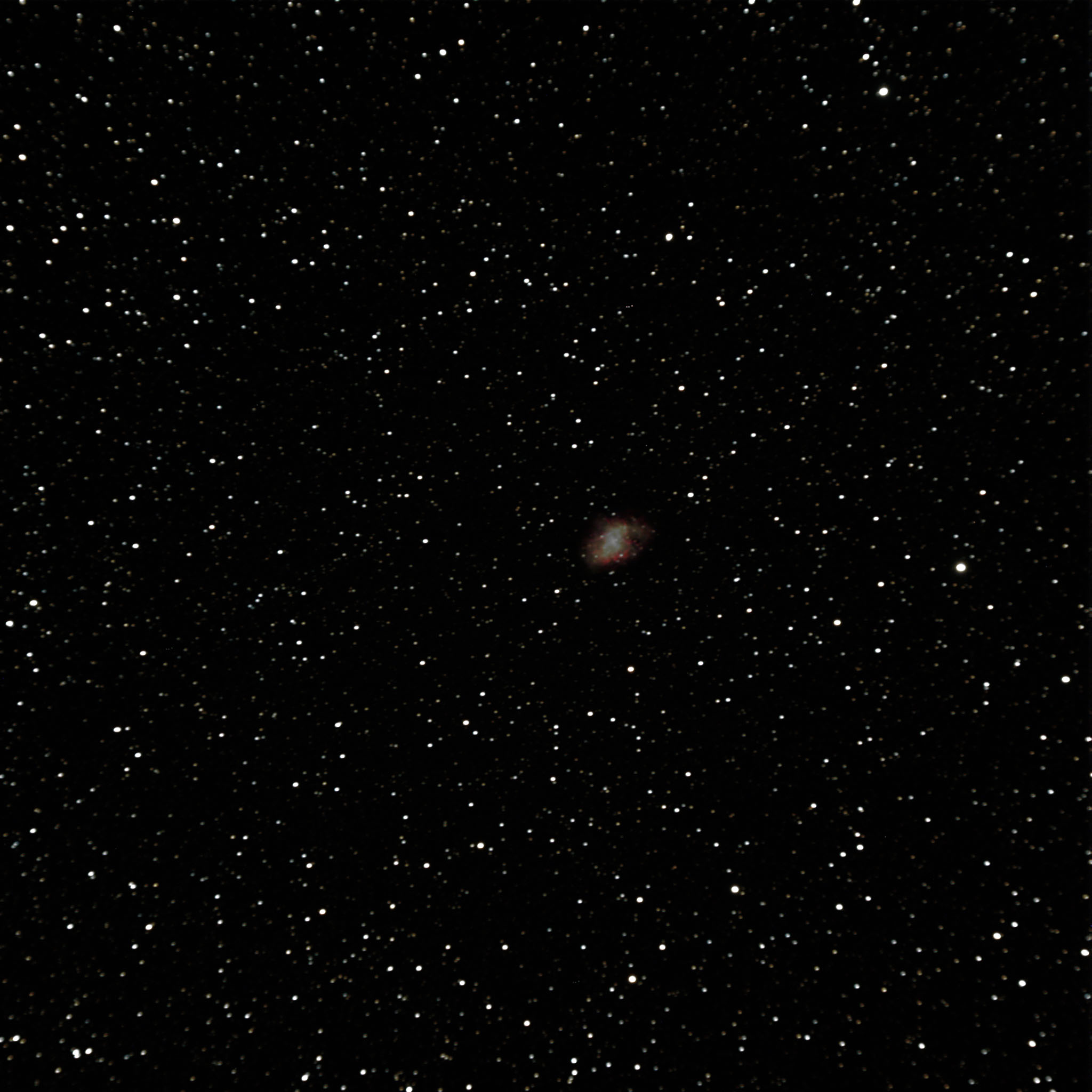
    Crop of M1, The Crab Nebula, click for the full frame.
    Crop of M1, "The Crab Nebula," click for the full frame.

    My Crab Nebula is a combination of three ten-minute exposures. It’s not a great image, but still a treat to see the kind of detail that we don’t get to see visually. The full-frame image (click to see) shows this small target.

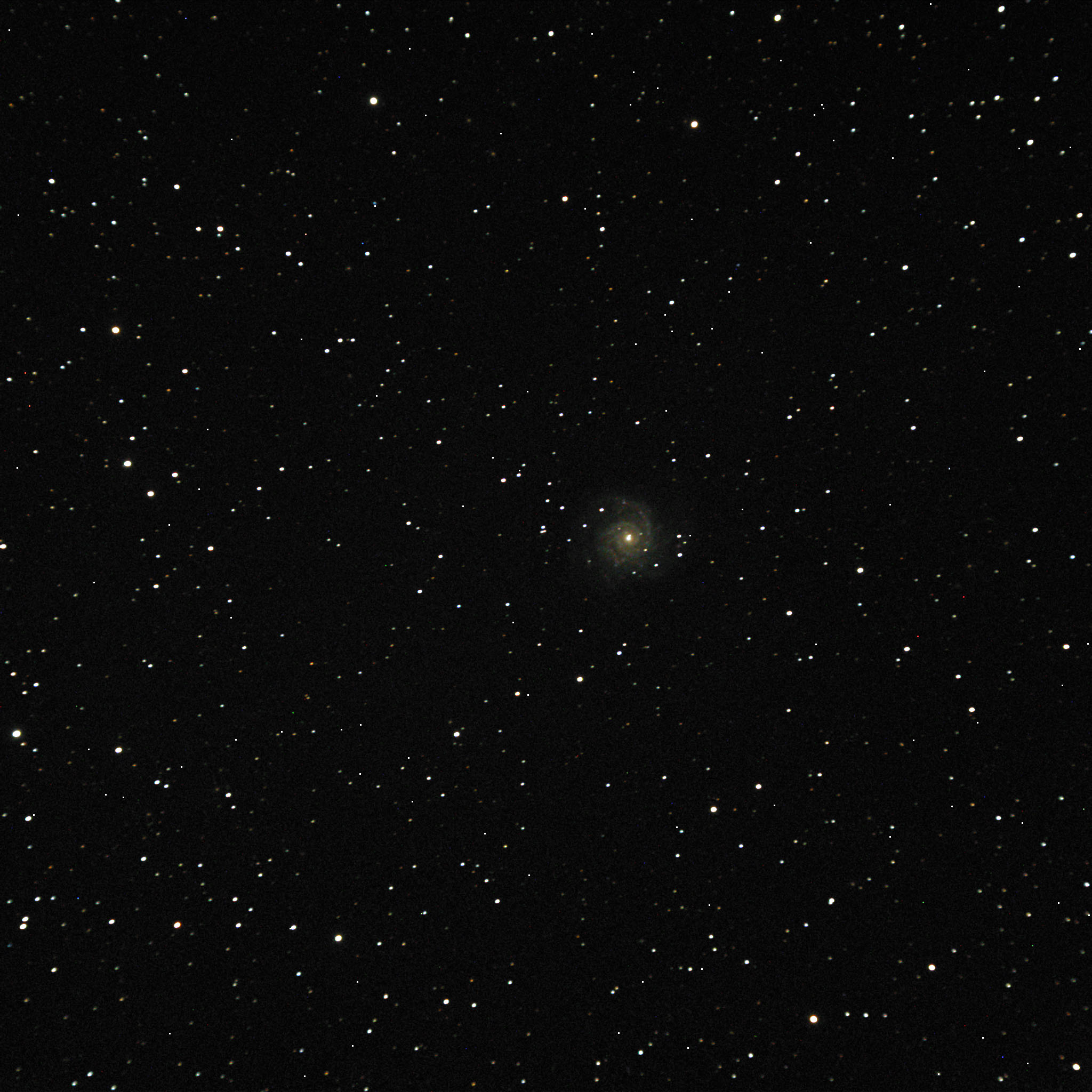
    A crop from my M74 image, click for the full frame.
    A crop from my M74 image, click for the full frame.

    I love galaxies, and M74 is a favorite — for being small, hard to find visually, and a difficult “first target” of the Messier Marathons we do in March. I couldn’t resist trying to get an image of this little gem.

    I know I need to put more exposure minutes into my images, especially of my favorite faint targets. My backgrounds are still very noisy; my focusing isn’t perfect. Since I don’t get to do this very often, I get impatient and want to grab several targets over an evening. Practice, practice!

    Gary Spiers snapped pictures as we set up in the desert. Click the image for a link to his photo album from the night.
    Gary Spiers snapped pictures as we set up in the desert. Click the image for a link to his photo album from the night.

    A night in the desert has to be followed by a great breakfast. After catching a couple hours of sleep, we all packed up the site in a gorgeous desert dawn and headed ten miles west to Chiriaco Summit, home of a great diner and the General Patton Memorial museum. Tanks and eggs, four stars! (Ratings and generals.)

  • Snakes, Tortoises, and Stars

    Photos and video found here

    What do herpetologists and astronomers have in common?

    They both like going out on new moon weekends: astronomers to find faint fuzzies, and herpetologists to find nocturnal reptiles.

    Last year in October, Jane met herpetologist Hanna Strauss at an event in Mojave National Preserve, and the two of them resolved to get together again on a new moon weekend. We did that this past weekend, the new moon weekend of April 2009.

    Windy Friday Night

    Telescope Pad and our tent set up Friday evening at Black Canyon Group Camp.
    "Telescope Pad" and our tent set up Friday evening at Black Canyon Group Camp.

    Jane and I departed Monrovia on Friday, April 24, just before noon, and were the first to arrive at Black Canyon Group Camp at about 4:00 p.m. The astronomy forecast for Friday was pretty bad; there was a persistent thin layer of clouds that made the sky a little more like Los Angeles sky than desert. We were able to coax out some fair views of Saturn and some of the bright double stars.

    Jane went out “herping” with Hanna and came back to report finding several varieties of snakes on Black Canyon Rd.

    The worst part of the evening was the wind. We knew it was coming; it was all over the forecasts. I was first to climb into my tent with the wind not being too bad, but around midnight, it really turned into a gale. Jane and I were warm and comfortable in our sleeping bag, and the tent was firmly staked down, but there was little sleep to be had that night!

    We could hear the gusts approaching, echoing off the smooth canyon walls, sounding a little like an approaching jet. It went on ’til almost sunrise. The tent managed to hold up, but our old tent already had a front door zipper that would not close well, and our front door was soon hanging by a couple of zipper pulls. Fortunately the door was facing away from the wind.

    The stakes held all night. I kept half-expecting the tent to rip apart, but it held. The wind would blow it almost horizontal onto our heads. A few equipment boxes lost their lids. Amazingly everything was recovered, and nothing seriously damaged — though we heard the next morning that our telescopes were blowing around like weather vanes.

    Saturday Exploring

    Aligning finders using yucca plants on the distant mountain ridge.
    Aligning finders using yucca plants on the distant mountain ridge.

    Big groups are difficult to keep to an early schedule, and the lizards won’t wait. We got everyone together for a walk across the road to Hole-in-the-Wall. We found several small lizards, and had fun crawling over the interesting formations. Several of the group took off to explore Mitchell Caverns, and Jane and I joined another group to drive through the park.

    We stopped along the way at a dense joshua tree forest, at the Kelso Depot, and walked the Kelso Dunes trail. After visiting Baker for ice cream and gas, we drove back on paved roads (94 miles) to the group campsite.

    This evening was looking a lot better for astronomy. The sky was crystal clear. The seeing forecast was poor, but the actual seeing was good enough to see dust lanes in galaxies.

    Everyone enjoyed seeing Saturn, of course. I really enjoyed seeing a strong zodiacal light in the dark transparent sky. The site is very dark, with a fairly strong light dome to the north from Primm. It’s galaxy season, and I enjoyed showing the big Ursa Major galaxies M81 and M82, the bright Leo pair M65 and M66, beautiful edge-on NGC4565, face-on spiral M51 the Whirlpool, M104 the Sombrero, and the Virgo galaxies near M64 and M66.

    What About Tortoises?

    Turtle three has been chowing down, or likes green lipstick.
    Tortoise three has been chowing down, or likes green lipstick.

    On Saturday evening, I didn’t go out herping. The group that did came back saying they’d been skunked.

    “What, you found skunks?” I asked. No, they hadn’t found anything!

    So we’d spent the whole weekend without seeing any of the desert tortoises Mojave National Preserve is famous for. It hardly mattered, as we’d had an adventurous and interesting weekend with great company.

    On Sunday morning we were among the last to be packed and ready to go along with Gary and his daughter Catherine. Jane was driving, and we were heading out of the park down Black Canyon Rd. We both saw a tortoise naively sitting in the oncoming lane about four miles from Hole-in-the-Wall. Jane quickly stopped, as did Gary behind us.

    We debated what to do with a tortoise not wanting to move, sitting right in the middle of a traffic lane. We vowed to see him safely off the road, and fortunately there was no traffic. Eventually Jane was able to help him off the road, and we left him in safety.

    Two more times we stopped for tortoises on Black Canyon. These two were up and walking around, and out of harm’s way at least for the moment. Everyone got pictures, and Jane took some great video.

    Once more we stopped for a tortoise shell on Essex Rd. before leaving the park. This one turned out to be a decoy, with a flier attached advising motorists to keep an eye out for tortoises on the road, and drive carefully and slowly through the park.

    Photo and Video Album

    Jane and I both shot a lot of pictures over the weekend. It’s not art-house photography by any means, but there are a lot of fun pictures. I enjoyed making a couple of panoramas: one of the group camp before anyone else arrived, and one of the Kelso Dunes from the dunes trail. With the laptop in the car, I was able to make panoramas and start the photo album. I uploaded a first draft from a Starbucks in Barstow.

    On Sunday Jane shot some short videos of our three tortoises. The first tortoise wasn’t terribly interesting, just sitting in the middle of a traffic lane. The other two, included in the album, are quite animated and fun to watch.

    One short epilogue about our Friday night gale. Our valiant tent kept us protected; it bent but never broke. It did have a funny shape on Saturday morning. When I took it down on Sunday, a couple of the metal sleeves that hold the support rods of the tent had deformed. It’s time for a new tent.

  • Messier Marathon 2009

    The Messier Marathon seems like a silly exercise, but it’s certainly fun. Jane and I were introduced to our favorite dark sky desert observing site five years ago when Don Machholz invited us to join him for a mid-week Messier Marathon.

    Big dobs set up for the Messier Marathon under clear steady blue skies.

    We’ve logged 108 and 109 of the 110 objects a couple of times, but this year looked like it could be our best opportunity to log all 110 objects in one evening. The Desert Center Clear Sky Clock along with the NOAA forecasts offered a clear dark transparent sky all evening with excellent seeing — a rare combination.

    The most challenging early twilight objects are difficult, but our site is far enough south, with good western horizons, that Jane and I were just able to detect M77 and M74 before they set. With those in the bag, a 110 night seemed like a sure thing. This late in the month, M30 should rise well enough before dawn that we’ll be able to see it.

    I was armed with a stack of custom charts from Skytools 2 for my 14.5-inch dob, and Rob Hawley’s Messier Marathon guide. Jane was working from a similar stack of Skytools charts that I’d made two years earlier — luckily none of the Messier objects had moved in that time.

    Stacks of charts and checklists ready for the marathon.
    Stacks of charts and checklists ready for the marathon.

    The Virgo galaxy cluster is probably the most challenging mid-evening observing puzzle. It’s easy to get lost in the broad stretch of sky with hundreds of galaxies and a seeming dearth of guide stars. Finding galaxies isn’t the difficulty, it’s identifying which is which.

    Most MM guides recommend an eyepiece-based star/galaxy hop that moves from a major guide star to each of the target galaxies in step. I’ve used this technique successfully in the past, but this night it didn’t work out.  I think the galaxy-hop is optimal for a smaller telescope with about 50x power and a 2-degree field of view. This helps keep you from getting lost by showing more context and fewer faint galaxies.

    I fell back on my individual Skytools finder charts, and was able to finish all of the Virgo objects. After bagging southerly M83 at about 11:00 p.m., I tucked into a sleeping bag and set my cell phone alarm for 2:00 a.m.

    (Click for full size) Example individual Skytools chart from my session, showing naked eye with Telrad circle, finder view, and eyepiece view, all customized for my finder, telescope, and eyepiece.
    (Click for full size) Example individual Skytools chart from my session, showing naked eye with Telrad circle, finder view, and eyepiece view, all customized for my finder, telescope, and eyepiece. On each chart I write the observation time and any notes with a Sharpie.

    When the ringing phone woke me, I looked out of the van to see what looked like a milky sky. “That can’t be!” I thought. I could still see a few stars, maybe it was just a trick of my dark adaptation.

    The morning sky at our desert observing site.
    The morning sky at our desert observing site.

    Jane was still at it when I stumbled out of the van to give me the bad news. There were still enough sucker holes for me to nab the Ophiucus clusters, but by the time I finished the Ring Nebula the sky was completely gone. This picture of the pre-dawn sky shows what it was like.

    I finished the night with 76 objects logged. Jane managed to log 82, stealing clear sky opportunities while I slept. All in all, we had a great night in the desert, and the clouds forced us to get a little extra sleep.

    My favorite neglected object from the list: M47 with its little embedded planetary nebula.